IRC 45S(a)IRC 45SInternal Revenue Code, Cornell LII, (b)(3), (c)(1) and (c)(4) as amended by P.L. 119-21 s. 70304; Instructions for Form 8994 (Rev. December 2024, and the December 2026 draft), compensation limit table.
Permanent from 2026: what changed
The 45S credit is a federal general business credit for an employer that pays its own family and medical leave under a written policy. It was due to expire: the old subsection (i) read “This section shall not apply to wages paid in taxable years beginning after December 31, 2025.” P.L. 119-21, section 70304, struck that subsection (“(5) by striking subsection (i).”) and rewrote much of the rest (P.L. 119-21, s. 70304). The changes “shall apply to taxable years beginning after December 31, 2025”. The IRS release on the new guidance (IR-2026-86) calls the law the Working Families Tax Cuts and says it “makes permanent and expands eligibility and coverage for employers offering PFML benefits to employees”.
For tax years beginning in 2026 the main changes are five. An employer may claim the credit on insurance premiums as well as on wages. State-paid or state-required leave now counts toward the policy's minimums, though never toward the credit amount. An employer may elect to treat employees as qualifying after six months instead of a year. Qualifying employees must be “customarily employed for not less than 20 hours per week”. And the related-employer rule now follows section 414(b) and (c), with no exception for an employer that skips a policy because of state leave law (45S(c)(3)).
26 U.S.C. 45S26 U.S.C. 45SUnited States Code, Cornell LII and notes; P.L. 119-21, s. 70304(c); IR-2026-86; the IRS draft forms listing (posted dates).
For a state paid leave employer the credit answers a narrow question: if you pay leave of your own on top of the state program, part of that pay may earn a federal credit. The state contributions and the state's benefits never do. The state programs are on our paid family leave by state page.
Who is an eligible employer
An eligible employer is one “who has in place a written policy that meets the following requirements”: at least two weeks of annual paid family and medical leave for each full-time qualifying employee (prorated for part-time), and “The policy requires that the rate of payment under the program is not less than 50 percent of the wages normally paid to such employee for services performed for the employer.” (45S(c)(1)). The leave must be for an FMLA purpose: the credit uses the purposes of “section 102(a) of the Family and Medical Leave Act of 1993”, “whether the leave is provided under that Act or by a policy of the employer”. General vacation, personal or sick leave does not count (45S(e)(2)). The FMLA purposes are on our FMLA and state paid leave page.
Three practical rules from the instructions. The policy must exist first: “The employer’s written policy must be in place before the paid family and medical leave for which the employer claims the credit is taken.” It may not leave out any group of qualifying employees, such as union members (draft instructions: “Written policy may not exclude any classification of employees.”). And if any qualifying employee is not covered by FMLA title I, the policy needs the statute's non-interference promise, that the employer “will not interfere with, restrain, or deny the exercise of or the attempt to exercise, any right provided under the policy” (45S(c)(2)). The draft instructions add that the FMLA's hours test plays no part: “which require an employee to work a minimum of 1,250 hours of service to be an eligible employee under the FMLA, don’t apply.”
Related employers are one employer. From 2026, “all persons which are treated as a single employer under subsections (b) and (c) of section 414 shall be treated as a single employer”. An exception exists for a substantial and legitimate business reason, but the statute rules out “the application of State or local laws relating to family and medical leave” as a reason. A related company that has no policy because its workers get state paid leave cannot be carved out of the group on that ground.
Qualifying employees and the pay limit
A qualifying employee “has been employed by the employer for 1 year or more (or, at the election of the employer, for not less than 6 months)”, is customarily employed at least 20 hours a week, and, for the preceding year, had compensation “as determined on an annualized basis (pro-rata for part-time employees), not in excess of an amount equal to 60 percent of the amount applicable for such year under clause (i) of section 414(q)(1)(B)” (45S(d)). The six-month election and the 20-hour floor are new for 2026.
The pay limit moves each year with the section 414(q) amount. The instructions print it as a table. In the final instructions (Rev. December 2024): “2024 $150,000 $90,000”, “2025 $155,000 $93,000” and “2026 $160,000 $96,000” (tax year, prior-year 414(q) amount, limit). The December 2026 draft repeats 2025 and 2026 and adds “2027 $170,000 $102,000”.
| Tax year | Prior-year 414(q)(1)(B) amount | Prior-year compensation limit | Where it appears |
|---|---|---|---|
| 2024 | $150,000 | $90,000 | Instructions (Rev. December 2024); IRM 21.6.3.4.1.38 |
| 2025 | $155,000 | $93,000 ($87,000 in Pub. 5327) | Instructions (Rev. December 2024 and the 2026 draft); IRM 21.6.3.4.1.38. Pub. 5327 differs; see below |
| 2026 | $160,000 | $96,000 | Instructions (Rev. December 2024 and the 2026 draft) |
| 2027 | $170,000 | $102,000 | Draft instructions only (Rev. December 2026); check the final |
The limit tests the employee's pay from the year before. For a 2026 claim, an employee who earned more than $96,000 from the employer in 2025 (annualized) is not a qualifying employee, and the policy need not cover them. A fiscal year employer may use either its preceding fiscal year or “The calendar year ending in the employer’s immediately preceding fiscal year.”
How state paid leave counts
This is the change that matters most in the paid leave states. Section 45S(c)(4) now reads: any leave “which is paid by a State or local government or required by State or local law”: “except as provided in subparagraph (B), shall be taken into account in determining the amount of paid family and medical leave provided by the employer”, and “shall not be taken into account in determining the amount of the paid family and medical leave credit under subsection (a)”. The IRS release says it plainly: “Employers can count leave provided under state or local mandates toward the eligibility for this federal tax credit, but not toward the credit calculation.”
IRC 45S(c)(4)IRC 45SInternal Revenue Code, Cornell LII as amended by P.L. 119-21; IR-2026-86; Notice 2026-28, Q&A-4.
Before 2026 it was the reverse. Notice 2018-71 said state leave “is not taken into account for any purpose in determining the amount of paid family and medical leave provided by the employer”, so a policy that only topped up a state benefit failed the 50% test. The draft instructions now take the same facts and reach the opposite result. In their Example 9 a state fund pays six weeks at 50% and the employer's policy pays 30% on top, and the conclusion is: “Your policy satisfies the requirement that the rate of payment be at least 50% of the wages normally paid to an employee.” The credit amount still uses only what the employer pays: “or local government or required by a state or local law isn’t taken into account when figuring the credit.”
So in a state with a paid leave program, an employer whose policy tops up the state benefit to full pay may now be an eligible employer, and its credit is figured on the top-up wages it pays for leave taken by qualifying employees. Whether the state benefit plus the top-up meets the 50% floor is a question about the policy, not about any one leave. The state benefit amounts are on our paid leave benefits by state page.
Figuring the credit: the wage method
The credit is a percentage of the leave wages. The applicable percentage is “12.5 percent increased (but not above 25 percent) by 0.25 percentage points for each percentage point by which the rate of payment (as described under subsection (c)(1)(B)) exceeds 50 percent” (45S(a)(2)). A policy paying 50% earns 12.5%, one paying 75% earns 18.75%, and one paying 100% earns 25%. The draft instructions work it through: an employee normally paid $1,000 a week takes four weeks at 75%, and “you can claim a credit of $562.50 with respect to the employee (18.75% of $3,000).”
| Rate of payment under the policy | Applicable percentage | Credit on $1,000 of leave wages |
|---|---|---|
| 50% | 12.5% | $125.00 |
| 60% | 15% | $150.00 |
| 75% | 18.75% | $187.50 |
| 90% | 22.5% | $225.00 |
| 100% | 25% | $250.00 |
Three limits apply. The leave counted for any employee in a year “shall not exceed 12 weeks” (45S(b)(3)). The wages counted cannot exceed the employee's normal hourly rate times the hours of leave (45S(b)(1)). And "wages" means FUTA wages “determined without regard to any dollar limitation contained in such section” (45S(g)), so the $7,000 FUTA cap does not apply, but an employer with no FUTA wages, such as a 501(c)(3) organization, has no wages for the credit (draft instructions, Example 19).
The credit reduces the deduction. Section 280C(a) denies a deduction for wages equal to the wage method credit, and from 2026 “No deduction shall be allowed for that portion of the premiums paid or incurred for the taxable year which is equal to that portion of the paid family and medical leave credit which is determined for the taxable year under section 45S(a)(1)(B).” An employer that prefers to keep the deduction may opt out: “A taxpayer may elect to have this section not apply for any taxable year.”
The premium method (Notice 2026-28)
From 2026, an employer that “has an insurance policy with regards to the provision of paid family and medical leave which is in force during the taxable year” may instead take the applicable percentage of the premiums it pays for that policy, and “the rate of payment under the insurance policy shall be determined without regard to whether any qualifying employees were on family and medical leave during the taxable year” (45S(a)(1)(B) and (a)(3)). Notice 2026-28 (released Aug. 5, 2026) is the guidance, and “Taxpayers may rely on the guidance contained in this notice for taxable years beginning after December 31, 2025, and before the issuance of the proposed regulations.”
The notice ties the premium method to the wage method: “a credit may be claimed for a premium that funds a benefit for which a credit would be available under the wage method if the benefit were paid (creditable coverage)” (A-1). A premium is not creditable to the extent it covers leave that is not family and medical leave (A-2), people who are not qualifying employees when the premium is paid (A-3), or state-mandated leave: “A premium (or portion thereof) is not paid or incurred for creditable coverage if it is for coverage with respect to leave that is required by state or local law or paid for by a state or local government.” (A-4). A premium that mixes creditable and other coverage must be split, and “A blended premium may be allocated using any reasonable method that is consistent with the policy terms and supported by contemporaneous records.” (A-6). An employer may use both methods, “provided that both the premium and the wage credit are not claimed as to a particular instance of leave” (A-7).
Two points for the paid leave states. First, A-4 reaches coverage for leave the state requires. An insured private or equivalent plan that replaces a state program covers leave the state law requires, so on A-4's words its premium does not earn the credit; the notice does not discuss private plans by name. The state private plan rules are on our PFML private plans page. Second, the IRS has not decided voluntary state programs. Among the open questions it asked about is “a voluntary paid family and medical leave program facilitated by a state and administered by a private insurance company”, with comments due Oct. 16, 2026. New Hampshire's plan is that kind of program (“the state's paid family and medical leave insurance partner”), and so is Vermont's, “a voluntary paid family and medical leave program”. An employer buying either should treat a 45S premium credit as unsettled until the proposed regulations issue. See New Hampshire and Vermont.
Form 8994: final and draft
The credit is figured on Form 8994 and carried to Form 3800. The current final Form 8994 is the January 2021 revision, and its Instructions for Form 8994 (Rev. December 2024) cover the old law. For 2026 the IRS has posted drafts: the draft Form 8994 (Rev. December 2026) and the draft instructions (Rev. December 2026), dated Nov. 12, 2026. They are drafts. The IRS listing says “Do not file draft forms and do not rely on information in draft instructions or publications.” The draft instructions say which form to use once final: “Use the December 2026 revision of Form 8994 and its instructions for tax years beginning in 2026 or later, until a later revision is issued.”
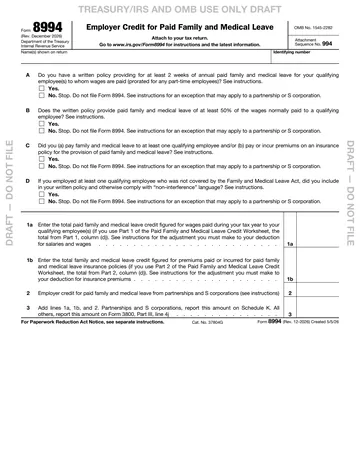
Form 8994 (Rev. December 2026), draft created 5/5/26 and posted May 11, 2026; the draft instructions dated Nov. 12, 2026. Drafts are not for filing.
The draft splits the old line 1 in two. Line 1b is new: “Enter the total family and medical leave credit figured for premiums paid or incurred for paid family and medical leave insurance policies”. Question C now asks whether the employer paid leave “and/or (b) pay or incur premiums on an insurance policy for the provision of paid family and medical leave”. Who files: “Partnerships and S corporations must file this form to claim the credit.” Other taxpayers whose only credit comes from a partnership or S corporation report it on Form 3800 instead. And timing: “An eligible employer can claim or elect not to claim the employer credit for paid family and medical leave any time within 3 years from the due date of the eligible employer’s return.” Our Form 8994 line by line page walks through the form.
Records: the draft lists what supports the claim, including the “Name and social security number of each qualifying employee,” the wages paid to each, the applicable percentage and the leave policy. Keep the worksheets with the return.
Where the IRS texts disagree
Four places where IRS documents say different things, each quoted both ways, with the text that governs.
| Point | One IRS text | The other | Which governs |
|---|---|---|---|
| 2025 compensation limit | Pub. 5327 (Rev. 9-2026): “Generally, for tax years beginning in 2025, the employee’s compensation from the employer must be $87,000 or less” | Form 8994 instructions (Rev. December 2024 and the 2026 draft): $93,000 for 2025; IRM 21.6.3.4.1.38: “$93,000 for tax year 2025” | The statute: 60% of the prior-year 414(q) amount; the instructions show $155,000, and 60% of it is $93,000 |
| Premiums for benefits that are not wages | Notice 2026-28, A-5: “if it is for coverage that provides a benefit that would not constitute wages as defined in section 45S(g)” | Draft instructions (Rev. December 2026): “coverage that provides a benefit that would constitute wages as defined in section 45S(g)” | The notice (taxpayers may rely on it); the draft's own heading says "do not constitute wages" |
| When the credit ends | 45S FAQ page (“Page Last Reviewed or Updated: 16-Sep-2026”) and IRM 21.6.3.4.1.38: “The credit is effective for wages paid in taxable years beginning after December 31, 2017, and before January 1, 2026.” | P.L. 119-21 struck the end date; Notice 2026-28: “The OBBBA amended various provisions of section 45S and made section 45S permanent.” | The statute; the FAQ page itself says it is not yet updated |
| State leave in the 50% test | 45S FAQ page, Example 1 (state 50% plus employer 30%): “Employer's policy doesn't independently satisfy the requirement” | Draft instructions, Example 9 (same facts): “Your policy satisfies the requirement that the rate of payment be at least 50% of the wages normally paid to an employee.” | The statute as amended (45S(c)(4)(A)) for tax years beginning in 2026; the FAQ result is the pre-2026 rule |
The $87,000. Pub. 5327 (Rev. 9-2026) is a short summary sheet; its figure appears nowhere else in the sources we read, and it does not follow from the statute's formula as the instructions apply it (60% of $155,000 is $93,000). Use $93,000 for 2025, the figure in both revisions of the instructions and in IRM 21.6.3.4.1.38 (IRM 21.6.3).
The missing "not." Notice 2026-28, A-5, excludes premiums for coverage of a benefit that “would not constitute wages as defined in section 45S(g)”, and points to Notice 2018-71's example of a tax-exempt employer whose leave pay is not FUTA wages. The draft instructions' heading for the same rule reads “Premium for benefits that do not constitute wages”, but the sentence under it drops the word: a premium is not creditable “if it is for coverage that provides a benefit that would constitute” wages. Read literally, the draft sentence would exclude exactly the coverage A-5 leaves creditable. The notice is the guidance taxpayers may rely on, and the draft's own heading agrees with it. Check the final instructions for the correction.
Stale pages. The IRS's 45S FAQ page carries a banner that “The Working Families Tax Cuts introduced changes not yet reflected in this content.” Its end date and its state leave examples are the pre-2026 law. IRM 21.6.3.4.1.38 (10-01-2025) and IRM 21.7.4.4.8.6 (10-01-2022) also still describe the old end date and the old state leave rule; IRM 21.7.4 still says “the employee must not have had compensation from the employer of more than $72,000”, the figure Notice 2018-71 gave for 2017 pay (“more than $72,000 in 2017”) (IRM 21.7.4).
Forms, line by line
Questions employers ask
Is the 45S credit still available after 2025?
Yes. P.L. 119-21, section 70304, struck the end date in section 45S(i). The credit is permanent, with new rules for tax years beginning after Dec. 31, 2025.
Can we claim the 45S credit for state paid family leave benefits?
No. Leave paid by a state or required by state law never counts in the credit amount. From 2026 it does count toward the policy's minimum of two weeks at 50% of normal pay, so an employer that tops up state benefits may qualify and claim the credit on its top-up wages.
Can we claim the credit on our state PFML contributions?
No. State contributions are not wages paid during leave, and Notice 2026-28 says premiums for coverage of leave required by state law are not creditable under the premium method.
What is the 2026 compensation limit for a qualifying employee?
$96,000 of compensation in 2025 (60% of the $160,000 prior-year section 414(q) amount), in both the December 2024 instructions and the December 2026 draft. For 2025 claims the limit is $93,000; Pub. 5327 prints $87,000, which does not match.
Which Form 8994 do we use for 2026?
The December 2026 revision, once final. As of Nov. 22, 2026 it is a draft (form posted May 11, 2026; instructions Nov. 13, 2026), and the IRS says not to file drafts or rely on draft instructions.
How much is the credit?
12.5% of the leave wages if the policy pays 50% of normal wages, rising by 0.25 points for each point above 50%, to 25% at full pay. Up to 12 weeks of leave per employee per year count.
Sources
- Statute: 26 U.S.C. 45S (as amended, with notes); P.L. 119-21, s. 70304
- IRS guidance: Notice 2026-28; Notice 2018-71; the release IR-2026-86; the 45S FAQ page (not yet updated); Pub. 5327 (Rev. 9-2026); 2026 to 2027 priority guidance plan
- Forms: Form 8994 (Rev. January 2021) and Instructions for Form 8994 (Rev. December 2024); Form 8994 (Rev. December 2026, draft) and its draft instructions; IRS draft forms listing; Form 3800
- Internal Revenue Manual: IRM 21.6.3 (21.6.3.4.1.38) and IRM 21.7.4 (21.7.4.4.8.6)
- States: New Hampshire PFML overview; Vermont FMLI