Counted from the 63 rows in the table below (4 ended), as of November 2026.
Which local taxes do you withhold or pay?
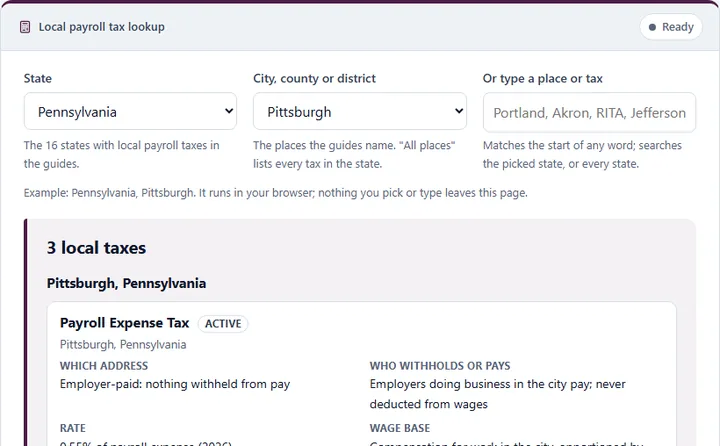
Start with two addresses for each employee: where the work is done and where the employee lives. Most local payroll taxes follow the work location, some follow the residence, many follow both, and some are a tax on the employer's own payroll that is never withheld. The answer for one employee can be three taxes at once: in Pittsburgh, for example, a city resident working in the city has the earned income tax and the Local Services Tax withheld, while the employer pays the payroll expense tax on the same wages.
Sixteen states have a local payroll tax on the sources read for this site: Pennsylvania, Ohio, Kentucky, Michigan, Missouri, Indiana, Maryland, New York, New Jersey, Delaware, West Virginia, Alabama, Oregon, Washington, California and Colorado. The table below lists all 63 taxes: 59 in force as of November 2026 and 4 that no longer apply, kept so an old payroll setup can be checked against them: New York City (nonresidents): NYC nonresident earnings tax (commuter tax); Jefferson County: County occupational tax; San Francisco: Payroll Expense Tax; Aurora: Occupational Privilege Tax. Each row gives the basis, who withholds or pays, the rate and base with their year, the return and its due date, and a link to where the employer files or registers. The place and tax name in each row links to the section of its own page that quotes the source.
A local tax is a separate account from the state's. In Pennsylvania, employers with a worksite in the state withhold the local earned income tax for each employee, and a business site includes the employee's home: “Examples of business sites include but are not limited to factories, warehouses, offices and residences of home-based employees.” In Ohio, an employer in a city “shall withhold from each employee an amount equal to the qualifying wages of the employee earned by the employee in the municipal corporation multiplied by the applicable rate of the municipal corporation's income tax”, and the employer “is liable for the payment of that amount required to be withheld, whether or not such taxes have been withheld” (ORC 718.03). Kentucky's rule is the same in one line: “Every employer making payment of compensation to an employee shall deduct and withhold upon the payment of the compensation any tax imposed against the compensation by a tax district.” (KRS 67.780).
Work location, residence or employer-paid
Every row in the table has one of four bases. They decide which address on the employee's file drives the withholding.
Counts are the taxes in force in the table below, by the basis each local page sources.
Work location (30 taxes). The tax belongs to the place where the work is done. Ohio is the largest example: cities collect on qualifying wages earned there, and withholding for the city of residence is optional: the employer “may also deduct and withhold, on the request of an employee, taxes for the municipal corporation in which the employee is a resident”. Where two Ohio cities claim the same wages, CCA's rule is short: “The work city has priority over the residence city.” A worker who visits an Ohio city “on twenty or fewer days in a calendar year” is usually withheld for the employer's base city instead under the 20-day rule (ORC 718.011). Work-location taxes are found in Pennsylvania, Ohio, Kentucky, New York, West Virginia, Alabama, Oregon and Colorado.
Residence (4 taxes). The tax follows the employee home. The four: School districts (statewide): School district income tax withholding; All 23 counties and Baltimore City: County (local) income tax; City of Yonkers (residents): Yonkers resident income tax surcharge; New York City (residents): New York City resident personal income tax. In Ohio's school districts, “This requirement is based on an employee's address of residence and applies even if the employer conducts no business or operations in the school district.” In New York, “Employers must continue to withhold New York City income tax from resident employees regardless of work location or length of assignment outside of New York City.” Maryland's guide says “For employees who are residents of Maryland, use the rate corresponding to the area where the employee lives.”
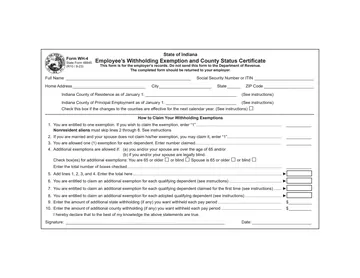
Residence and work location (15 taxes). Residents are taxed on all wages and nonresidents on wages earned in the place, often at a lower rate. Pennsylvania's earned income tax compares the two: “The applicable EIT rate owed and to be withheld is always the higher of the two rates.” Kansas City's page puts it plainly: “All Kansas City, Missouri, residents are required to pay the earnings tax, even if they work outside the city. Nonresidents are required to pay the earnings tax on income earned within Kansas City, Missouri, city limits.” Indiana uses one date for the county: “Withholding agents should withhold county tax based on the employee's Indiana county of residence as of Jan. 1 of the tax year.”
Employer-paid (10 taxes). These are taxes on the employer's payroll, not on the employee. The ten: Pittsburgh: Payroll Expense Tax; St. Louis: Payroll expense tax (0.5%); MCTD: New York City and 7 nearby counties: Metropolitan commuter transportation mobility tax (MCTMT); Newark: Payroll Tax; Jersey City: Payroll Tax; TriMet district (Portland area): TriMet transit payroll tax; Lane Transit District (Eugene-Springfield area): Lane Transit District payroll tax; Seattle: Payroll Expense Tax (SMC 5.38); Seattle: Social Housing Tax (SMC 5.37); San Francisco: Administrative Office Tax (with add-ons). Nothing goes on the pay stub. For the MCTMT, “An employer may not deduct any amount of MCTMT from the wages or compensation of an employee.” For Oregon's transit district taxes, “The transit tax is imposed directly on the employer.” For Seattle's Social Housing Tax, “Businesses may not subject employee compensation to withholding or deduction to pay the Social Housing Tax.”
Remote and home-based employees
A home office usually counts as the work location. Pennsylvania lists the residences of home-based employees among business sites; RITA says “If an employee works from home or lives and works in the same municipality, the tax should be reported to RITA as workplace”; Columbus taxes wages “earned in Columbus (including from their home)”; and Huntington's fee covers employees “who report to work at a physical location or work from home within the City of Huntington”. Oregon's transit district tax is figured on payroll for services in the district, which “includes traveling sales representatives and employees working from home.” So an employee who moves home to a different city can change the employer's local accounts even though nothing else in payroll changed.
An employer outside the state is often not required to withhold a residence-based tax, but the rules differ. Pennsylvania DCED says “As an out-of-state employer, you are NOT required to complete the Residency Certification Form or withhold the local Earned Income Tax (EIT) for a PA resident employee.” New York says employers “who are not incorporated or licensed under New York State law and do not maintain an office or transact business in New York State are not required to withhold New York State, New York City, or Yonkers income taxes on the wages of employees who reside in New York State.” Oregon's statewide transit tax: “we cannot require out-of-state employers to do so, as they're outside Oregon's taxing jurisdiction.” Kansas City lets them choose: “Nonresident businesses of Kansas City, Missouri have the option to voluntarily withhold the City's Earnings Tax for their employees.” Where the employer does not withhold, the employee pays; DCED's advice to such an employer is “If you choose not to withhold and remit, then please notify your PA resident employee that they will be responsible for making quarterly estimated payments”. The which programs apply tool and the multi-state setup checklist cover the state programs that follow the same addresses.
Each step is sourced on the local page for the tax.
All 63 local taxes by state
Grouped by state, in the order of the menu. Rates are as each source states them, with their year; a field no source gives shows "Not listed". "Ended" rows no longer apply and say when they stopped. The last column links the employer's own filing or registration page, or the form where there is no online system. A city lookup by name is on the local payroll tax lookup.
Pennsylvania: 6 taxes
Pennsylvania's local earned income tax follows the worksite: “Employers with worksites located in Pennsylvania are required to withhold and remit the local Earned Income Tax”, and “The applicable EIT rate owed and to be withheld is always the higher of the two rates.” Philadelphia's Wage Tax sits outside Act 32 and covers Philadelphia residents wherever they work and nonresidents for work in the city; for the Pittsburgh resident earned income tax, “The determining factor is the residency of the employee, not the location of the employer.” Pages: Philadelphia Wage Tax, PA Local Earned Income Tax, PA Local Services Tax (LST), Pittsburgh Payroll Expense Tax, EIT and LST for Employers.
| Place and tax (links to its page) | Basis | Who withholds or pays | Rate | Base | Return and due date | Where to file |
|---|---|---|---|---|---|---|
| Philadelphia: Wage Tax Sterling Act tax, outside Act 32; register on the Tax Center within 30 days | Residence and work location | Employers in PA or with a Philadelphia office withhold | 3.735% residents, 3.425% nonresidents from July 1, 2026; 3.73%/3.42% July 1, 2027 | Salaries, wages, commissions, other compensation; no wage floor | Quarterly return on the Philadelphia Tax Center; W-2s to the City Due: Apr. 30, July 31, Oct. 31, Feb. 1, 2027; payments weekly to quarterly | Filing or registration |
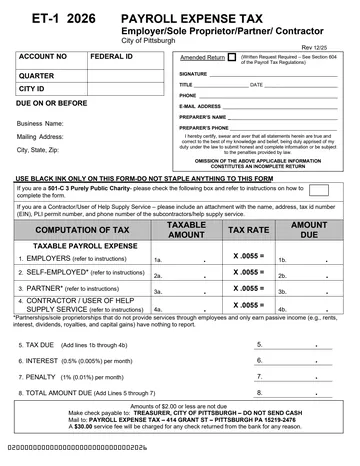
| Pittsburgh: Payroll Expense Tax LTEA 303 cap 0.55%; register with the City within 15 days | Employer-paid | Employers doing business in the city pay; never deducted from wages | 0.55% of payroll expense (2026) | Compensation for work in the city, apportioned by hours worked there | Form ET-1, quarterly, to the City Treasurer Due: May 31, Aug. 31, Nov. 30, Feb. 28 | Filing or registration |
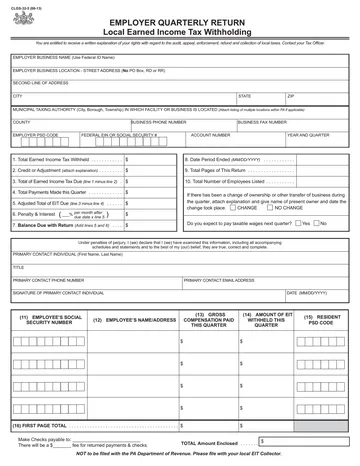
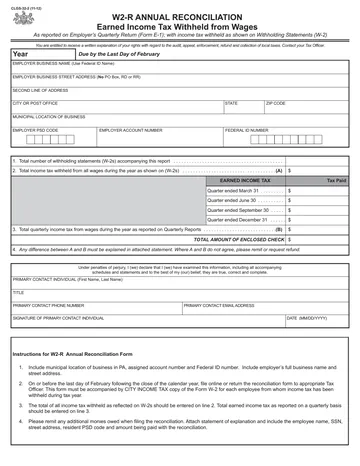
| Pittsburgh: Earned Income Tax (Act 32) Allegheny Central TCD (PSD 700102); part of the city is in Baldwin-Whitehall SD | Residence and work location | PA employers withhold the higher of resident or worksite rate | Residents 3% (1% city + 2% school); nonresident worksite 1% (2026) | Earned income: wages, salaries, commissions | Quarterly return to the district tax officer; W2-R annual reconciliation Due: Last day of the month after each quarter; W2-R by Feb. 28 | Filing or registration |
| statewide: Local Earned Income Tax (Act 32) Higher of resident and worksite rate; Philadelphia is outside Act 32 | Residence and work location | Employers with a PA worksite, including home offices | Set locally on DCED's register (rates as of June 15, 2026); 1% base cap, more by law | Earned income: wages, salaries, commissions | Quarterly return (CLGS-32-5) to the worksite tax officer; W2-R annually Due: Last day of the month after each quarter; W2-R by Feb. 28 | Filing or registration |
| statewide: Local Services Tax (LST) Prorated per pay period over $10; collector listed on DCED's register | Work location | Employers withhold at the worksite if the tax is on the register | Up to $52 a year per person; up to $156 in Act 47 cities | Flat per person; exempt under $12,000 where the rate is over $10 | Remit to the municipality's LST collector each quarter Due: 30 days after the end of each quarter | Not listed |
| Pittsburgh: Local Services Tax (LS-1) Pay stubs show the amount and locality PGH | Work location | Employers withhold; self-employed pay the City directly | $52 a year (2026); $1 a week on a weekly payroll | Flat per person; exempt under $12,000 earned in the city | Form LS-1, quarterly, to the City Treasurer Due: Apr. 30, July 31, Oct. 31, Jan. 31 (statute: 30 days after quarter) | Filing or registration |
Ohio: 7 taxes
Ohio cities tax wages where they are earned: an employer located or doing business in a city “shall withhold from each employee an amount equal to the qualifying wages of the employee earned by the employee in the municipal corporation multiplied by the applicable rate of the municipal corporation's income tax” (ORC 718.03). School district income tax runs the other way: “This requirement is based on an employee's address of residence and applies even if the employer conducts no business or operations in the school district.” Pages: Ohio Municipal Income Tax Withholding, RITA Withholding, CCA and Cleveland Income Tax Withholding for Employers, Columbus and Cincinnati Income Tax Withholding, Ohio School District Income Tax.
| Place and tax (links to its page) | Basis | Who withholds or pays | Rate | Base | Return and due date | Where to file |
|---|---|---|---|---|---|---|
| All municipalities (ORC 718): Municipal income tax withholding About 790 cities, villages, JEDDs and JEDZs; residence withholding optional; 20-day rule | Work location | Employers located or doing business in the city, on wages earned there | Set by each city; over 1% needs voter approval (ORC 718.04) | Qualifying wages: Medicare wages, no cap; 401(k) deferrals added back | Withholding return to each city or collector; annual reconciliation Due: Monthly by the 15th or quarterly; reconciliation by the last day of Feb. | Filing or registration |
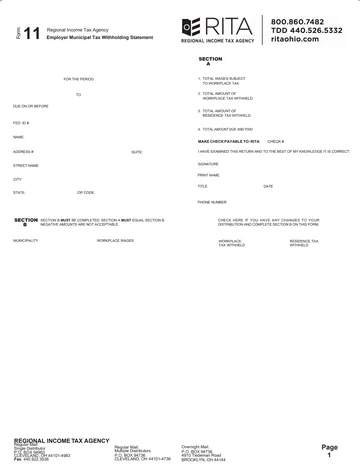
| RITA member cities and villages: Municipal income tax withholding (RITA) More than 400 members; 2027 rate table posted; W-2s electronic at 10 or more | Work location | Employers with employees working in a RITA member city | Set by each member; 0% to 3.000% on RITA's 2026 table (Youngstown 2.750%) | Qualifying wages (ORC 718); home workers reported as workplace wages | Form 11; Form 17 reconciliation and W-2 transmittal Due: Semimonthly, monthly (15th) or quarterly; Form 17 by the last day of Feb. | Filing or registration |
| Cleveland and CCA members: Municipal income tax withholding (CCA) No withholding or W-3 extensions; TY2026 W-2 submittals due March 1, 2027 | Work location | Employers doing business in a CCA community with one or more employees | Cleveland 2.50% (2026); members 0.75% to 2.75% | Qualifying wages (ORC 718): typically Medicare wages | Employer's Return of Income Tax Withheld; W-3 reconciliation with W-2s Due: Monthly by the 15th, semimonthly or quarterly; W-3 by the last day of Feb. | Filing or registration |
| Columbus: City income tax withholding Also three Columbus JEDDs; one-time penalty abatement from 50% to 10% | Work location | Employers with employees working in Columbus (including from home) or its JEDDs | 2.5% (state table: effective Oct. 1, 2009) | Qualifying wages earned in Columbus or the JEDD | IT-11 quarterly return; IT-13 reconciliation with W-2s Due: Pay daily to quarterly by volume; IT-11 Apr. 30, Jul. 31, Oct. 31, Jan. 31; IT-13 Feb. 28 | Filing or registration |
| Cincinnati: City income tax withholding Reconciliation form and date not listed; ORC 718.03(H) sets the last day of February | Work location | Employers paying wages earned in Cincinnati | 1.8% (effective Oct. 2, 2020) | Qualifying wages (ORC 718) | Withholding payments; year-end withholding reconciliation with W-2s Due: Quarterly, monthly (15 days) or semimonthly under Sec. 311-23 | Filing or registration |
| Toledo, Akron, Dayton, Youngstown: City income tax withholding Dayton rate from ODT's March 2025 table; Toledo takes payments via Ohio Business Gateway | Work location | Employers with employees working in the city | Toledo, Akron, Dayton 2.50%; Youngstown 2.75% (2026) | Qualifying wages (ORC 718) | Toledo W-3; Akron Form AW-3; Youngstown via RITA; Dayton not listed Due: Monthly by the 15th or quarterly; Toledo W-3 Feb. 28 | Not listed |
| School districts (statewide): School district income tax withholding 214 districts in 2026 (68 earned income, 146 traditional); IT 4 names the district | Residence | Every employer, for employees living in a taxing school district | 0.25% to 2% by district (2026 list) | Traditional (state wage base and exemptions) or earned income only (flat) | SD 101 return; SD 141 annual reconciliation Due: State withholding frequency; SD 141 by Jan. 31 | Filing or registration |
Kentucky: 8 taxes
“Every employer making payment of compensation to an employee shall deduct and withhold upon the payment of the compensation any tax imposed against the compensation by a tax district.” (KRS 67.780). Districts post their forms on the Secretary of State's occupational tax portal. Pages: Kentucky Occupational License Tax, Louisville Occupational License Tax, Lexington Occupational License Fee, Northern Kentucky, Bowling Green and Boone County Taxes.
| Place and tax (links to its page) | Basis | Who withholds or pays | Rate | Base | Return and due date | Where to file |
|---|---|---|---|---|---|---|
| statewide: Occupational license tax (city, county and school tax districts) 229 tax districts on the Secretary of State's list (our count, Nov. 2026); school rates frozen from 2027 | Work location | Every employer paying compensation for work in a tax district | Set by each district; statutory limits 0.5% to 1.25% by type (2026) | Compensation incl. 401(k), 403(b), 457 deferrals and Section 125, 132 reductions | District withholding return; annual reconciliation with W-2/W-3 or a listing Due: End of month after quarter unless the district sets another; reconciliation Feb. 28 | Filing or registration |
| Louisville Metro / Jefferson County: Occupational license tax (Metro, transit and school boards taxes) 0.75% school boards tax only on employees who live and work in Louisville Metro; e-file over 25 returns a year | Residence and work location | Employers with employees working in Louisville Metro | 2.2% residents, 1.45% nonresidents (2026) | Gross wages for work performed in Louisville Metro | W-1 quarterly; W-1D monthly deposits over $3,000 a quarter; W-3 annual Due: W-1 last day of month after quarter; W-1D by the 15th; W-3 and W-2s Feb. 28 | Filing or registration |
| Lexington-Fayette Urban County: Occupational license fee (and Fayette County Public Schools tax) FCPS 0.5% school tax applies only to Fayette residents; KRS 67.783 and 67.790 govern | Work location | Employers with employees working in Fayette County, including nonresident employers | 2.25% (2026); plus 0.5% school tax for Fayette residents working in the county | Compensation incl. tips and pretax deferrals; apportioned by time in county | Form 220-221 (mailed, paper); Form 222 annual reconciliation Due: Quarterly, or monthly over $300 a quarter; Form 222 by Feb. 28 | Filing or registration |
| Kenton County: Kenton County payroll license fee (occupational fee) Business Services also collects for most Kenton County cities; QCC1 due even with no activity | Work location | Employers with employees working in Kenton County, on top of any city fee | 0.6997% up to the FICA wage base (July to Dec. 2026) | Total gross earnings before Section 125, 401(k) and similar deductions | Form QCC1 quarterly; Form KC-AR annual reconciliation Due: QCC1 last day of month after quarter; KC-AR Feb. 28 | Filing or registration |
| Covington: Covington payroll license fee Kenton County's table lists a separate Covington phone, 859-292-2180; Covington's own filing rules not read | Work location | Employers with employees working in Covington, on top of Kenton County's fee | 2.45% up to the FICA wage base (July to Dec. 2026) | Pay up to the FICA wage base | Not listed | Not listed |
| Elsmere: Elsmere payroll withholding (city occupational fee) Rate change posted on Kenton County's rates page | Work location | Employers paying wages for work conducted within Elsmere | 1.75% for check dates from July 1, 2026 (1.25% before) | Wages for work conducted within Elsmere | Form QCC1 quarterly and Form KC-AR, with Kenton County Business Services Due: QCC1 last day of month after quarter; KC-AR Feb. 28 | Filing or registration |
| Bowling Green: Occupational license tax (City Employee Withholding Tax) Reported separately from the Warren County occupational tax | Work location | Employers with employees working in the city | 2% (since Jan. 1, 2024; was 1.85%) | Gross wages less pay for services outside Bowling Green | City Employee Withholding Tax return; annual wage reconciliation Due: Monthly or quarterly (first 2024 dates Feb. 15 and Apr. 30); reconciliation end of Feb. | Filing or registration |
| Boone County: Boone County payroll taxes (county, mental health, Board of Education) 2027 rate sheet posted but not read; Walton withholding also filed with Boone County | Residence and work location | Employers with employees working in Boone County; school tax if also a district resident | 0.8% to $79,494; 0.15% to $16,666; school 0.5%, no cap (2026) | Gross compensation, no pretax deductions | Quarterly withholding return; annual reconciliation Due: Quarterly; county due dates not read | Filing or registration |
Michigan: 5 taxes
“Twenty-four Michigan cities levy municipality taxes related to income.” The default uniform ordinance rate is “an annual tax of 1% on corporations and resident individuals and of 1/2% on nonresident individuals” (MCL 141.611); Detroit taxes “All residents of the City of Detroit whether or not they work inside the City of Detroit”. Pages: Michigan City Income Taxes, Detroit City Income Tax.
| Place and tax (links to its page) | Basis | Who withholds or pays | Rate | Base | Return and due date | Where to file |
|---|---|---|---|---|---|---|
| 24 cities (uniform ordinance): City income tax (Uniform City Income Tax Ordinance) Each city runs its own forms; Treasury runs Detroit, and Flint from Jan. 1, 2027 | Residence and work location | Employers doing business or with an establishment in the city | 1% resident, 0.5% nonresident (uniform default; Detroit and a few cities higher) | Compensation after exemptions; nonresidents only if 25% or more of work is in the city | Quarterly withholding return; annual reconciliation with W-2 copies Due: Last day of the month after each quarter; reconciliation by the last day of February | Filing or registration |
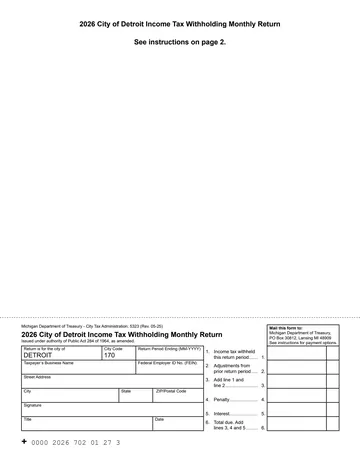
| Detroit: City of Detroit income tax withholding Administered by Michigan Treasury; eServices since Nov. 12, 2026 | Residence and work location | Every employer with a Detroit location or doing business in Detroit | 2.4% resident, 1.2% nonresident (2026) | Compensation less $600 per exemption; nonresidents on the share earned in Detroit | Form 5323 monthly return; Form 5321 annual reconciliation with W-2s Due: 5323: 15th of the next month; 5321 for 2026: Feb. 28, 2027 (Sunday: next business day) | Filing or registration |
| Grand Rapids: City income tax withholding City-administered; SS-4 registration form | Residence and work location | Employers with a location or doing business in the city | 1.5% resident, 0.75% nonresident (since July 1, 2010) | Compensation after exemptions ($600 each, city list) | Withholding payments; W-3 annual employer reconciliation Due: Monthly if over $100 a month, else quarterly; last day of the month after the period | Filing or registration |
| Saginaw: City income tax withholding Rate conflict quoted both ways on the page; the city's own page governs | Residence and work location | Employers withholding for the city | 1.50% resident, 0.75% nonresident (city page; another city's list shows 1%, 0.5%) | Compensation after exemptions ($1,000 each, Grand Rapids list) | Monthly or quarterly payments; SW-3 annual reconciliation with W-2s Due: Monthly over $100 (last day of next month), else quarterly; SW-3 by Feb. 28 | Filing or registration |
| Flint: City income tax withholding Treasury takes over Flint on Jan. 1, 2027; withholding must be paid electronically | Residence and work location | Employers withholding for the city; Michigan Treasury administers from Jan. 1, 2027 | 1% resident, 0.5% nonresident | Compensation after exemptions ($600 each, Grand Rapids list) | City quarterly returns through 2026; Treasury monthly returns from January 2027 Due: From 2027: 15th of the next month (first: Feb. 16, 2027); 2027 annual: Feb. 28, 2028 | Filing or registration |
Missouri: 3 taxes
Only Kansas City and St. Louis levy an earnings tax. In Kansas City, “All Kansas City, Missouri, residents are required to pay the earnings tax, even if they work outside the city. Nonresidents are required to pay the earnings tax on income earned within Kansas City, Missouri, city limits.” Pages: Kansas City Earnings Tax, St. Louis Earnings and Payroll Expense Taxes for Employers.
| Place and tax (links to its page) | Basis | Who withholds or pays | Rate | Base | Return and due date | Where to file |
|---|---|---|---|---|---|---|
| Kansas City: Earnings tax (1%) RD-113 and W-2 data due Jan. 31; filed on Quick Tax or the bulk program | Residence and work location | Employers of KC residents and of nonresidents working in the city | 1% (2026); voters continued it Apr. 7, 2026 for five years from Jan. 1, 2027 | Gross compensation less cafeteria and qualified deferred compensation contributions | RD-110 quarterly return; RD-113 annual reconciliation with W-2 data, both electronic Due: Remit at the state withholding frequency; RD-110 Apr. 30, July 31, Oct. 31, Jan. 31 | Filing or registration |
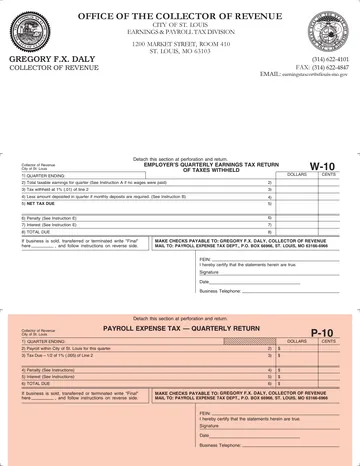
| St. Louis: Earnings tax withholding (1%) Returns by mail, fax or email; payments online | Residence and work location | Employers with employees working in the city; city resident employers for all employees | 1% (2026); continued by voters Apr. 7, 2026 for five years from Jan. 1, 2027 | Gross earnings: wages, bonuses, commissions, severance, tips and other pay | Form W-10 quarterly; Form W-3 reconciliation with W-2s Due: W-10: Apr. 30, July 31, Oct. 31, Jan. 31; monthly deposits at $1,500 a month; W-3 Jan. 31 | Filing or registration |
| St. Louis: Payroll expense tax (0.5%) Employer pays; businesses located only at the airport are not subject | Employer-paid | Employers with employees working in the city; nonprofits and governments exempt | 0.5% of payroll for work in the city (Form P-10, v.2026) | Payroll for work or services performed within the city | Form P-10 quarterly, filed with Form W-10 Due: Apr. 30, July 31, Oct. 31 and Jan. 31 | Filing or registration |
Indiana: 1 tax
Every Indiana county has a local income tax, withheld with the state tax: “Withholding agents should withhold county tax based on the employee's Indiana county of residence as of Jan. 1 of the tax year.” The rates are in DOR's county withholding rates (Departmental Notice #1). Pages: Indiana County Tax Rates.
| Place and tax (links to its page) | Basis | Who withholds or pays | Rate | Base | Return and due date | Where to file |
|---|---|---|---|---|---|---|
| Statewide (92 counties): County local income tax (LIT) withholding County set on Jan. 1: residence, or principal work county for out-of-state residents | Residence and work location | Employers withholding Indiana income tax (withholding agents) | 0.5% (Porter) to 3.0% (Randolph) by county, effective Oct. 1, 2026; Marion 2.02% | Same taxable wages as state tax: wages less WH-4 exemptions | WH-1 periodic return with county breakdown; WH-3 annual reconciliation Due: WH-1 monthly (20th early filers, 30th others) or annual; WH-3 Jan. 31 | Filing or registration |
Maryland: 1 tax
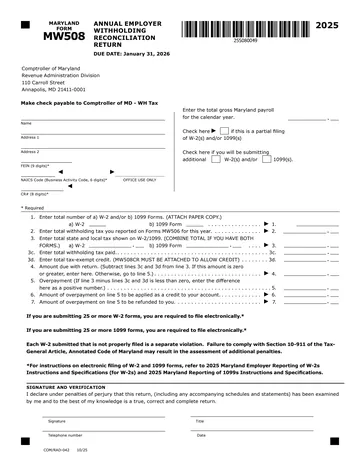
“Withholding is a combination of the state income tax rate and local taxes.” “For employees who are residents of Maryland, use the rate corresponding to the area where the employee lives.” Pages: Maryland County Income Tax.
| Place and tax (links to its page) | Basis | Who withholds or pays | Rate | Base | Return and due date | Where to file |
|---|---|---|---|---|---|---|
| All 23 counties and Baltimore City: County (local) income tax Rate follows the county of residence on Form MW507; 2027 rates not yet published | Residence | Employers withholding Maryland tax, combined with the state tax | 2.25% to 3.30% by county (2026); nonresidents: special 2.25% rate | Maryland taxable wages after the standard deduction and exemptions | MW506 returns; MW508 annual reconciliation Due: 15th of the month after the period; MW508 by Jan. 31 | Filing or registration |
New York: 5 taxes (4 in force, 1 ended)
New York City and Yonkers taxes ride on the state return: “Every employer paying wages or other payments subject to income tax withholding must file a return and pay the New York State, New York City, and Yonkers taxes required to be withheld.” The MCTMT is the employer's own tax, and “An employer may not deduct any amount of MCTMT from the wages or compensation of an employee.” Pages: MCTMT, NYC and Yonkers Income Tax Withholding for Employers.
| Place and tax (links to its page) | Basis | Who withholds or pays | Rate | Base | Return and due date | Where to file |
|---|---|---|---|---|---|---|
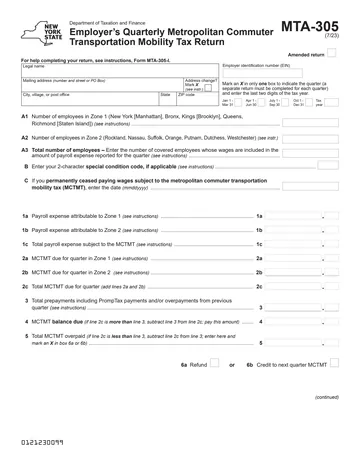
| MCTD: New York City and 7 nearby counties: Metropolitan commuter transportation mobility tax (MCTMT) Employer-paid; tested each quarter across both zones | Employer-paid | Employers withholding NY tax with MCTD payroll over $312,500 in a quarter | Zone 1: 0.055% to 0.895%; Zone 2: 0.055% to 0.635% (quarters from July 1, 2025) | All pay of covered employees, no Social Security wage cap | Form MTA-305, quarterly Due: Last day of the month after the quarter; no extensions | Filing or registration |
| City of Yonkers (residents): Yonkers resident income tax surcharge Includes parts of Bronxville, Scarsdale and Tuckahoe | Residence | Employers withholding NY tax, from Yonkers residents' wages | 16.75% of the NY State tax withheld (2026); supplemental 1.95975% | All wages of a Yonkers resident, wherever earned | NYS-1 deposits; NYS-45 quarterly, with the state tax Due: NYS-45: last day of month after quarter; NYS-1: 3 or 5 business days | Filing or registration |
| City of Yonkers (nonresidents working there): Yonkers nonresident earnings tax Employee files Form IT-2104.1; no withholding on annualized pay under $4,000 | Work location | Employers with a NY office or business, from nonresidents working in Yonkers | 0.50% of Yonkers wages after the exclusion (2026, unchanged) | Wages for work in Yonkers, by days; none if Yonkers wages under $3,000 | NYS-1 deposits; NYS-45 quarterly, with the state tax Due: NYS-45: last day of month after quarter; NYS-1: 3 or 5 business days | Filing or registration |
| New York City (residents): New York City resident personal income tax Residents of the five counties; no 2026 change to the city tables | Residence | Employers withholding NY tax, from NYC residents' wages | NYS-50-T-NYC tables (1/26), 2.05% to 4.25%; supplemental 4.25% | All wages of a city resident, wherever earned | NYS-1 deposits; NYS-45 quarterly, with the state tax Due: NYS-45: last day of month after quarter; NYS-1: 3 or 5 business days | Filing or registration |
| New York City (nonresidents): NYC nonresident earnings tax (commuter tax) Ended. Ended for wages on or after July 1, 1999 (Notice N-00-7) | Ended | None: employers have no further withholding obligation | Not listed | Not listed | Not listed | Not listed |
New Jersey: 2 taxes
State law lets a city tax the employer's payroll: “Any municipality may, by ordinance, impose and collect an employer payroll tax for general municipal purposes of the municipality, or for the purposes set forth in subsection d. of this section, at a rate of up to one percent of the employer's payroll.” (N.J.S.A. 40:48C-15). In Jersey City, “No! Employers may not deduct or withhold payment from employee wages to pay for the Payroll Tax.” Pages: Newark and Jersey City Payroll Taxes for Employers.
| Place and tax (links to its page) | Basis | Who withholds or pays | Rate | Base | Return and due date | Where to file |
|---|---|---|---|---|---|---|
| Newark: Payroll Tax Web page says 0.50% rate; booklet 18% interest vs statute 8% on first $1,500 | Employer-paid | Employer with Newark payroll over $2,500 in the quarter | 1% of payroll; no tax on resident wages above a 50% resident workforce | Federal wages for work in, supervised from or reporting to Newark | Quarterly Newark Payroll Tax Statement Due: Last day of April, July, October and January | Filing or registration |
| Jersey City: Payroll Tax Interest 8% on the first $1,500 and 18% above; charities pay only on unrelated business | Employer-paid | Employers located in Jersey City with quarterly payroll of $2,500 or more | 1% of payroll; Jersey City residents' wages exempt (since Jan. 1, 2019) | Form 941 pay for work in or supervised from Jersey City | Quarterly payroll tax return in the city's online portal Due: Last day of April, July, October and January | Filing or registration |
Delaware: 1 tax
Delaware lets only a city over 50,000 tax wages, and the rate “shall not exceed 1.25 percent of the income of residents of such city per annum and 1.25 percent of the income of nonresidents earned within the city per annum.” (22 Del. C. 902). Wilmington publishes an Address Coding Guide for addresses. Pages: Wilmington Earned Income Tax.
| Place and tax (links to its page) | Basis | Who withholds or pays | Rate | Base | Return and due date | Where to file |
|---|---|---|---|---|---|---|
| Wilmington: Earned income tax (city wage tax) Payments by phone or in person; refunds for out-of-city days go to the employee | Residence and work location | Delaware employers of city residents; city employers of staff based there | 1.25% (the state law's cap) | Salaries, wages, commissions and other compensation | Quarterly return; monthly if over $50 in month 1 or 2; W-2 file Due: 15th of April, July, October, January; W-2s by Jan. 31 | Form or instructions |
West Virginia: 4 taxes
West Virginia cities charge a flat weekly fee through payroll; Huntington's applies to employees “who report to work at a physical location or work from home within the City of Huntington”. Pages: West Virginia City Service Fees.
| Place and tax (links to its page) | Basis | Who withholds or pays | Rate | Base | Return and due date | Where to file |
|---|---|---|---|---|---|---|
| Huntington: City Service Fee Return due date and penalty not listed (Article 772 not read) | Work location | Employer withholds each pay period; self-employed pay | $5.00 per week per employee (since Oct. 1, 2015) | Each week worked in the city or from home there, any hours | Monthly, quarterly or annual remittance; Employer Worksheet by Jan. 31 Due: Not listed | Form or instructions |
| Wheeling: City Service Fee Penalty 5% then 2% a month; ordinance sunsets in 2045 | Work location | Employers with a Wheeling office withhold; self-employed pay | $2.00 per week (since Jan. 1, 2020) | Each calendar week employed in the city or from home there | Form CSF-2 with each quarterly remittance Due: Within one month after the quarter ends | Form or instructions |
| Parkersburg: City Service User Fee Ordinance, form, due date and penalty not listed | Work location | Employer withholds; self-employed pay each quarter | $2.50 per week | Each week working within the city limits | Quarterly remittance to the city Due: Not listed | Not listed |
| Morgantown: Municipal Service Fee (Safe Streets and Safe Community Service Fee) Penalty 5% then 2% a month; withheld even if employer is based outside the city | Work location | Every employer withholds; self-employed pay | $3.00 per calendar week | Each calendar week employed in the city | Quarterly MSF return (blank filing form) Due: Within one month after the quarter ends | Form or instructions |
Alabama: 6 taxes (5 in force, 1 ended)
Alabama cities levy occupational license fees under the general power “To license any exhibition, trade, business, vocation, occupation, or profession not prohibited by the Constitution or laws of the state which may be engaged in or carried on in the municipality.” (Ala. Code 11-51-90(a)(1)). Jefferson County's tax has ended; the county says “employers should stop withholding Jefferson County occupational taxes from their employees' paychecks”. Pages: Alabama Occupational License Taxes.
| Place and tax (links to its page) | Basis | Who withholds or pays | Rate | Base | Return and due date | Where to file |
|---|---|---|---|---|---|---|
| Birmingham: Occupational license fee (occupational tax) No mail payments from July 1, 2026 | Work location | Every employer of people working in the city | 1% of gross receipts and compensation | Pay for work in the city (day-count share for work in and out) | Monthly return (quarterly if under $50 a month); annual reconciliation Due: 20th of the following month; reconciliation Jan. 31 | Filing or registration |
| Bessemer: Occupational tax Paper forms; no online filing found | Work location | Each employer of one or more persons working in the city | 1% of gross salaries, wages and commissions | Pay for work within the city limits | Quarterly return (zero returns too); annual reconciliation Due: 20th of the month after the quarter; reconciliation Jan. 31 | Form or instructions |
| Gadsden: Occupational license fee Penalty 10% then 2% a month, 28% maximum, $25 minimum | Work location | Every employer of people working in the city | 2% of gross receipts | All pay for work in the city, before deductions | Monthly return (quarterly with written permission under $25); Form G-3 Due: 20th of the following month; Form G-3 by Jan. 31 | Filing or registration |
| Auburn: Occupation license fee Interest at the State of Alabama rate (5% a year on the form) | Work location | Each employer of one or more persons working in the city | 1% of gross earnings | Gross earnings for work in the city, incl. board and lodging at value | Quarterly return; annual reconciliation with Form W-3 Due: 1st of month after quarter, delinquent after its last day; recon Jan. 31 | Form or instructions |
| Opelika: Occupation license fee No postmark credit; Form 0-3 still prints 1 1/2% | Work location | Employers withhold on wages earned in the city | 1% of gross wages (from April 1, 2025; was 1.5%) | Wages earned within city limits | Form 0-1 quarterly; Form 0-3 annual reconciliation Due: Last day of month after quarter; Form 0-3 by Jan. 31 | Form or instructions |
| Jefferson County: County occupational tax Ended. Ended after an Alabama Supreme Court ruling; county notice undated, end date not listed | Ended | None: employers told to stop withholding | Not listed | Not listed | Not listed | Not listed |
Oregon: 5 taxes
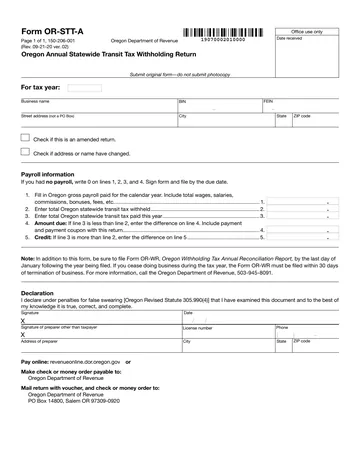
Oregon's statewide transit tax covers “Wages of Oregon residents (regardless of where the work is performed)” and “Wages of nonresidents who perform services in Oregon.” The TriMet and Lane taxes are different: “The transit tax is imposed directly on the employer.” Metro and Multnomah County taxes are withheld for employees who work there; addresses can be checked with the Metro boundary address lookup. Pages: Oregon Statewide Transit Tax, TriMet and Lane Transit Payroll Taxes for Employers, Metro SHS and Multnomah PFA Taxes.
| Place and tax (links to its page) | Basis | Who withholds or pays | Rate | Base | Return and due date | Where to file |
|---|---|---|---|---|---|---|
| statewide: Statewide transit tax Measure 120 (0.2% rate in HB 3991) failed May 19, 2026 | Residence and work location | Employer withholds from employees' wages | 0.1% of wages (2026 and 2027) | Wages of Oregon residents anywhere; nonresidents for work in Oregon; no cap | Form OQ quarterly (OR-STT-A annual filers); Form OR-WR reconciliation Due: Last day of month after quarter, with payment; OR-WR Jan. 31 | Filing or registration |
| TriMet district (Portland area): TriMet transit payroll tax Exceeds ORS 267.385's 0.8% cap; TMC 13.09 cites ORS 267.260 withdrawal adjustments | Employer-paid | Employer pays; no deduction from wages | 0.8237% of wages (2025 and later, incl. 2026 and 2027) | Wages for services performed in the TriMet district | Form OQ quarterly to Oregon DOR Due: Last day of April, July, October and January | Filing or registration |
| Lane Transit District (Eugene-Springfield area): Lane Transit District payroll tax Rate 0.0080 from 2025 in LTD Ordinance 50, sec. 1.03; ordinance read in full | Employer-paid | Employer pays; no deduction from wages | 0.80% of wages (2025 and later, incl. 2026 and 2027) | Wages for services performed in the LTD district | Form OQ quarterly to Oregon DOR Due: With the quarterly report: last day of month after quarter | Filing or registration |
| Metro district (Portland region): Metro Supportive Housing Services personal income tax Thresholds indexed from 2026; tax runs through tax year 2030 (Metro Code 7.06.050) | Work location | Employers withhold from employees working in Metro (code) | 1% of subject wages over $200,000 (withholding) | Employees working in Metro earning $200,000+; opt in or out allowed | WSHS-QR quarterly; WSHS-AR annual and W-2 data to Portland Due: Apr. 30, July 31, Oct. 31, Jan. 31; annual Jan. 31 | Filing or registration |
| Multnomah County: Preschool for All personal income tax 0.8 point increase delayed to Jan. 1, 2028 (Board, Aug. 27, 2026) | Work location | Employers withhold from employees working in the county (code) | 1.5% over $200,000; 3% over $400,000 (2026 and 2027) | Employees working in county earning $200,000+; residents on all wages | WPFA-QR quarterly; WPFA-AR annual and W-2 data to Portland Due: Apr. 30, July 31, Oct. 31, Jan. 31; annual Jan. 31 | Filing or registration |
Washington: 2 taxes
Seattle's two taxes fall on the business. Asked whether the payroll expense tax is an employee tax, the city answers “No. The tax is imposed on businesses that have Payroll Expense in the City above the threshold.” For the Social Housing Tax, “Businesses may not subject employee compensation to withholding or deduction to pay the Social Housing Tax.” Pages: Seattle Payroll Expense Tax and Social Housing Tax.
| Place and tax (links to its page) | Basis | Who withholds or pays | Rate | Base | Return and due date | Where to file |
|---|---|---|---|---|---|---|
| Seattle: Payroll Expense Tax (SMC 5.38) Only if prior-year Seattle payroll was $9,074,409+ (2026) or $9,485,485+ (2027) | Employer-paid | Business pays; not an employee tax | 0.746% to 2.557% by tier and pay band (2026 and 2027) | Seattle pay of employees at $194,452+ (2026) or $203,260+ (2027) | Quarterly return; Q4 return is the annual true-up Due: Jan. 31, Apr. 30, July 31, Oct. 31 | Filing or registration |
| Seattle: Social Housing Tax (SMC 5.37) 2025 tax was due with the return due Jan. 31, 2026 | Employer-paid | Business pays; withholding from employees prohibited | 5% of excess compensation (effective Jan. 1, 2025; not indexed) | Each employee's Seattle pay above $1,000,000 a year; no size threshold | Quarterly return from 2026; Q4 reconciliation Due: Jan. 31, Apr. 30, July 31, Oct. 31 | Filing or registration |
California: 2 taxes (1 in force, 1 ended)
San Francisco's payroll tax is gone (“Proposition F fully repealed the Payroll Expense Tax”); what remains measured by payroll is the Administrative Office Tax, paid by the business. Pages: San Francisco Payroll Expense Tax.
| Place and tax (links to its page) | Basis | Who withholds or pays | Rate | Base | Return and due date | Where to file |
|---|---|---|---|---|---|---|
| San Francisco: Payroll Expense Tax Ended. Repealed by Proposition F (Nov. 2, 2020), generally from 2021 | Ended (was employer-paid) | Not listed | None for 2026 or 2027 (repealed) | Not listed | Not listed | Not listed |
| San Francisco: Administrative Office Tax (with add-ons) 2026 and 2027 base rate not listed; executive pay add-on 0.080% to 0.480% (2026) | Employer-paid | Business classified as an administrative office pays | 1.47% of SF payroll expense (2025); plus 1.5% homelessness add-on | SF payroll expense; groups with 1,000+ US employees and $1B+ receipts | Annual Business Registration and Tax Form Due: Last day of February (2025 year: March 2, 2026); estimates Apr. 30, July 31, Oct. 31 | Filing or registration |
Colorado: 5 taxes (4 in force, 1 ended)
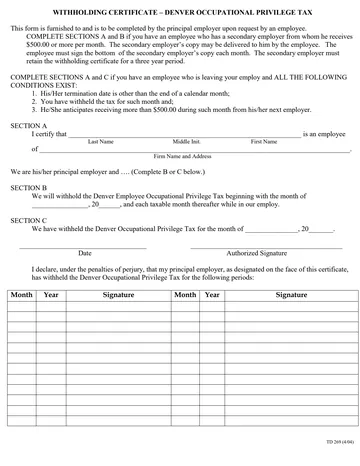
Colorado's occupational privilege taxes are flat monthly head taxes set by home rule cities; Greenwood Village, for example, “is a home-rule municipality that administers and collects its own taxes.” “Denver imposes two separate but related Occupational Privilege Taxes”: one withheld from the employee and one paid by the business. Pages: Denver Occupational Privilege Tax (OPT) for Employers, Colorado Occupational Privilege Taxes.
| Place and tax (links to its page) | Basis | Who withholds or pays | Rate | Base | Return and due date | Where to file |
|---|---|---|---|---|---|---|
| Denver: Occupational Privilege Tax (employee and business) DRMC 53-200 to 53-299; no change found for 2026 or 2027 | Work location | Employer withholds employee OPT and pays business OPT | $5.75 a month employee + $4.00 a month business | Per employee earning $500+ in Denver in a month; per owner, partner, manager | OPT return, monthly (10+ employees) or quarterly Due: Last day of month after the period; annual owner payment Jan. 31 | Filing or registration |
| Aurora: Occupational Privilege Tax Ended. Repealed effective Jan. 1, 2025 (Ord. 2022-77); amended and past returns still accepted | Ended (was work location) | Not listed | Was $2 employee + $2 employer a month (repealed Jan. 1, 2025) | Not listed | Not listed Due: Last returns (Dec. 2024 and Q4 2024) were due Jan. 31, 2025 | Filing or registration |
| Greenwood Village: Occupational Privilege Tax Filing frequency, due dates and penalties not listed on city pages | Work location | Employer withholds employee part and remits both parts | $2 a month employee + $2 a month employer | Per employee earning $250+ in a calendar month; OPT license required | Online returns via the city's Tax Payment Portal Due: Not listed | Filing or registration |
| Glendale: Occupational Privilege Tax Interest 1% or 1.5% a month (forms differ); penalty 10% or $100 | Work location | Employer withholds employee part and matches it | $5 a month employee + $5 a month employer | Per employee earning over $750 (page) or $750+ (forms) in a month | Monthly, quarterly or annual OPT return (paper); file even if no tax Due: Not listed | Form or instructions |
| Sheridan: Occupational Privilege Tax Earnings threshold, frequency, due dates and penalties not listed | Work location | Employer withholds employee part and remits both parts | $3 a month employee + $3 a month employer | Not listed | Remitted through the city's online tax system Due: Not listed | Filing or registration |
The March and April season
Local taxes are busiest from late January to the end of April, when the year-end work for one year meets the first quarter of the next. Kentucky districts want each employee's statement first: “Every employer shall furnish each employee a statement on or before January 31 of each year showing the amount of compensation and license tax deducted” (KRS 67.783). Maryland's reconciliation is due then too: “On or before January 31st of each year, employers must file a year end reconciliation to the Revenue Administration Division using Form MW508.” Oregon's statewide transit tax: “Annual reconciliation reports are also due by January 31.” Then come the February reconciliations. In Ohio, “On or before the last day of February of each year, an employer shall file a withholding reconciliation return” (ORC 718.03); in Kentucky the reconciliation is due “annually on or before February 28 of each year”; Pennsylvania's W2-R and the Michigan city reconciliations follow the same last-day-of-February pattern. Cleveland's CCA sets its own date: “Submittals for Tax Year 2026 are due on or before March 1, 2027.”
From the due dates in the table below; Ohio ORC 718.03, KRS 67.783, CCA and Portland Revenue Division.
In March and April employees file their own local returns and check the local boxes on their W-2s against them. For Metro and Multnomah County, Portland's Revenue Division says personal returns are filed “following the same schedule that federal and state income tax returns are due (generally April 15)”. The W-2 local amounts must match the residence history; New York's guide says that for a mid-year move “the employer must report in the Local wages, tips, etc. box on federal Form W-2 only the amount of federal wages for the period the employee was a New York City resident.” Questions from employees peak then, and so do corrections: a wrong PSD code, a missed residence change or a home office in a new city all surface on the employee's return.
Rates change on several dates, not just Jan. 1. In Pennsylvania, “Tax rates released on December 15 shall become effective January 1 of the following year.” Philadelphia's Wage Tax rates changed July 1, 2026 and change again July 1, 2027, Indiana's county rates took effect Oct. 1, 2026, and Elsmere's rate changed for check dates from July 1, 2026; each row gives the rate's date. The first-quarter returns that follow, due April 30 for most quarterly filers, are the first to use the new rates.
Address and rate finders
The jurisdiction comes from the address, not the mailing city or ZIP code. Use the official finder before setting up an employee:
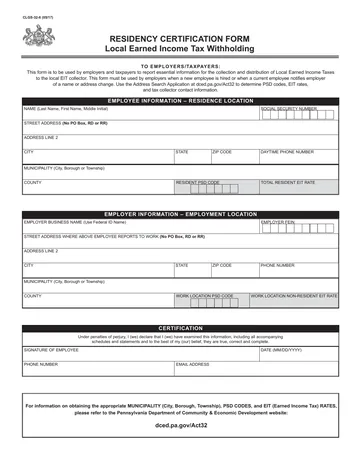
- Pennsylvania: DCED's Withholding Rates by Address search looks up the local withholding rates for any worksite or home address; new hires complete the residency certificate, since the law says “An employer shall require each new employee to complete a certificate of residency form”. See PA local earned income tax.
- Ohio: the Department of Taxation says “School districts and the corresponding four-digit codes can be verified using The Finder at tax.ohio.gov/finder or by contacting the applicable county auditor.” Use The Finder with the employee's home address. See Ohio municipal income tax and Ohio school district income tax.
- Kentucky: the Secretary of State's occupational tax portal lists each tax district and its forms.
- Michigan: Treasury's list of cities with an income tax.
- Indiana: DOR's county withholding rates (Departmental Notice #1), by county.
- Oregon: the Metro boundary address lookup for the Metro district; the transit district boundaries are on the TriMet and Lane page.
- Delaware: Wilmington's Address Coding Guide.
Forms, line by line
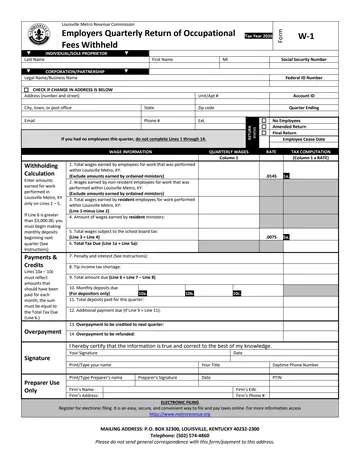
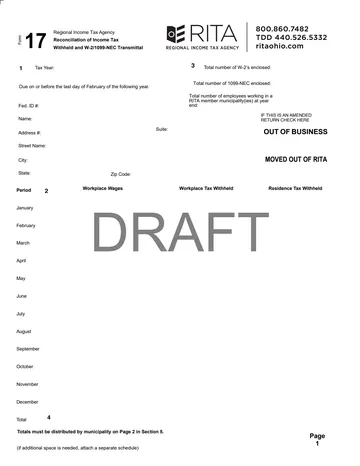
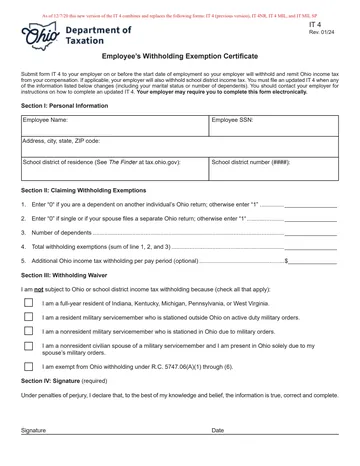
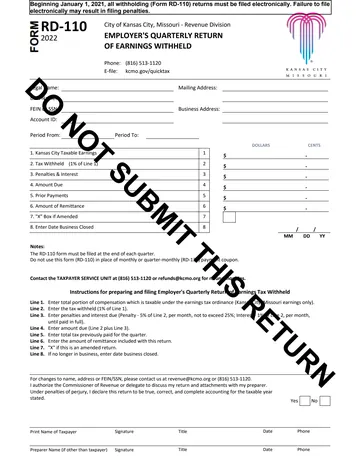
Tools and templates for this topic
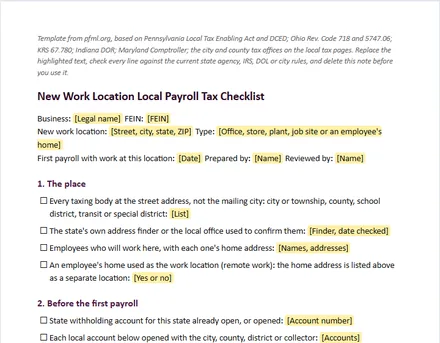
New work location checklist
Open payroll at a new office, store, plant or remote employee's home: the local accounts, codes and residence forms, with every local tax we cover listed by state.
Questions employers ask
Do I withhold local tax for an employee who works from home?
Usually yes, for the place where the home is. Pennsylvania treats a home-based employee's residence as a business site, RITA reports home workers as workplace wages, Columbus taxes wages earned from home in the city, and Oregon's transit districts include employees working from home. Check the employee's home address in the official finder.
An employee lives in one city and works in another. Which tax do I withhold?
It depends on the basis of each tax. Pennsylvania's earned income tax uses the higher of the resident and worksite rates. Ohio cities tax where the work is done, and the work city has priority; residence withholding is optional. Michigan cities, Kansas City and St. Louis tax residents on all wages and nonresidents on wages earned there.
We have no office in the state. Do we still withhold local tax?
For work-location taxes, yes, if the employee works there. For residence-based taxes, often not: Pennsylvania does not require an out-of-state employer to withhold the earned income tax, New York does not require an employer with no office or business in the state to withhold, and Kansas City makes it voluntary for nonresident businesses. The employee then pays directly.
Which local payroll taxes can't be taken out of pay?
The employer-paid ones: the MCTMT, the Newark and Jersey City payroll taxes, the Pittsburgh and St. Louis payroll expense taxes, the TriMet and Lane transit taxes, Seattle's payroll expense tax and Social Housing Tax, and San Francisco's Administrative Office Tax. New York, Jersey City and Seattle say in writing that they may not be deducted.
Which local taxes no longer apply?
Four in the table: the New York City nonresident earnings tax (for wages from July 1, 1999), Jefferson County, Alabama's occupational tax, San Francisco's Payroll Expense Tax (repealed by Proposition F) and Aurora, Colorado's occupational privilege tax (repealed Jan. 1, 2025). Old payroll setups sometimes still carry them.
When are local W-2s and reconciliations due?
Most fall between Jan. 31 and the last day of February: Maryland, Indiana, Kansas City, St. Louis, Oregon and Alabama in January; Ohio, Pennsylvania, Kentucky and Michigan in February. Cleveland's CCA takes 2026 W-2s by March 1, 2027. Each row of the table gives the exact date.
Sources
- Every row: the sources quoted on its own local page, linked from the place and tax name; the filing links are each agency's own pages.
- Pennsylvania: DCED Local Withholding Tax FAQs and local income tax information; Local Tax Enabling Act; City of Pittsburgh tax descriptions
- Ohio: ORC 718.03, ORC 718.011; Department of Taxation employer withholding; RITA employer withholding FAQ; CCA business FAQ and W-2 submittals; Columbus employer withholding
- Kentucky: KRS 67.780, KRS 67.783; Michigan: City Income Tax Act, Treasury cities with an income tax; Missouri: Kansas City Earnings Tax and guide for nonresident businesses; Indiana: DOR Departmental Notice #1
- Maryland: Comptroller Employer Withholding Guide; New York: Publication NYS-50, MTA-305 instructions; New Jersey: N.J.S.A. 40:48C, Jersey City taxes; Delaware: 22 Del. C. ch. 9
- West Virginia: Huntington City Service Fee; Alabama: Ala. Code 11-51-90, Jefferson County occupational tax information; Oregon: DOR Statewide Transit Tax and transit payroll taxes, Metro SHS taxes FAQ, Portland personal income tax
- Washington: Seattle Payroll Expense Tax and Social Housing Tax; California: San Francisco Gross Receipts Tax; Colorado: Denver Tax Guide Topic No. 61, Greenwood Village taxes and fees