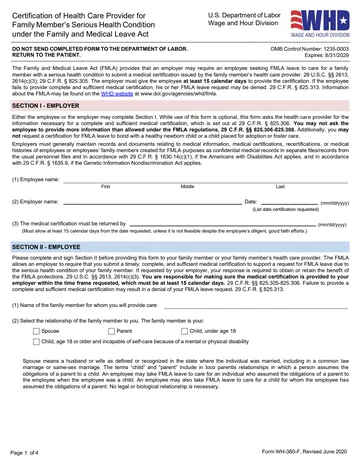
- Who fills it in
- Employer, employee, family member's provider
- Due
- At least 15 calendar days after you ask
- Returned to
- The employer, through the employee
- Form revision
- Revised June 2020 (expires 8/31/2029)
- Pages
- 4
At a glance
Form WH-380-F, Certification of Health Care Provider for Family Member's Serious Health Condition under the Family and Medical Leave Act, supports a request for FMLA leave to care for a spouse, child or parent with a serious health condition. Unlike WH-380-E, it has an employee section: the employee names the family member, the relationship and the care, then the family member's provider certifies the condition.
- Who fills it in. You (or the employee) complete Section I, the employee completes and signs Section II, and the family member's health care provider completes Section III and signs.
- When. When you require certification. “The employer must give the employee at least 15 calendar days to provide the certification.”
- How it is returned. To you, through the employee. Not to the Department of Labor.
- Form. Form WH-380-F (Revised June 2020, OMB Control Number 1235-0003, expires 8/31/2029), four pages; a Spanish version is on the DOL's FMLA forms page.
Form WH-380-F (Revised June 2020).
Tap a box once for its note, again to jump to the line. Zoom in to read the small print.
Section I: the employer's part
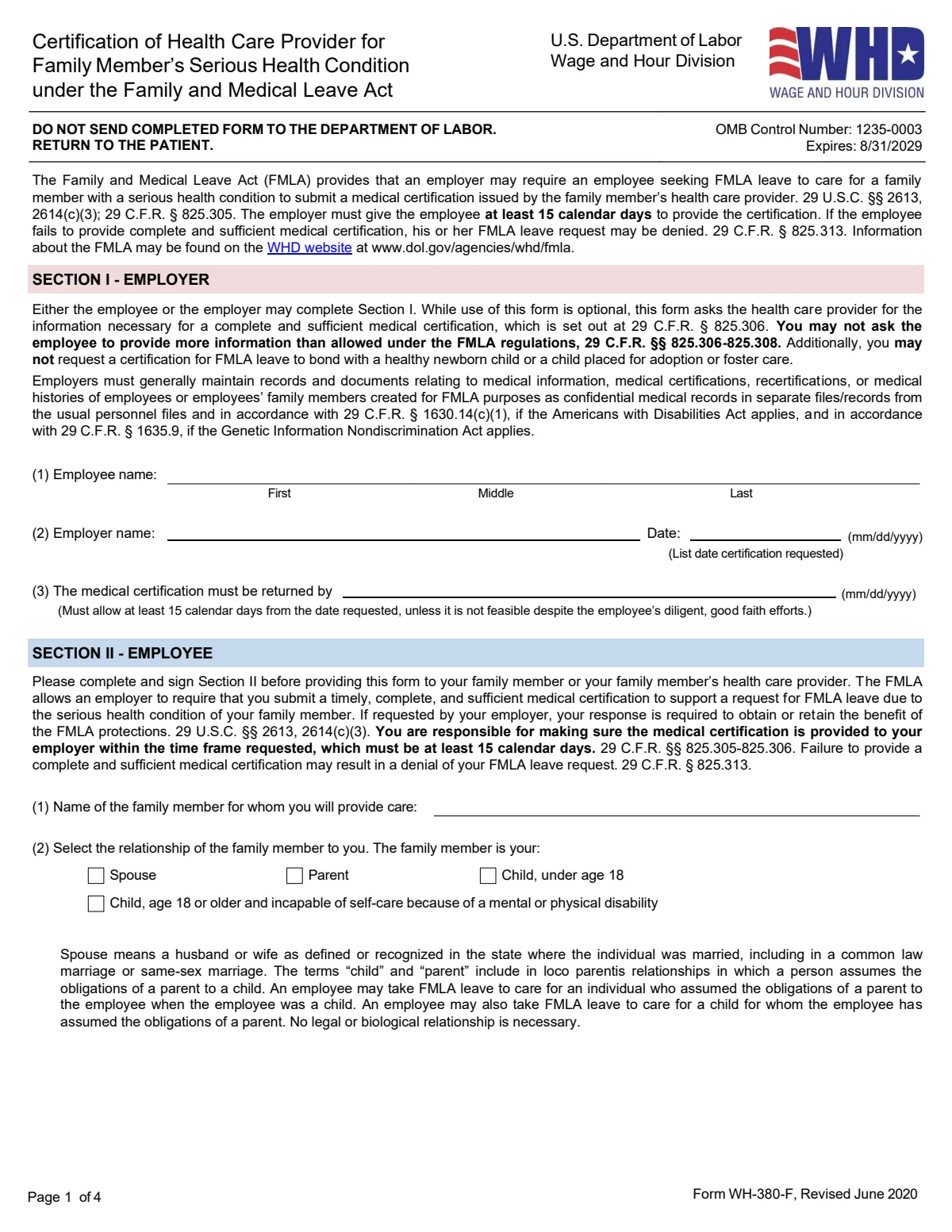
| Line | Label | What goes there |
|---|---|---|
| I-1 | (1) Employee name: First, Middle, Last | The employee's full name. As on WH-380-E, either you or the employee may complete Section I. |
| I-2 | (2) Employer name; Date: (List date certification requested) | Date it the day you ask. The return period in (3) runs from this date. |
| I-3 | (3) The medical certification must be returned by | The form's rule: at least 15 calendar days, unless that is not feasible despite the employee's diligent, good faith efforts. The employee is responsible for getting it back to you on time. |
Section II: the employee's part
Section II is what makes WH-380-F different. The employee answers first, so the provider sees what care the employee says the family member needs.
| Line | Label | What goes there |
|---|---|---|
| II-1 | (1) Name of the family member for whom you will provide care | The patient's name. The provider repeats it in Section III, Part A, item (1). |
| II-2 | (2) Select the relationship of the family member to you. The family member is your: Spouse; Parent; Child, under age 18; Child, age 18 or older and incapable of self-care because of a mental or physical disability | Only these relationships qualify under the FMLA. In loco parentis counts both ways, and “No legal or biological relationship is necessary.” You may ask the employee to confirm the relationship; “This documentation may take the form of a simple statement from the employee, or a child's birth certificate, a court document, etc.” Parents-in-law, grandparents and siblings are not covered by the FMLA, even where a state program covers them. |
| II-3 | (3) Briefly describe the care you will provide to your family member: (Check all that apply) | The employee's own description of the care. It should line up with the provider's answer in Part A, item (4). |
| II-4 | (4) Give your best estimate of the amount of leave needed to provide the care described | The employee's estimate, which the provider's Part B answers support. |
| II-5 | (5) If a reduced work schedule is necessary to provide the care described, give your best estimate of the reduced schedule you are able to work. | Only if a reduced schedule is needed. Only the hours not worked count against the FMLA entitlement. |
| II-sig | Employee Signature; Date | The form's instruction to the employee: “Please complete and sign Section II before providing this form to your family member or your family member’s health care provider.” |
Section III: the provider's details
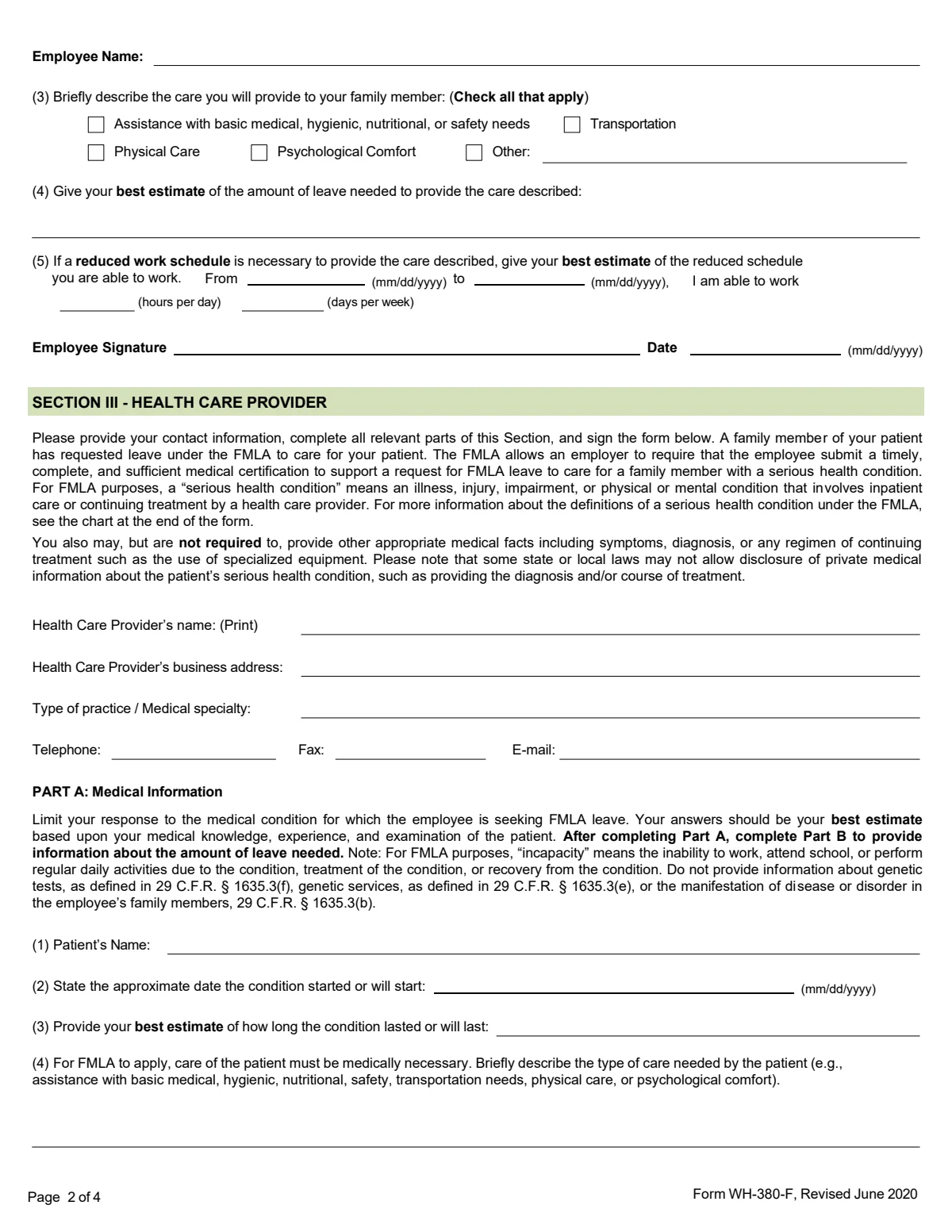
| Line | Label | What goes there |
|---|---|---|
| EN | Employee Name: | The employee's name (not the patient's), so the pages stay together in the medical file. |
| HCP | Health Care Provider's name (Print); business address; Type of practice / Medical specialty; Telephone; Fax; E-mail | The family member's provider. Any contact you make later is for clarification or authentication only, and never by the employee's direct supervisor (29 CFR 825.307(a))29 CFR 825.307Code of Federal Regulations, eCFR. |
Part A: medical information
The provider certifies the family member's condition, using the same categories and definitions chart as WH-380-E, and says what care the patient needs.
| Line | Label | What goes there |
|---|---|---|
| 1 | (1) Patient's Name | The patient is the family member, not your employee. |
| 2 | (2) State the approximate date the condition started or will start | An approximate date is enough. |
| 3 | (3) Provide your best estimate of how long the condition lasted or will last | Sets the recertification timing, as on WH-380-E (29 CFR 825.308)29 CFR 825.308Code of Federal Regulations, eCFR. |
| 4 | (4) For FMLA to apply, care of the patient must be medically necessary. Briefly describe the type of care needed by the patient | The form's condition: “For FMLA to apply, care of the patient must be medically necessary.” Care includes basic medical, hygienic, nutritional and safety needs, transportation, physical care and psychological comfort. |
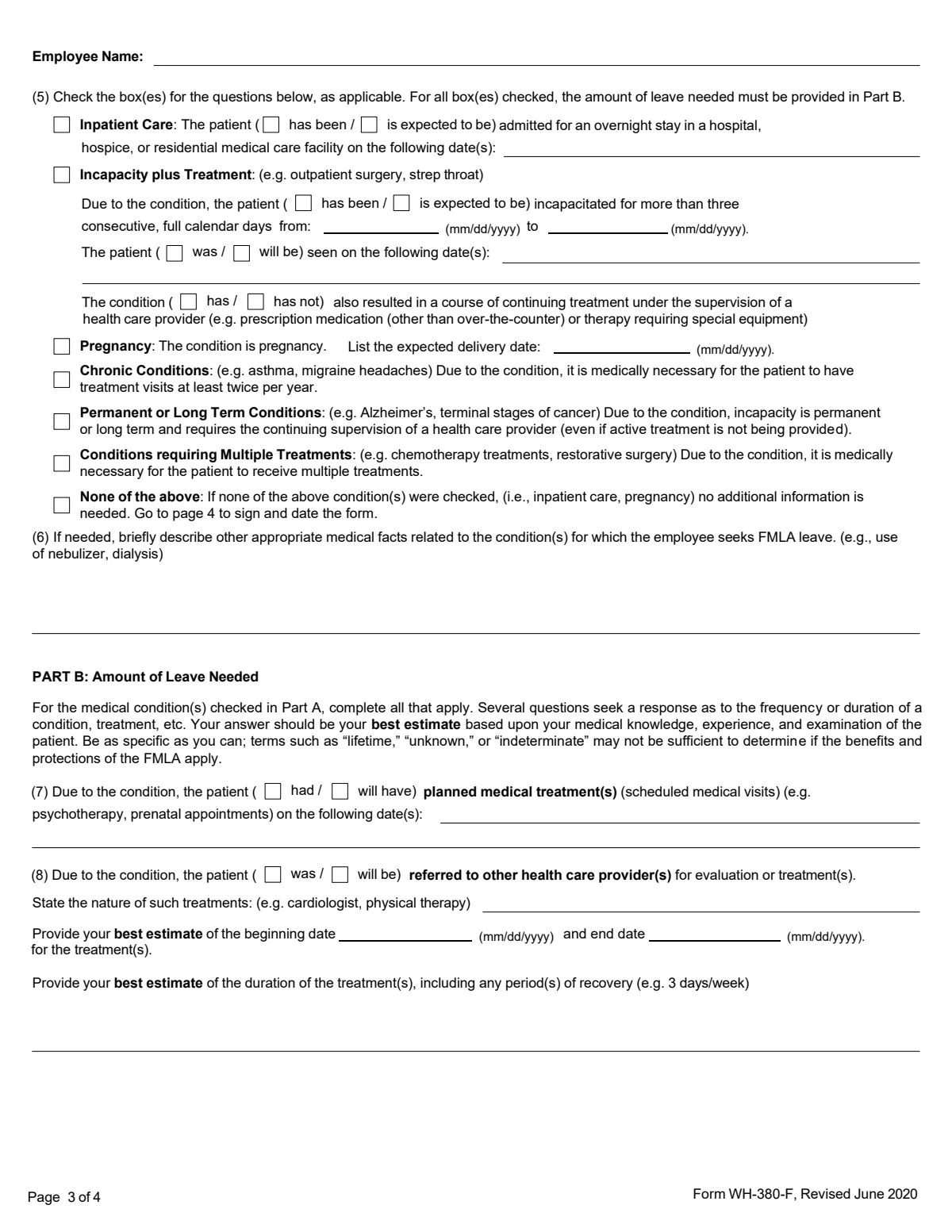
| 5 | (5) Check the box(es) for the questions below, as applicable. | The same categories as WH-380-E, defined in the chart on page 4. |
| 5-inpatient | Inpatient Care | An overnight stay and its dates. |
| 5-incapacity | Incapacity plus Treatment | Incapacity dates, visit dates and the continuing-treatment answer; the first in-person visit must be within seven days of the first day of incapacity (29 CFR 825.115(a)(3))29 CFR 825.115Code of Federal Regulations, eCFR. |
| 5-pregnancy | Pregnancy: The condition is pregnancy. List the expected delivery date | A spouse is entitled to leave to care for a pregnant spouse who is incapacitated, or during her prenatal care (29 CFR 825.120(a)(5))29 CFR 825.120Code of Federal Regulations, eCFR. |
| 5-chronic | Chronic Conditions | Usually paired with question 10 (intermittent leave). |
| 5-permanent | Permanent or Long Term Conditions | Active treatment is not required. |
| 5-multiple | Conditions requiring Multiple Treatments | Chemotherapy and restorative surgery are the form's examples. |
| 5-none | None of the above | On its own, this box does not show a serious health condition. |
| 6 | (6) If needed, briefly describe other appropriate medical facts related to the condition(s) for which the employee seeks FMLA leave. | Optional. The provider is asked to “Limit your response to the medical condition for which the employee is seeking FMLA leave.” |
Part B: amount of leave needed
As on WH-380-E, “terms such as ‘lifetime,’ ‘unknown,’ or ‘indeterminate’ may not be sufficient to determine if the benefits and protections of the FMLA apply.”
| Line | Label | What goes there |
|---|---|---|
| 7 | (7) Due to the condition, the patient (had / will have) planned medical treatment(s) | Supports intermittent leave to take the family member to appointments. |
| 8 | (8) Due to the condition, the patient (was / will be) referred to other health care provider(s) for evaluation or treatment(s). | As on WH-380-E, item (6). |
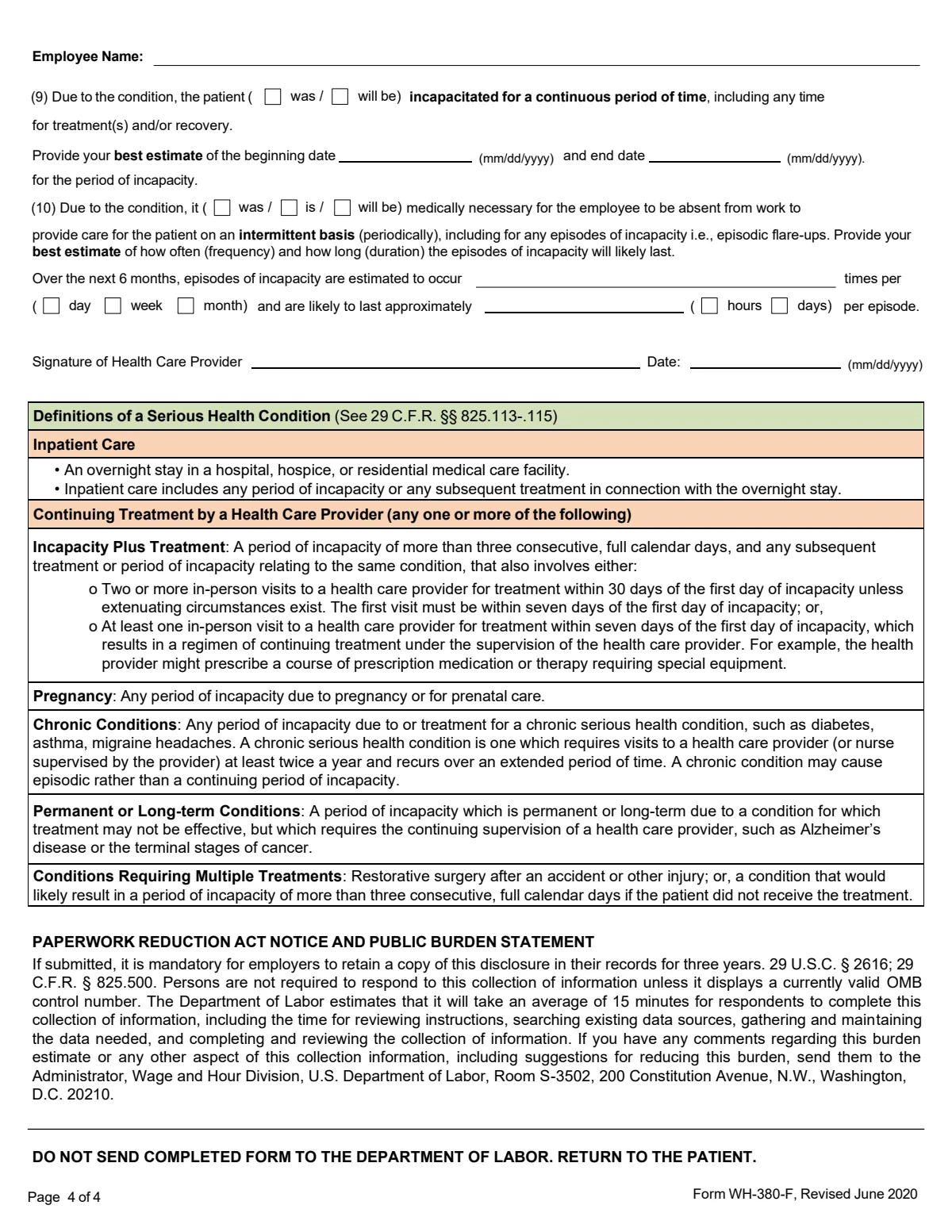
| 9 | (9) Due to the condition, the patient (was / will be) incapacitated for a continuous period of time | The block of time the patient is incapacitated, which supports a continuous leave. |
| 10 | (10) Due to the condition, it (was / is / will be) medically necessary for the employee to be absent from work to provide care for the patient on an intermittent basis | Frequency and duration over the next 6 months. The regulation asks for a statement that intermittent leave is medically necessary to care for the family member, which can include assisting in the family member's recovery (29 CFR 825.306(a)(8))29 CFR 825.306Code of Federal Regulations, eCFR. |
| Sig | Signature of Health Care Provider; Date | An unsigned form is incomplete. The employee returns the form to you. |
When the form comes back
The review rules are the same as for the employee's own condition. Ask in writing for anything incomplete or insufficient and allow seven calendar days to fix it (29 CFR 825.305(c))29 CFR 825.305Code of Federal Regulations, eCFR. If you doubt a complete form, “An employer who has reason to doubt the validity of a medical certification may require the employee to obtain a second opinion at the employer's expense.” Records go in a confidential medical file kept apart from the personnel file, because the regulation requires that certifications “shall be maintained as confidential medical records in separate files/records from the usual personnel files.” Then decide and send the WH-382 designation notice within five business days.
Family members the FMLA does not cover
State paid leave programs often cover more relatives than the FMLA: grandparents, siblings, in-laws, domestic partners. The FMLA does not: “Care for parents-in-law is not covered by the FMLA.” When an employee takes state paid leave to care for a relative outside the FMLA list, that leave is not FMLA leave and does not reduce the 12 weeks. The regulation's rule for the two laws: “Nothing in FMLA supersedes any provision of State or local law that provides greater family or medical leave rights than those provided by FMLA.” Each state program's covered relatives are on its page; start from paid family leave by state and paid leave benefits by state.
How it connects
- The DOL forms side by side: FMLA forms. The employee's own condition: Form WH-380-E. A family member who is a servicemember or veteran: WH-385 or WH-385-V.
- Notices before and after: WH-381 and WH-382; timing in the designation notice guide.
- How FMLA leave and state family leave run at the same time: FMLA and state paid leave.
Questions employers ask
Who fills in Section II of WH-380-F?
The employee, before giving the form to the family member or the family member's provider. The employee names the family member, gives the relationship, describes the care and estimates the leave, then signs.
Can we require a birth certificate or marriage certificate?
You may ask for reasonable documentation or a statement of the relationship. A simple statement from the employee is enough under the regulation, and you must return official documents after you look at them.
Does WH-380-F cover care for a grandparent or in-law?
No. The FMLA covers a spouse, a parent (including someone who stood in loco parentis) and a son or daughter under 18, or 18 or older and incapable of self-care. A state program may still cover the leave, but it is not FMLA leave.
Is an adult child covered?
Only if the child is 18 or older and incapable of self-care because of a mental or physical disability, the last box in Section II, item (2).
How long does the employee have to return it?
At least 15 calendar days after your request, and longer when diligent, good faith efforts fall short.
Sources
- Form WH-380-F, Certification of Health Care Provider for Family Member’s Serious Health Condition (Revised June 2020), DOL Wage and Hour Division
- FMLA: Forms (DOL WHD)
- 29 CFR part 825, eCFR text current as of Nov. 1, 2026: 825.122, 825.201, 825.305 to 825.308, 825.500, 825.701