Notice 2026-6; Form 941 instructions (Rev. March 2026); Form 8922 (Rev. October 2024). Dates computed from the quoted rules.
What third-party sick pay is
Sick pay is pay for time off sick, from any payer. Pub. 15-A defines it: “Sick pay generally means any amount paid under a plan because of an employee's temporary absence from work due to injury, sickness, or disability.” Notice 2015-6 adds that “Third-party sick pay is sick pay that is paid to an employee by some person (the third party) other than the employer for whom services are normally performed.”
The key question is whether the third party is the employer's agent. “The determining factor is whether the third party has insurance risk with respect to the sick pay benefits provided.” An agent bears no insurance risk and is reimbursed on a cost-plus-fee basis, and the employer keeps the tax duties. A third party that is not an agent, such as an insurer paid a premium, “is liable for federal income tax withholding (if requested by the employee), as described above, and the employee FICA tax with respect to the sick pay”, and “The third party is also liable for the employer FICA tax and FUTA tax, unless the third party transfers this liability to the employer.”
A state paid leave program is a third party that is not the employer's agent. Rev. Rul. 2025-4 says so of the employer-funded part of a state medical leave benefit: “It is a third-party payment (by a party that is not an agent of the employer) of sick pay”.
Why state medical leave benefits count
Rev. Rul. 2025-4 splits each medical leave benefit by who funded it. The part funded by the employee's own contributions is excluded from income and is not sick pay. The part funded by the employer's required contributions is taxable and, in the ruling's words, these amounts “are third-party payments of sick pay, as defined in § 3402(o)”, and “The State must comply with the employment tax and reporting requirements that apply to such payments under § 32.1 and other guidance.” (holding 4). This is old law for disability programs: Congress said in 1981 that “payments made under a state temporary disability insurance law shall be treated as remuneration for service”, and New Jersey's TDI state plan already withholds the employee FICA from its benefits (see NJ TDI and FLI).
The taxable part follows the contribution ratio for the year. In the ruling's example the employer paid $416 of $1,040, so “$7,680 ($19,200 x $416/$1,040) of Employee B's medical leave benefits is included in Employee B's gross income under § 105”. Minnesota has published its ratios for 2027: “50 percent of the Medical Leave payment for large employers” and “33 percent of the Medical Leave payment for Paid Leave small employers”. Family leave benefits are never sick pay; the state reports them on Form 1099-G (see Is paid family leave taxable?).
The 2026 relief and what follows
For 2025 and 2026, the IRS has not required the sick pay steps on state medical leave benefits. Notice 2026-6 says that for benefits a state pays in 2026, “a State or an employer is not required to follow the income tax withholding and reporting requirements applicable to third-party sick pay”, and “a State or an employer is not required to comply with § 32.1 and related Code sections (as well as similar requirements under § 3306) during the calendar year; (b) a State or an employer is not required to withhold and pay associated taxes”, with no penalties. It applies only to 2026 payments: “This notice is effective for medical leave benefits paid from States to individuals during calendar year 2026.”
As of Nov. 22, 2026, no notice extending the relief to 2027 had been found. The IRS's 2026 to 2027 priority guidance plan (Sept. 29, 2026) has one paid leave item, and it is about the credit, not the relief: “Guidance under §45S regarding paid family and medical leave credit.” Several states are planning for Jan. 1, 2027: DC says “Starting January 1, 2027, DC Paid Family Leave Medical Leave benefits are treated as third-party sick pay under IRS Revenue Ruling 2025-4.” (DC Paid Family Leave). Minnesota says “Starting January 1, 2027, the IRS will require employers to pay payroll taxes when an employee takes Medical Leave.” Washington and Massachusetts changed how contributions divide between family and medical leave for 2027 to shrink the employer-funded part of medical benefits (see the 2027 changes page).
Pub. 15-A (2026), section 6; Form 941 instructions; Form 8922. The Jan. 15 statement date is the rule as stated, with no weekend move given.
Who does what once the relief ends
The work divides according to whether the state shifts the employer share of the taxes to the employer. A third party that is not the agent can shift it only by taking three steps, set out in Notice 2015-6: it “withholds employee FICA tax from the sick pay”, “makes timely deposits of employee FICA tax”, and “notifies the employer of the sick pay payments on which employee FICA tax were withheld and deposited”. “The third party must notify the employer within the time required for the third party's deposit of the employee FICA tax to satisfy the notification requirement.”
Pub. 15-A (2026), section 6; Notice 2015-6. If the third party does not take the first three steps, the liability stays with it and the employer reports nothing.
If the liability is shifted, the employer pays its share of Social Security and Medicare and the FUTA tax. It deposits them under its own name and EIN, and its liability starts when it receives the third party's notice (Pub. 15-A, section 6). The employer, not the third party, prepares Form 940 for the sick pay, and the Form 940 instructions list in line 3 “Sick pay (including third-party sick pay if liability is transferred to the employer)”. The IRS reminds employers who think the insurer paid everything that they “remain liable to report and pay the employer's share of FICA taxes by including the wages on their employment tax return and deducting the employee's share of FICA reported and paid by Third-Party Payor on the appropriate adjustment line” (IRM 21.7.2.4.2).
If the liability is not shifted, the third party files its own Forms 941 and 940 and its own W-2s, and in that case “the employer has no tax responsibilities for sick pay”. Minnesota's plan is a shift: “Employers pay their share of FICA taxes, and all FUTA taxes if applicable, directly to the IRS”, and DEED posts the amounts in the Administrator Account (see our Minnesota Paid Leave page). Maine says that from 2027 “the Department will assume this responsibility and associated costs during the initial phase of the program”; the excerpt does not say which duties, so confirm with the program. New Jersey's state plan TDI already shifts: the Division withholds the worker's FICA from each benefit, and the employer figures its share from the “Taxable Amount” column of Form DS-7C.
| Step | Employer | State or other third party |
|---|---|---|
| Withhold employee Social Security and Medicare | No | Yes |
| Withhold federal income tax | No | Only if the employee files Form W-4S |
| Deposit employee taxes | No | Yes, under its own EIN |
| Deposit employer Social Security, Medicare and FUTA | Yes, under the employer's EIN | No |
| Form 941 | Wages on lines 2, 5a, 5c (5d); subtract the employee share on line 8 | Tax withheld; subtract the employer share on line 8 |
| Form W-2 | Yes (unless the optional agent rule is used) | No; files Form 8922 |
The table follows Pub. 15-A's chart for a third party that is not an agent and has shifted the liability (Pub. 15-A, section 6).
Form 941 line 8
The employer reports the sick pay with its own wages and then backs out the tax the state already paid. For line 2 the instructions say: “Also include sick pay paid by a third party that isn't your agent (for example, an insurance company) if you were given timely notice of the payments and the third party transferred liability for the employer's taxes to you.” Line 8 is the adjustment: “If your third-party payer of sick pay that isn't your agent (for example, an insurance company) transfers the liability for the employer share of the social security and Medicare taxes to you, enter a negative adjustment on line 8 for the employee share of social security and Medicare taxes that were withheld and deposited by your third-party sick pay payer on the sick pay.” Line 3 leaves out the third party's income tax: “Don't include any income tax withheld by a third-party payer of sick pay even if you reported it on Forms W-2.”
No line 8 entry is made for sick pay paid through an agent. The Form 941 instructions explain: “No adjustment is reported on line 8 for sick pay that is paid through a third party as an employer's agent.” File on the current Form 941.
Form 8922
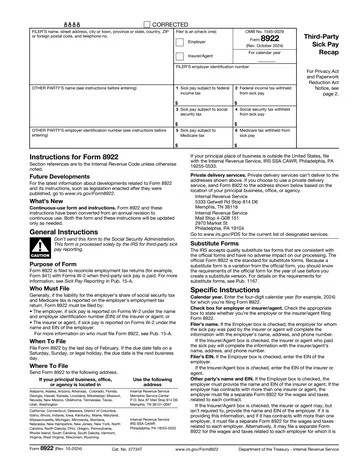
Form 8922 ties the W-2s to the 941s when the tax was split; our Form 8922: Third-Party Sick Pay Recap page goes through it line by line. “Form 8922 is filed to reconcile employment tax returns (for example, Form 941) with Forms W-2 when third-party sick pay is paid.” Who files depends on whose name is on the W-2s: “The employer, if sick pay is reported on Forms W-2 under the name and employer identification number (EIN) of the insurer or agent”, or “The insurer or agent, if sick pay is reported on Forms W-2 under the name and EIN of the employer.” When the liability is shifted and the third party sends the sick pay statement, the employer files the W-2s (Pub. 15-A, section 6), so the state files Form 8922. It lists totals, not names: “Form 8922 doesn’t show the names of individuals who received the third-party sick pay”.
Due date and address: “File Form 8922 by the last day of February. If the due date falls on a Saturday, Sunday, or legal holiday, the due date is the next business day.” The address depends on where the filer's principal business is. Among the paid leave states, a filer in California, Connecticut, Delaware, DC, Maine, Maryland, Massachusetts, Minnesota, New Jersey, New York, Oregon, Rhode Island, Vermont or Virginia sends it to “IRS SSA CAWR” in Philadelphia; one in Colorado, Hawaii or Washington sends it to the Memphis Service Center (Form 8922, Where To File). “Don't send this form to the Social Security Administration.” Get the current Form 8922 (PDF).
Form W-4S
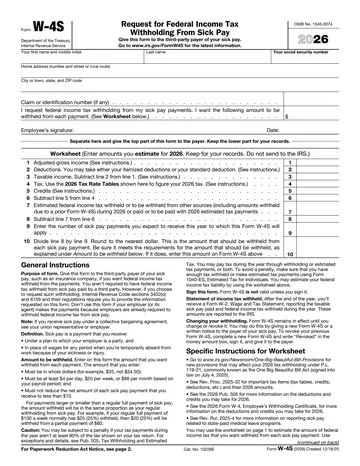
Income tax withholding on third-party sick pay is optional. Sick pay from a third party that is not the employer's agent “is not wages under section 3401(a) and thus is not subject to mandatory income tax withholding under section 3402(a)”; the employee asks for withholding on Form W-4S, given to the payer, not the employer (line by line on our Form W-4S: Request for Federal Income Tax Withholding From Sick Pay page). The form says “Give this form to the third-party payer of your sick pay, such as an insurance company, if you want federal income tax withheld from the payments.” and points to “See Rev. Rul. 2025-4 for more information on reporting sick pay related to state-paid medical leave programs.”
The amount must be in whole dollars and “Must be at least $4 per day, $20 per week, or $88 per month based on your payroll period”, and it “Must not reduce the net amount of each sick pay payment that you receive to less than $10.” The payer withholds on payments made 8 or more days after it gets the form (Pub. 15-A). Employees file the form with the state program, not with payroll; New Jersey's TDI handbook says a federal tax deduction may be made “Upon the claimant's completion of Form W4S”. Link employees to the Form W-4S (PDF).
Six months, wage bases and FUTA
Three limits cut the taxable amount. First, the six-month rule: Social Security, Medicare and FUTA taxes do not apply to “sick pay paid more than 6 calendar months after the last calendar month in which the employee worked” (Pub. 15-A, section 6). Second, the wage bases: sick pay counts toward the yearly limits, and “For 2026, the social security tax wage base limit is $184,500 and the FUTA tax wage base limit is $7,000.” For 2027 the Social Security base is “For earnings in 2027, this base is $192,300.” There is no Medicare wage limit. Third, the part paid for by the employee's after-tax contributions is not taxable sick pay at all.
FUTA applies to the taxable part the same way as Social Security, but only until the employee's wages for the year, sick pay included, reach $7,000; Pub. 15-A's own example has an employee whose regular wages already passed the limit, and “None of the sick pay is subject to FUTA tax.” New Jersey tells employers to direct FUTA questions on the employer-funded part of TDI benefits to the IRS, because “The Division makes no deduction from paid benefits to meet employer FUTA liability.”
When the numbers do not match
Third-party sick pay is a known source of IRS wage reconciliation (CAWR) cases, which compare W-2s with 941s. The IRM says “Discrepancy cases generate when the sick pay Forms W-2 are filed under the employer's EIN but a portion of the Social Security and Medicare taxes and any FIT is reported on the third party's return.” (IRM 4.19.4.2.8) Form 8922 is the document that resolves them: examiners are told “Form 8922 3rd Party Sick Pay Recap may have been filed and input by clerical. Use the amounts reported on the Form 8922.”
The costly mistake is taking the line 8 credit without reporting the wages. For that case the reply procedures say: “third-party sick pay wages are not reported on lines 5a and 5c of the Form 941, but the credit was taken on line 8 of Form 941,” then “assess the sick pay wages and the full tax (12.4 percent for Social Security and 2.9 percent for Medicare) on the employer's account.” (IRM 4.19.4.3.16). Keep the state's sick pay notices and statements with the 941 workpapers, and check the W-2 boxes described on our SDI on the W-2 page. If a CAWR notice or a civil penalty notice arrives, TaxProc covers the steps in the CP215 civil penalty notice and responding to an IRS notice.
Forms, line by line
Questions employers ask
Are state paid medical leave benefits third-party sick pay?
The part funded by the employer's required contributions is, under Rev. Rul. 2025-4 holding 4. The part funded by employee contributions is not. For benefits paid in 2025 and 2026 the IRS does not require the sick pay steps (Notice 2026-6).
Do we have to report state medical leave benefits on Form 941 in 2026?
No. Notice 2026-6 says a state or employer is not required to follow the third-party sick pay withholding, deposit and reporting rules for medical leave benefits a state pays in 2026.
What happens on Jan. 1, 2027?
Unless the IRS extends the relief, the employer-funded part of state medical leave benefits paid from Jan. 1, 2027 is third-party sick pay. If the state withholds and deposits the employee FICA and notifies you, you pay the employer share and FUTA and report the sick pay on Form 941 with a line 8 adjustment.
Who files Form 8922?
The party whose name and EIN are not on the W-2s: the employer if the third party files the W-2s, the third party if the employer files them. It is due by the last day of February.
Does the employer withhold income tax on the benefits?
No. Third-party sick pay from a payer that is not your agent is not subject to mandatory income tax withholding. The employee may ask the payer to withhold by filing Form W-4S with it.
Is family leave paid by the state sick pay?
No. State family leave benefits are taxable income but not wages and not sick pay. The state reports them on Form 1099-G, box 10, and the employer does nothing.
Sources
- IRS: Rev. Rul. 2025-4 (holding 4 and the transition period); Notice 2026-6; Notice 2015-6, Reporting Sick Pay Paid by Third Parties; Pub. 15-A (2026), section 6; Form 941 instructions (Rev. March 2026), lines 2, 3 and 8; Form 8922 (Rev. October 2024); Form W-4S (2026); Instructions for Form 940 (2025)
- Internal Revenue Manual: IRM 4.19.4 (4.19.4.2.8 and 4.19.4.3.16, CAWR) and IRM 21.7.2 (21.7.2.4.2, sick pay)
- Social Security Administration: Contribution and benefit base
- States: Minnesota Paid Leave 2027 employer handout; Maine PFML employer FAQ; DC Paid Family Leave program updates; New Jersey Department of Labor employer handbook, TDI and FLI