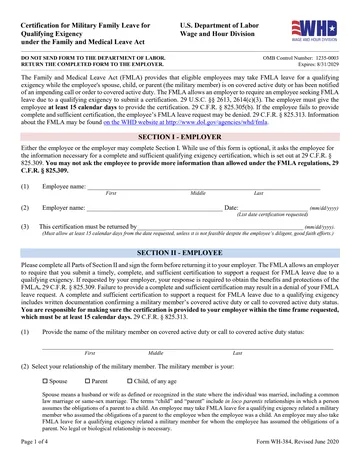
- At a glance
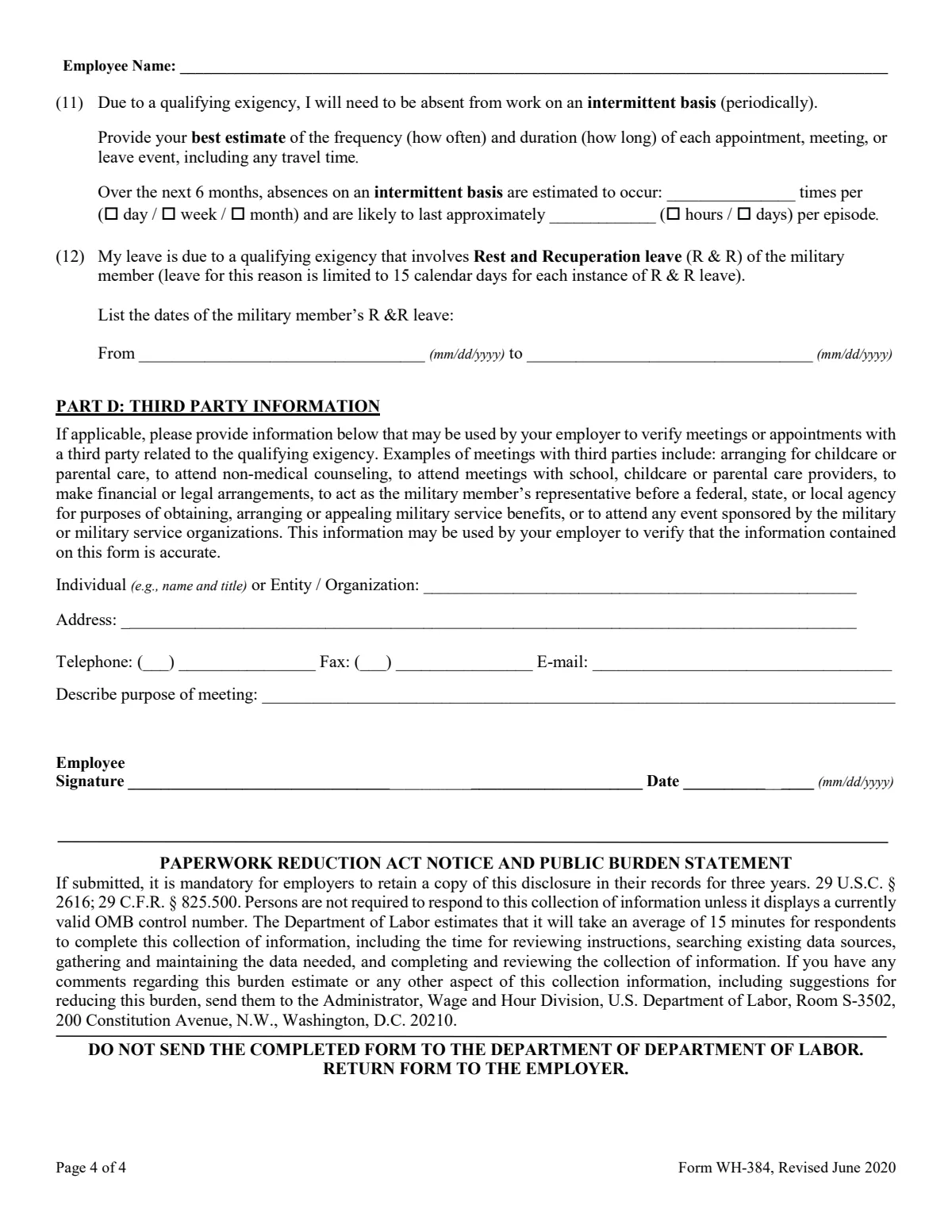
- The form, with hotspots
- Section I: the employer's part
- Section II: the employee and the military member
- Part A: covered active duty status
- Part B: the qualifying exigency
- Part C: amount of leave needed
- Part D: third party information
- Rules that matter
- How it connects
- Questions employers ask
- Sources
- Who fills it in
- Employer (Section I), employee
- Due
- At least 15 calendar days after you ask
- Returned to
- The employer; never the DOL
- Form revision
- Revised June 2020 (expires 8/31/2029)
- Pages
- 4
At a glance
Form WH-384, Certification for Military Family Leave for Qualifying Exigency under the Family and Medical Leave Act, supports FMLA leave for a qualifying exigency arising from the covered active duty of the employee's spouse, child or parent. There is no health care provider: the employee certifies the facts and signs.
- Who fills it in. You (or the employee) complete Section I; the employee completes all of Section II and signs.
- When. When you require certification; at least 15 calendar days to return it (29 CFR 825.305(b))29 CFR 825.305Code of Federal Regulations, eCFR.
- How it is returned. The form says “RETURN THE COMPLETED FORM TO THE EMPLOYER.” Never to the Department of Labor.
- Form. Form WH-384 (Revised June 2020, OMB Control Number 1235-0003, expires 8/31/2029), four pages; a Spanish version is on the DOL's FMLA forms page.
Form WH-384 (Revised June 2020); 29 CFR 825.12629 CFR 825.126Code of Federal Regulations, eCFR and 825.309.
Tap a box once for its note, again to jump to the line. Zoom in to read the small print.
Section I: the employer's part
| Line | Label | What goes there |
|---|---|---|
| I-1 | (1) Employee name: First, Middle, Last | Either party may complete Section I, but you may not ask for more than 29 CFR 825.30929 CFR 825.309Code of Federal Regulations, eCFR allows. |
| I-2 | (2) Employer name; Date: (List date certification requested) | The 15-day return period runs from this date. |
| I-3 | (3) This certification must be returned by (mm/dd/yyyy) | At least 15 calendar days, unless not feasible despite the employee's diligent, good faith efforts (29 CFR 825.305(b))29 CFR 825.305Code of Federal Regulations, eCFR. |
Section II: the employee and the military member
| Line | Label | What goes there |
|---|---|---|
| 1 | (1) Provide the name of the military member on covered active duty or call to covered active duty status: First, Middle, Last | The military member, not the employee. |
| 2 | (2) Select your relationship of the military member. The military member is your: Spouse; Parent; Child, of any age | For exigency leave the child may be any age, and in loco parentis counts both ways. You may ask for a simple statement or documents confirming the relationship (29 CFR 825.122(k))29 CFR 825.122Code of Federal Regulations, eCFR. |
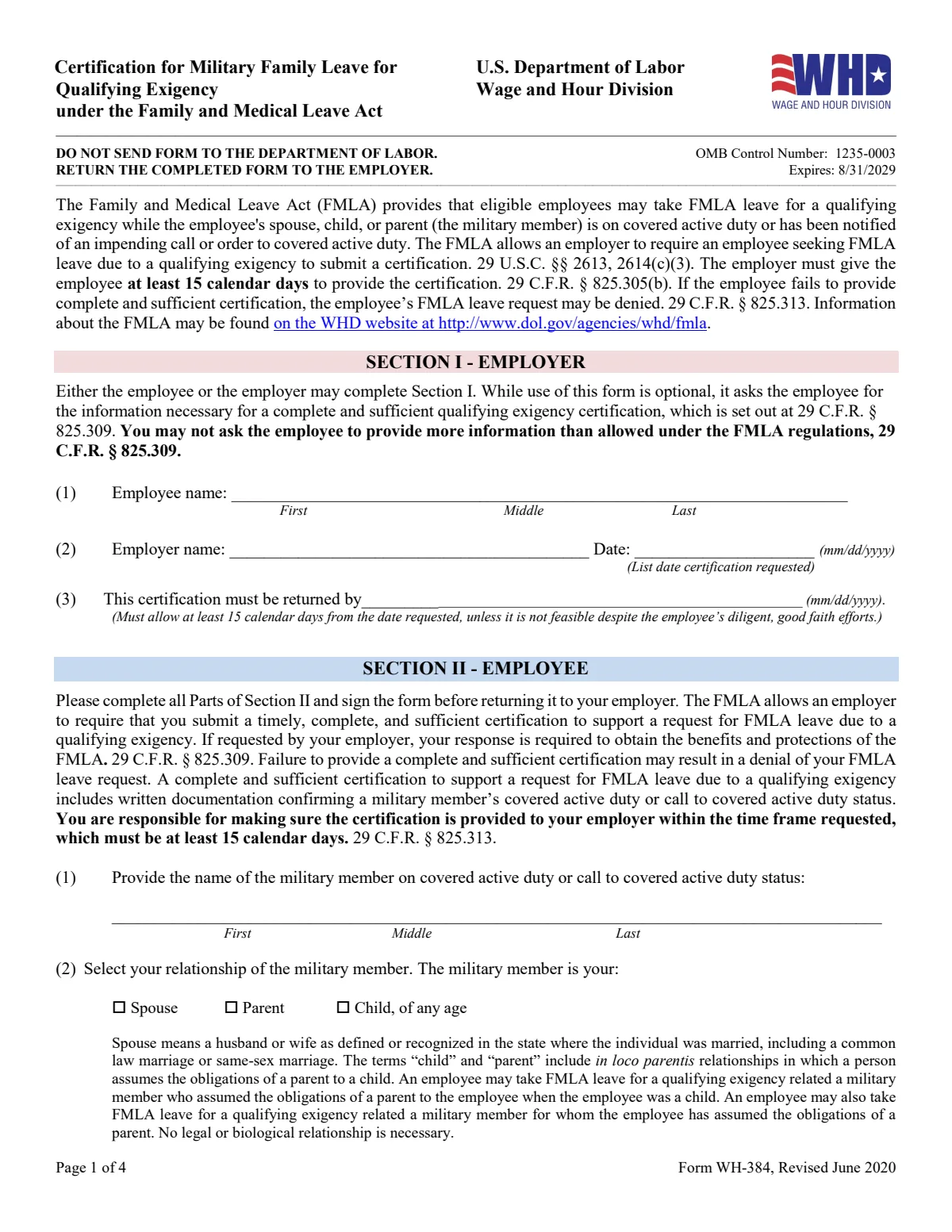
Part A: covered active duty status
Part A proves the deployment. The form prints the legal definition: duty during deployment to a foreign country, and for the Reserve components, under a federal call to active duty in support of a contingency operation (10 U.S.C. 101(a)(13)(B))10 U.S.C. 101United States Code, Cornell LII.
| Line | Label | What goes there |
|---|---|---|
| EN | Employee Name: | The employee's name. |
| 3 | (3) Provide the dates of the military member's covered active duty service: | Covered active duty means deployment to a foreign country: “Deployment of the member with the Armed Forces to a foreign country means deployment to areas outside of the United States, the District of Columbia, or any Territory or possession of the United States, including international waters.” For a reservist it must be a federal call in support of a contingency operation; “State calls to active duty are not covered unless under order of the President of the United States”. |
| 4 | (4) Please check one of the following and attach the indicated written document: A copy of the military member's covered active duty orders; Other documentation from the military...; I have previously provided my employer with sufficient written documentation | You may ask for the orders the first time. The form's rule: “This information need only be provided to the employer once, unless additional leave is needed for a different military member or different deployment.” |
Part B: the qualifying exigency
Part B names the event. Each category is defined in 29 CFR 825.126(b)29 CFR 825.126Code of Federal Regulations, eCFR, and several carry their own limits on time or on who counts.
| Line | Label | What goes there |
|---|---|---|
| 5 | (5) Select the appropriate Qualifying Exigency Category and, if needed, provide additional information related to the event: | One box per request. The nine categories below come from the regulation, each with its own limits. |
| 5-short | Short notice deployment (i.e., deployment within seven or fewer days of notice) | The limit: “Leave taken for this purpose can be used for a period of seven calendar days beginning on the date the military member is notified of an impending call or order to covered active duty”. |
| 5-events | Military events and related activities (e.g., official ceremonies or events, or family support and assistance programs) | Events sponsored by the military, military service organizations or the American Red Cross that relate to the deployment. |
| 5-childcare | Childcare related activities for the child of the military member (e.g., arranging for alternative childcare) | The child is the military member's child under 18 (or older and incapable of self-care). Routine, everyday childcare does not qualify. |
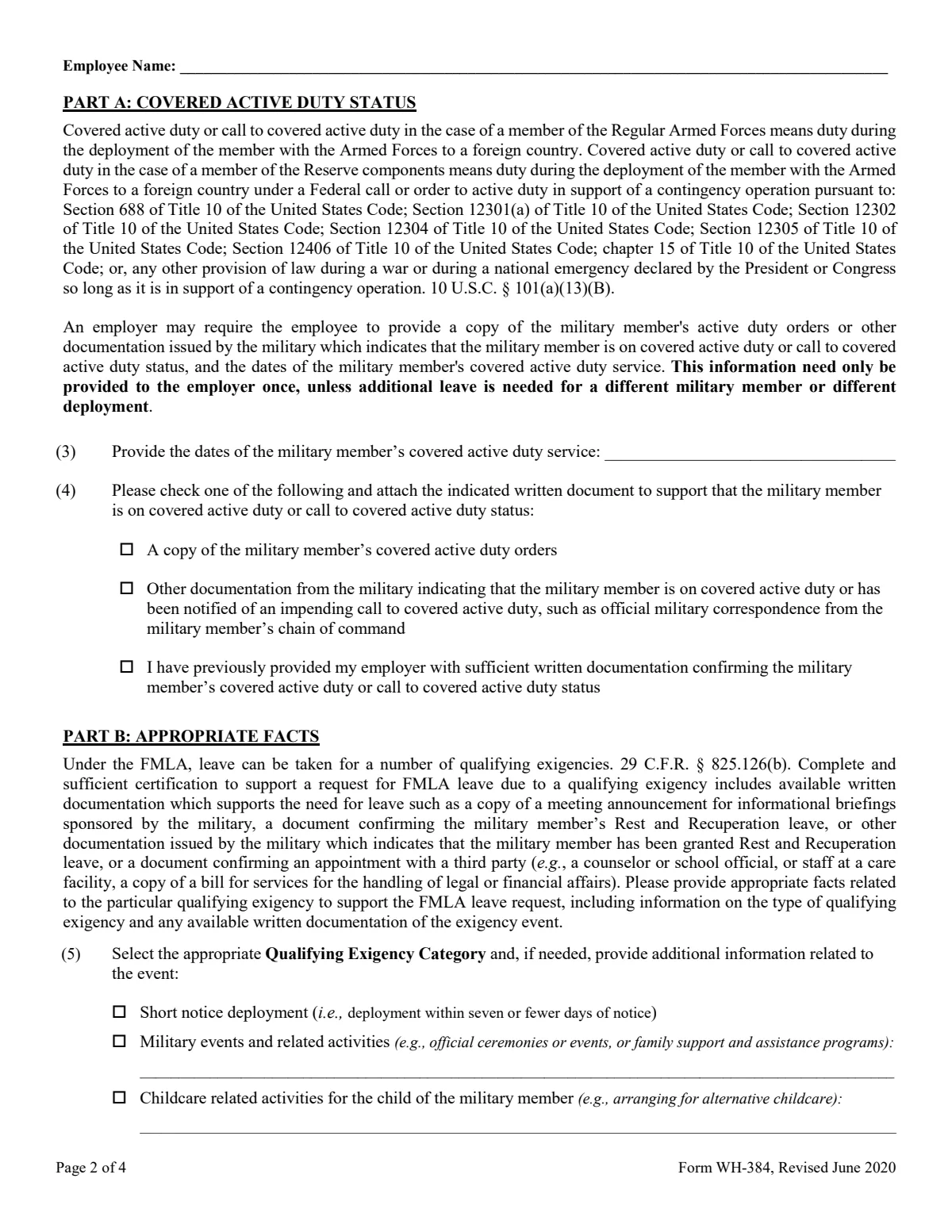
| 5-parent | Care for the military member's parent (e.g., admitting or transferring the parent to a new care facility) | The parent must be incapable of self-care, which means needing “active assistance or supervision to provide daily self-care in three or more of the activities of daily living or instrumental activities of daily living”. |
| 5-financial | Financial and legal arrangements related to the deployment (e.g., obtaining military identification cards) | Includes acting as the member's representative on military service benefits during the deployment and for 90 days after it ends (29 CFR 825.126(b)(4))29 CFR 825.126Code of Federal Regulations, eCFR. |
| 5-counseling | Counseling related to the deployment (i.e., counseling provided by someone other than a health care provider) | For the employee, the military member or the member's child. Counseling by a health care provider is a different FMLA reason. |
| 5-rr | Military member's short-term, temporary Rest and Recuperation leave (R&R) (leave for this reason is limited to 15 calendar days for each instance of R&R) | The regulation's limit: leave “can be used for a period of 15 calendar days beginning on the date the military member commences each instance of Rest and Recuperation leave”. Question 12 asks for the R and R dates. |
| 5-post | Post deployment activities (e.g., arrival ceremonies, or reintegration briefings and events) | Within 90 days after covered active duty ends, plus issues arising from the member's death on duty. |
| 5-other | Any other event that the employee and employer agree is a qualifying exigency | Both sides must agree: the regulation allows it “provided that the employer and employee agree that such leave shall qualify as an exigency, and agree to both the timing and duration of such leave”. |
| 6 | (6) Available written documentation supporting this request for leave is (attached / not attached / not available). | A meeting notice, R and R orders, an appointment confirmation or a bill. Not available is a permitted answer; the employee's signed statement of facts is the core of the certification (29 CFR 825.309(b)(1))29 CFR 825.309Code of Federal Regulations, eCFR. |
Part C: amount of leave needed
The employee's own estimates. The form asks for specifics: “terms such as ‘unknown’ or ‘indeterminate’ may not be sufficient to determine FMLA coverage.”
| Line | Label | What goes there |
|---|---|---|
| 7 | (7) List the approximate date exigency started or will start | An approximate date is enough. |
| 8 | (8) Provide your best estimate of how long the exigency lasted or will last: From ... to ... | The employee's best estimate. The form warns that answers such as unknown or indeterminate may not be enough. |
| 9 | (9) Due to a qualifying exigency, I need to work a reduced schedule. | Only the hours not worked count against the 12 weeks. |
| 10 | (10) Due to a qualifying exigency, I will need to be absent from work for a continuous period of time. | For a single block of leave, the regulation asks for the beginning and end dates (29 CFR 825.309(b)(3))29 CFR 825.309Code of Federal Regulations, eCFR. |
| 11 | (11) Due to a qualifying exigency, I will need to be absent from work on an intermittent basis (periodically). | Frequency and duration of each appointment, meeting or event, including travel time. |
| 12 | (12) My leave is due to a qualifying exigency that involves Rest and Recuperation leave (R & R) of the military member. List the dates of the military member's R &R leave: From ... to ... | R and R leave runs up to 15 calendar days from the start of each instance; you may ask for a copy of the R and R orders (29 CFR 825.309(b)(6))29 CFR 825.309Code of Federal Regulations, eCFR. |
Part D: third party information
| Line | Label | What goes there |
|---|---|---|
| D | Individual (e.g., name and title) or Entity / Organization; Address; Telephone; Fax; E-mail; Describe purpose of meeting | If the exigency is a meeting, you may check it with the third party, but only the meeting: “The employee's permission is not required in order to verify meetings or appointments with third parties, but no additional information may be requested by the employer.” |
| Sig | Employee Signature; Date (mm/dd/yyyy) | The employee's signature makes the statement of facts the regulation requires. |
Rules that matter
- Ask only for what 29 CFR 825.30929 CFR 825.309Code of Federal Regulations, eCFR lists. With a complete and sufficient certification, you may not ask the employee for more. You may verify a third-party meeting, and you may ask the Department of Defense to confirm the member's covered active duty status, without the employee's permission.
- No recertification. “Recertification does not apply to leave taken for a qualifying exigency or to care for a covered servicemember.”
- No medical opinion to test. The second and third opinion process in 29 CFR 825.30729 CFR 825.307Code of Federal Regulations, eCFR is written for medical certifications of a serious health condition, and this form has no health care provider.
- Orders once per deployment. Ask again only for a different military member or a different deployment.
- Same 12 weeks. Exigency leave shares the 12-week entitlement with the other FMLA reasons; only military caregiver leave has 26 weeks.
- Records. Keep the certification for three years (29 CFR 825.500)29 CFR 825.500Code of Federal Regulations, eCFR.
State paid leave programs set their own list of covered reasons, so whether a state also pays benefits for an exigency depends on the program; check the program page for each state you run payroll in, starting from paid family leave by state.
How it connects
- The notice that asks for this form: WH-381 (Section II, Qualifying Exigency). The decision after it: WH-382.
- Care for an injured or ill servicemember is a different reason with 26 weeks: WH-385 and WH-385-V. All the DOL forms: FMLA forms.
- How FMLA leave and state leave run together: FMLA and state paid leave.
Questions employers ask
Who fills in Form WH-384?
The employee, who signs it. You (or the employee) fill in Section I. No doctor is involved.
Can we ask for a copy of the military orders?
Yes, the first time the employee asks for exigency leave for that deployment. After that, only for a different military member or a different deployment.
Does a National Guard call-up by the governor qualify?
No. A state call to active duty is not covered unless it is under an order of the President under one of the federal provisions listed in the regulation, and the duty must be a deployment to a foreign country.
How long can an employee take for Rest and Recuperation leave?
Up to 15 calendar days for each instance of the military member's R and R, starting on the date the R and R begins.
Can we call the school or the counselor to check?
Yes, to verify the meeting or appointment and its nature, without the employee's permission. You may not ask the third party for anything else.
Sources
- Form WH-384, Certification for Military Family Leave for Qualifying Exigency (Revised June 2020), DOL Wage and Hour Division; FMLA: Forms
- 29 CFR part 825, eCFR text current as of Nov. 1, 2026: 825.122(k), 825.126, 825.305, 825.309, 825.313, 825.500