Colorado drops to 0.86%, New Jersey worker TDI and FLI go to 0.24% each, and Maryland starts at 0.9%.
From the agencies' pages, the statutes and IRS Notice 2026-6, quoted below.
Rate changes on Jan. 1, 2027
Five programs change their rate for wages paid from Jan. 1, 2027, and Maryland adds a new one. California: “The SDI withholding rate for 2027 is 1.4 percent.” New York: “The 2027 Paid Family Leave rate will be set at 0.452% of an employee's wages each pay period”, “annual maximum employee contribution of $451.81”; DFS says the rate “shall be increased by +4.55% as compared to the premium rate applicable for calendar year 2026”. Washington: “STARTING JAN. 1, 2027: The premium rate will be 1.2%.” Colorado goes the other way: “the premium rate will drop from 0.88% in 2026 to 0.86% starting in 2027”, and the CDLE adds that it is “the first to be set administratively by the FAMLI Division”. New Jersey's worker rates rise to 0.24% for TDI and 0.24% for FLI, from the NJDOL rate table for “January 1, 2027 to December 31, 2027”; the employer's own TDI rate does not change in January, because “Unemployment and Temporary Disability contribution rates in New Jersey are assigned on a fiscal year basis (July 1st to June 30).”
Most programs hold their rates. Minnesota: “For 2027, the rate will stay at 0.88% of covered wages, and 0.66% for Paid Leave small employers.” Connecticut: “The CT Paid Leave Board of Directors has voted to maintain the contribution rate at 0.5% for 2027.” Oregon: “The 2027 Paid Leave contribution rate is 1% of subject wages up to $192,300”. DC's 0.75% is set by statute and DOES lists the contribution as “No change. Leave remains fully employer-funded with no payroll deductions from workers.” Delaware's rates “will automatically renew at the same rates as stated in the Act” unless the Division amends them. Massachusetts keeps 0.88% (0.46% under 25 covered individuals) but moves the shares, below. Rhode Island's 2027 TDI rate and Hawaii's 2027 weekly cap had not been posted as of Nov. 22, 2026.
| Program | 2026 | 2027 | Change | 2027 wage base | Source |
|---|---|---|---|---|---|
| California SDI (DI and PFL) | 1.3% of all wages (SDI, withheld from employees) | 1.4% of all wages (SDI) | Up | No cap: all wages are subject to SDI | edd.ca.gov |
| Colorado FAMLI | 0.88% of wages | 0.86% of wages (set by the FAMLI Division) | Down | $192,300 (SSA base; FAMLI's calculator says $190,200) | cdle.colorado.gov |
| New Jersey TDI and FLI | Worker TDI 0.19%, FLI 0.23%; employer TDI 0.10% to 0.75% | Worker TDI 0.24%, FLI 0.24%; employer TDI by rate notice | Up (worker rates) | $177,100 (worker TDI and FLI); $46,400 (employer TDI) | nj.gov |
| New York PFL and DBL | PFL 0.432% (max $411.91 a year); DBL up to $0.60 a week | PFL 0.452% (max $451.81 a year); DBL up to $0.60 a week | Up (PFL) | PFL: contributions stop at $451.81 a year | dfs.ny.gov |
| Washington Paid Family and Medical Leave | 1.13% of wages up to $184,500 | 1.2% of wages | Up, new split | $192,300 (Social Security cap) | paidleave.wa.gov |
| Maryland FAMLI | None: contributions start Jan. 1, 2027 | 0.9% of wages | New program | $192,300 (Social Security base) | paidleave.maryland.gov |
| Massachusetts PFML | 0.88% of wages (25 or more covered individuals); 0.46% under 25 | 0.88% of wages (25 or more covered individuals); 0.46% under 25 | Same total, new split | $192,300 (Social Security base) | mass.gov |
| CT Paid Leave | 0.5% of wages (employee contribution) | 0.5% of wages (employee contribution) | No change | $192,300 (Social Security base) | ctpaidleave.org |
| DC Paid Family Leave | 0.75% of wages (employer only) | 0.75% of wages (D.C. Code 32-541.03; no 2027 table posted) | No change | No cap: total gross wages | code.dccouncil.gov |
| Delaware Paid Leave | 0.8% of wages (medical 0.40, family 0.08, parental 0.32) | 0.8% of wages (rates renew; no 2027 change published) | No change published | $192,300 (Social Security base) | laborfiles.delaware.gov |
| Maine PFML | 1% of wages (15 or more employees); 0.5% under 15 | 1% of wages (15 or more employees); 0.5% under 15 | No change | $192,300 (Social Security base) | maine.gov |
| Minnesota Paid Leave | 0.88% of wages (small employer 0.66%) | 0.88% of wages (small employer 0.66%) | No change | $192,300 (Social Security base) | pl.mn.gov |
| Paid Leave Oregon | 1% of wages up to $184,500 | 1% of wages up to $192,300 | No change in rate | $192,300 (Social Security base) | oregon.gov |
| Rhode Island TDI and TCI | 1.1% of wages up to $100,000 (employee only) | Not listed | Not posted | At least $100,000 (formula in R.I. Gen. Laws 28-40-1) | dlt.ri.gov |
| Hawaii TDI | Employee share up to 0.5% of weekly wages, max $7.50 a week | Employee share up to 0.5% (2027 weekly maximum not yet published) | Weekly cap not posted | Not listed | capitol.hawaii.gov |
| Puerto Rico SINOT | 0.60% of wages up to $9,000 a year (DTRH; no year stated) | 0.60% of wages up to $9,000 a year (no change published) | No change published | $9,000 a year | trabajo.pr.gov |
| Virginia Paid Family and Medical Leave | None: contributions start by Apr. 1, 2028 | None: the 2028 rate is to be fixed by Oct. 1, 2027 | Rate due by Oct. 1, 2027 | Not listed | Va. Acts 2026, ch. 1093 |
Each figure in the table is the state's own, linked in the source column; the same rates with their effective dates are on PFML rates by state, and our contribution calculator applies them to a paycheck. Remember that a missed deduction usually cannot be made up later: Washington's ESD says “Remember, you cannot retroactively withhold premiums from employees.”
The 2027 wage base
Most programs stop at the Social Security base, which the Social Security Administration has set: “For earnings in 2027, this base is $192,300.” For 2026 it was “2026 184,500”. That base is the 2027 cap in Colorado, Connecticut, Delaware, Maine, Maryland, Massachusetts, Minnesota, Oregon and Washington. California and DC have no cap. New Jersey sets its own: $177,100 for worker TDI and FLI and $46,400 for employer TDI. Rhode Island's base is at least $100,000 by statute; Puerto Rico's stays $9,000.
One agency page disagrees with SSA. Colorado's calculator says “Premiums are paid on wages up to the Federal Social Security Wage Cap, which is $190,200 for earnings in 2027.” The same sentence ties the cap to the Social Security base, and SSA's published base is $192,300, so the SSA figure governs; the $190,200 reads as an error on that page (as of Nov. 22, 2026). Payroll systems set to $190,200 would stop Colorado premiums $2,100 of wages early.
New splits in Massachusetts and Washington
Two states rearranged their premiums for 2027 because of the federal ruling on medical leave benefits. Massachusetts: “New Massachusetts legislation (Chapter 101 of the Acts of 2026) shifts employer contributions from medical leave to family leave, effective January 1, 2027.” Chapter 101 was “Approved, June 12, 2026.”, and DFML explains why: “This legislation mitigates the impact of IRS Revenue Ruling 2025-4”. The total stays 0.88% for employers with 25 or more covered individuals, and the employee still pays at most 0.46%, but the employer's 0.42% moves from medical leave to family leave:
| Year | Family leave share | Medical leave share |
|---|---|---|
| 2026 | “Up to 100% of the family leave contribution can be withheld from a covered individual's wages (0.18% of eligible wages).” | “Up to 40% of the medical leave contribution can be withheld from a covered individual's wages (0.28% of eligible wages). Employers are responsible for contributing the remaining 60% (0.42% of eligible wages).” |
| 2027 | “Up to 40% of the family leave contribution can be withheld from a covered individual's wages (0.28% of eligible wages). Employers with 25 or more covered individuals are responsible for contributing the remaining 60% (0.42% of eligible wages).” | “Up to 100% of the medical leave contribution can be withheld from a covered individual's wages (0.18% of eligible wages).” |
Washington's total split moves to 70.7% employee and 29.3% employer: “Employers will pay 29.3% of the total premium and employees will pay 70.7%.” 2SHB 2345 then “modifies the distribution of employer and employee contributions between family and medical leave premiums without affecting how the total premium is divided between employees and employers”. ESD says it “takes effect Jan. 1, 2027”; the session law carries “EFFECTIVE DATE: June 11, 2026”. Both are right in practice: the text has been law since June 2026 and ESD applies it to the 2027 premium year. ESD gives the purpose: “This change will avoid unintended employer or state payroll tax liability associated with medical leave benefits financed through employer contributions”. Details are on the Massachusetts PFML and Washington Paid Family Leave pages.
Maryland starts; Virginia next
Maryland FAMLI contributions begin with the first 2027 paycheck. “MD Labor set the initial contribution rate at 0.9% of wages up to the Social Security wage cap.” “The contribution amount is split equally between employers and employees (0.45% each).” “This rate will apply to wages paid from January 1, 2027 through December 31, 2027.” Employers with fewer than 15 employees “are only responsible for remitting 50% of the contribution rate”, the employee half. Employers register with FAMLI and submit the quarterly wage and hour report online; the first report and payment “will be due April 30, 2027”. “Private plan applications will be due October 1, 2027.” The 2028 rate is announced in the fall: “Starting November 2027, MD Labor will announce the contribution rate for the following calendar year.” The full employer guide is on the Maryland FAMLI page.
Virginia has nothing to file in 2027, but its first rate is due that year: “No later than October 1, 2027, and annually thereafter, the Commissioner shall fix the contribution rate”. Contributions start by April 1, 2028 and claims by Dec. 1, 2028 (Virginia Paid Family and Medical Leave).
The federal tax change
The largest change for payroll is federal. Rev. Rul. 2025-4 holds that the part of a state medical leave benefit funded by employer contributions is wages and that such benefits “are third-party payments of sick pay”. The IRS gave states and employers a transition period, and Notice 2026-6 extended it after “A number of States with PFML statutes requested that the transition period in Revenue Ruling 2025-4 be extended for an additional year”. The extension covers one year: “This notice is effective for medical leave benefits paid from States to individuals during calendar year 2026.” No notice extending it to 2027 had been found as of Nov. 22, 2026. The relief for employer pick-ups ended earlier: Notice 2026-6 “does not extend the third component of the transition relief announced in Revenue Ruling 2025-4 to an employer pick-up for calendar year 2026”.
The states are telling employers what that means. Minnesota: “Starting January 1, 2027, the IRS will require employers to pay payroll taxes when an employee takes Medical Leave.” The taxable part is “50 percent of the Medical Leave payment for large employers” and “33 percent of the Medical Leave payment for Paid Leave small employers”; “Employers pay their share of FICA taxes, and all FUTA taxes if applicable, directly to the IRS” (DEED's employer handout). DC: “Starting January 1, 2027, DC Paid Family Leave Medical Leave benefits are treated as third-party sick pay under IRS Revenue Ruling 2025-4.” “That makes them subject to Social Security and Medicare (FICA) taxes.” Maine is taking the work on itself: “Starting in tax year 2027, the Department will assume this responsibility and associated costs during the initial phase of the program to reduce complexity in the tax treatment of benefits.” Family leave benefits are taxable income but, in the ruling's words, “these amounts are not wages for Federal employment tax purposes”, so this is a medical leave change only. Our pages on third-party sick pay and whether paid family leave is taxable cover Forms 941, W-2 and 8922.
Benefit and rule changes
New York adds an eligibility rule for construction workers: “Beginning January 1, 2027, there is a new eligibility standard for construction employees”, who qualify “if they were in employment and worked the employer's normal work week for at least 26 of the last 39 weeks with any covered employer under a collective bargaining agreement”. The rules are not final: “There are currently proposed regulations open for public comment and the Board is updating the necessary forms and guidance.” Contractors on public works can read it with their New York prevailing wage duties.
Maximum benefits rise with wages: “The maximum weekly benefit for 2027 is $1,287.91.” (New York PFL); “For 2027, this maximum benefit amount is $1,284.61.” (Massachusetts); “2027 Maximum Temporary Disability Insurance weekly benefit rate: $1,158” (New Jersey). Rhode Island's TDI benefit rate is “for benefit years beginning on or after January 1, 2027, and prior to January 1, 2028, five and thirty-eight hundredths percent (5.38%)” of high-quarter wages (R.I. Gen. Laws 28-41-5). DC cut its leave weeks earlier: “These updates take effect October 1, 2026, and affect the number of weeks available under Medical Leave and Family Leave.” Washington's job protection reaches more employers: RCW 50A.35.010 covers employers with “15 or more employees beginning January 1, 2027, until December 31, 2027”, then “Eight or more employees beginning January 1, 2028, and thereafter”.
Local payroll tax changes
Two local changes land on the same date. “The Michigan Department of Treasury will begin administering Flint city income taxes beginning January 1, 2027.” Withholding changes with it: “How often you send a return will change from quarterly to monthly filing.” and “The first monthly tax return on this new schedule is January 2027 and the due date is February 16, 2027 (because February 15, 2027 is a state holiday).” Employers file and pay in Michigan Treasury eServices. In Oregon, Multnomah County put off its Preschool for All increase: “This amended resolution delays a .8% increase in the tax by one year so that instead of increasing on Jan. 1, 2027, the tax will increase on Jan. 1, 2028.” The local pages, including Michigan city income taxes and Metro SHS and Multnomah PFA, are part of the local payroll taxes section.
The January checklist
For a payroll department, the year-end work comes down to six steps, each drawn from the changes above:
- Update each program's rate and employee share for wages paid on and after Jan. 1, 2027 (the table above), and the wage cap to $192,300 where the program follows Social Security.
- Massachusetts and Washington: change the family and medical leave allocation as well as the totals; the employee maximum stays 0.46% of wages in Massachusetts and becomes 70.7% of the premium in Washington.
- Maryland: register, give the employee notice, and start the deduction from the first 2027 pay period; the first report and payment are due April 30, 2027.
- Hang the new year's posters where the state has issued one: Massachusetts 2027 poster and Washington 2027 poster; give each program's written notices (the program pages list them).
- Plan for state medical leave benefits as third-party sick pay from Jan. 1, 2027 unless the IRS extends Notice 2026-6, and watch each state's instructions (Minnesota, DC and Maine have published theirs).
- Local taxes: Flint withholding moves to monthly returns with Michigan Treasury; the Multnomah County PFA increase is delayed to 2028.
Tools and templates for this topic
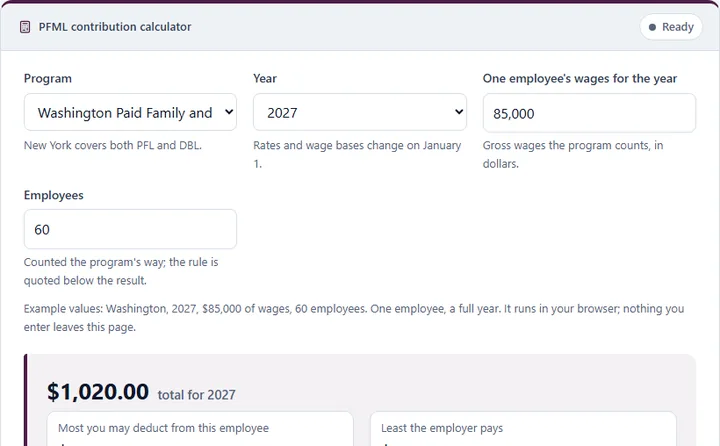
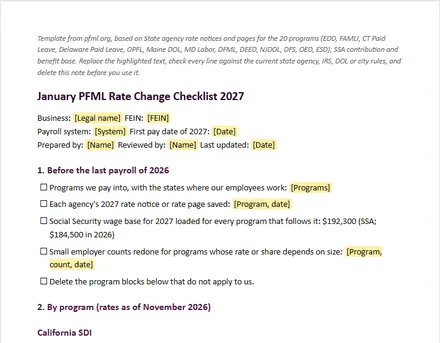
January rate change checklist
Load every state paid leave program's 2027 rate, wage base and split before the first payroll of the year, with the effective date and the notice each program asks for.
Questions employers ask
What is the 2027 wage base for paid family leave?
In most programs it is the Social Security base, $192,300 for 2027 (Colorado, Connecticut, Delaware, Maine, Maryland, Massachusetts, Minnesota, Oregon and Washington). California and DC have no cap; New Jersey uses $177,100 for worker TDI and FLI; Rhode Island's base is at least $100,000; Puerto Rico's is $9,000.
Which PFML rates go up in 2027?
California SDI (1.3% to 1.4%), New York PFL (0.432% to 0.452%), Washington (1.13% to 1.2%) and New Jersey's worker TDI and FLI (to 0.24% each). Colorado goes down, from 0.88% to 0.86%. Maryland starts at 0.9%. Rhode Island's 2027 rate was not posted as of Nov. 22, 2026.
Does the Massachusetts change raise what employees pay?
No. The total stays 0.88% for employers with 25 or more covered individuals and the employee share stays at most 0.46% of wages. What moves is the allocation: from 2027 the employer's share funds family leave rather than medical leave.
Will state medical leave benefits be subject to FICA in 2027?
Unless the IRS extends Notice 2026-6, yes for the part funded by employer contributions, which Rev. Rul. 2025-4 treats as third-party sick pay. Minnesota, DC and Maine have told employers how they will handle it; check each state's instructions.
What does a Maryland employer need to do before January?
Register with FAMLI, give employees the required notice, and set up a 0.45% employee deduction (and the 0.45% employer share at 15 or more employees) for wages paid from Jan. 1, 2027. The first quarterly report and payment are due April 30, 2027.
Sources
- Rates: California EDD Rates and withholding; NJDOL Rate information; NY DFS 2027 PFL rate decision; Washington ESD Paid Family and Medical Leave employer pages and 2SHB 2345; Colorado CDLE release and FAMLI calculator; Minnesota DEED employer page; CT Paid Leave contributions; Oregon OED current rates; DC program updates; Delaware Paid Leave regulations
- Massachusetts DFML Contribution rates and private plan requirements; Chapter 101 of the Acts of 2026; Maryland Make contributions, Understand your plan, 8.3-601; Virginia 2026 Acts, Chapter 1093
- Social Security Administration: Contribution and benefit base; IRS: Rev. Rul. 2025-4, Notice 2026-6; Minnesota DEED 2027 employer handout; Maine PFML employer FAQ
- New York PFL updates for 2027; RCW 50A.35.010; R.I. Gen. Laws 28-41-5; Michigan Treasury Flint business tax changes; Multnomah County Preschool for All delay