Counted from the tables below. California's 1.4% is larger but is the whole SDI contribution, on all wages.
How to read the tables
Each row is one program, in order by state; the name opens the withholding or coverage section of the program's own page. Each cell links to the agency page, rule or statute that states it. "Not listed" means no saved agency source gave the fact as of Nov. 22, 2026. The rates themselves, with their wage bases, are on the PFML rates page; this page is about who pays them.
The split is the part of a paid leave contribution that the employer may take from pay. Every program sets a ceiling on the employee's part, and none requires an employer to take all of it: Colorado says “It is important to know employees are never required to pay more than 50% of the total premium.” The employer may always pay more. Washington's statute: “An employer may elect to pay all or any portion of the employee's share of the premium”. Oregon's says the same: “an employer may elect to pay the required employee contributions, in whole or in part, as an employer-offered benefit”. What an employer may not do is take more than the ceiling, or skip a payday and collect it later where the program forbids it.
Built from the rules in the tables on this page.
Who pays: the 2026 and 2027 split
As of Nov. 22, 2026. The 2027 column applies to wages paid from Jan. 1, 2027.
Two programs change how the cost is divided on Jan. 1, 2027. Washington's shares move a little toward the employer: “Employers will pay 29.3% of the total premium and employees will pay 70.7%.” ESD gives the arithmetic as “Total premium x .707 = maximum employee share. Total premium x .293 = minimum employer share.” Massachusetts keeps the totals but swaps which leave the employer funds: for 2027, employers with 25 or more covered individuals “are responsible for a minimum of 60% of the family leave contribution (.42% of wages)”, where in 2026 the 0.42% was 60% of the medical contribution. The employee still pays at most 0.46%. Colorado's total falls to 0.86%, so each half becomes “with 0.43% paid by the employer and 0.43% paid by the employee”. Maryland starts: “The contribution amount is split equally between employers and employees (0.45% each).”
The Washington and Massachusetts changes come from the federal ruling on state paid leave, which treats medical leave benefits funded by employer contributions as third-party sick pay. Washington's statute now lets employers take the whole medical premium from pay, “without affecting how the total premium is divided between employees and employers”. The tax reasons are on the is paid family leave taxable page.
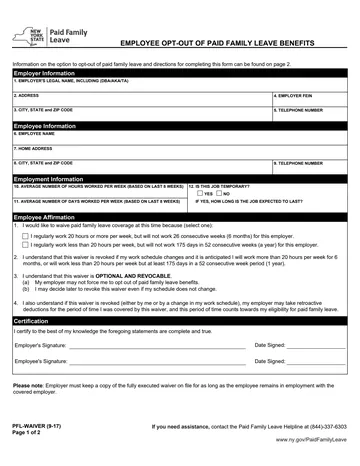
Four programs put the whole cost on employees. California's SDI, Connecticut's 0.5%, Rhode Island's TDI and New Jersey's worker TDI and FLI are withheld only from pay; New Jersey adds an employer TDI contribution on a separate, lower base. New York lets the employer take all of the PFL premium from pay: “No employer shall be required to fund any portion of the family leave benefit.” DC is the reverse: “The Paid Family Leave tax is 100% employer-funded and may not be deducted from a worker's paycheck.” New Hampshire and Vermont leave the split to the employer that buys a plan, and Hawaii and New York DBL cap only what may be taken from pay toward a policy the employer buys.
The 2027 employee maximum in dollars
The table applies each program's 2027 employee maximum to $60,000 of wages and to the wages at its 2027 cap (our arithmetic from the quoted percentages and bases). Most programs stop at the Social Security base, “For earnings in 2027, this base is $192,300.” New Jersey's worker base is $177,100 and Puerto Rico's is $9,000; New York caps the PFL contribution at $451.81 a year instead of capping wages.
| Program | Employee maximum | On $60,000 | At the cap |
|---|---|---|---|
| California SDI (DI and PFL) | 1.4% | $840.00 | No cap: $3,500.00 on $250,000 |
| Colorado FAMLI | 0.43% | $258.00 | $826.89 at $192,300 |
| CT Paid Leave | 0.5% | $300.00 | $961.50 at $192,300 |
| Delaware Paid Leave | 0.4% | $240.00 | $769.20 at $192,300 |
| Maine PFML | 0.5% | $300.00 | $961.50 at $192,300 |
| Maryland FAMLI | 0.45% | $270.00 | $865.35 at $192,300 |
| Massachusetts PFML | 0.46% | $276.00 | $884.58 at $192,300 |
| Minnesota Paid Leave | 0.44% | $264.00 | $846.12 at $192,300 |
| New Jersey TDI and FLI | 0.48% | $288.00 | $850.08 at $177,100 |
| New York Paid Family Leave | 0.452% | $271.20 | $451.81 a year, reached at $99,957.96 of wages |
| Paid Leave Oregon | 0.6% | $360.00 | $1,153.80 at $192,300 |
| Puerto Rico SINOT | 0.3% | $27.00 | $27.00 at $9,000 |
| Washington Paid Family and Medical Leave | 0.8484% | $509.04 | $1,631.47 at $192,300 |
A payroll system should stop the deduction at the cap for each employer separately. Connecticut says each employer keeps “remitting the contributions until the employee reaches the Social Security contribution limit with that employer”, so an employee with two jobs can pay twice and claims any refund from the state, not from the employer. Minnesota adds two limits on how the deduction is taken: it “must be in equal proportion to the premiums paid based on the wages of that employee”, and it “must not cause an employee's wage, after the deduction, to fall below the rate required to be paid to the employee” by law. Virginia's statute has the same minimum wage floor for 2028. The PFML contribution calculator works out a single paycheck.
Small employer rules and how size is counted
Nine programs lower or drop the employer's share for small employers. In none of them does a small employer escape the program: it still registers, files the wage report and sends the employee share. Colorado's page is plain about it: “Businesses with nine or fewer employees should submit wage reports and send in employee premiums each quarter.” The line and the counting method differ, and the counting method is where payroll teams go wrong.
FAMLI employer page; 7 CCR 1107-1; Maine DOL FAQ; MD Labor; DFML; Minn. Stat. 268B.14; ORS 657B.150; Va. Code 60.2-806 (2026 Acts ch. 1093); ESD; 19 Del. C. ch. 37 and its regulation.
Three programs count employees outside the state. Colorado counts an employee “if they are employed in any state of the United States”, and FAMLI warns that “if the employer has more than ten TOTAL employees, even if they work outside of Colorado, the employer is still responsible for sending in the full premium once a quarter.” Oregon does the same: “We count both in-state and out-of-state employees to calculate employer size.” Maryland counts “both Maryland and out-of-state employees”. A company with one remote employee in Colorado and fifty elsewhere is a large employer there.
The look-back also differs. Washington averages headcount each Sept. 30 and applies it the next year, and Minnesota uses the four quarters ending Sept. 30 of the prior year. Maine looks at the 12 months before Sept. 30. Massachusetts uses last year's workforce, and after the first year “the Department of Revenue (DOR) determines your workforce count.” Colorado requires a yearly update: “If your Annual Total Employee headcount is not updated by February 28, the FAMLI Division will assume you have 10 or more employees”. Maryland makes the report field matter: “An employer that does not complete the total employee headcount field for any QWHR in a year will not be eligible for the small employer discount in the following year.”
Minnesota's small employer test has two parts: “has 30 or fewer employees pursuant to subdivision 5b”, and an average wage at or below 150% of the state's. The employer then pays “a minimum of 25 percent of the rate calculated in subdivisions 6 and 7”, and employees pay the rest, which lands on the same 0.44% employee maximum. Delaware works differently: size decides which leave the Act covers, not the split. Under its regulation, “If the number of employees working for an employer is below 10, that employer shall not be subject to any of the provisions of the Act”, unless it enrolls voluntarily. Small employer grants carry a price: Washington requires a small business that takes one to pay the employer share “for all employees for three years (12 quarters) after receiving a grant”, and Oregon for “eight calendar quarters (two years) after they receive their grant”.
Missed deductions
When a payday goes by without the deduction, most programs make the employer absorb it. The rows below are the programs whose saved sources state a rule; the others are silent, so treat a missed deduction as the employer's cost there too.
7 CCR 1107-1, section 1.4(6); CTPL-003-CTRB (c); 19 Del. C. 3705(g); R.I. Gen. Laws 28-40-4; ESD; Paid Leave Oregon Employer Guidebook; N.Y. WCL 209(4); MD Labor.
Colorado's rule explains the logic most programs share: when the employer fails to deduct, “the employer is considered to have elected to pay that portion of the employee share”, and “the employer cannot deduct this amount from a future paycheck of the employee for a different pay period”. Washington repeats it in its 2027 update: “Remember, you cannot retroactively withhold premiums from employees.” Oregon is the most forgiving: “If the employer doesn’t take out enough contributions by the end of the quarter, they must pay the missed contributions and can’t take those contributions from their employees’ wages.” New York allows a month. The safest setup is a deduction code that runs every payday from the first day of coverage, which is also why a new state needs its own row in the multi-state PFML setup checklist.
Taking too much is its own violation. In Colorado, if an employer deducts more than allowed, “the Division may assess a fine of up to $25.00 per employee per instance”. Massachusetts reminds employers of tipped staff that the employer owes the full amount anyway: “Employers of tipped employees are still required to remit the full contribution on behalf of those tipped employees, even where net wages are insufficient to cover the employee’s contribution.”
Paying the employee share for employees
Every program lets the employer pay some or all of the employee share, and several let the split differ by group. Massachusetts: “An employer can withhold varying amounts among full-time and part-time staff”. Delaware lets splits differ by employee class, but a change “shall be noticed to the Division and to all employees of the employer by December 1 of the year prior to the January 1 effective date the following year.” Maryland requires an employer that picks up part of the share to tell employees “the portion of that amount that the employer is electing to pay”.
Paying the employee's share has a federal tax cost. The IRS “contemplates that employers will treat contribution amounts they voluntarily pay on behalf of their employees to a State PFML program as wages for Federal employment tax purposes” (Notice 2026-6). The employee's own withheld share stays in wages too: “Even though these amounts are withheld from the employee's wages, they are included in the employee's gross income” (Rev. Rul. 2025-4). The employer pick-up page covers the W-2 side, and the split each employer chooses also goes on its required employee notice, compared on the paid leave posters and notices page.
Forms, line by line
Questions employers ask
How much PFML can I deduct from an employee's paycheck in 2027?
It depends on the program: 0.44% in Minnesota, 0.43% in Colorado, 0.45% in Maryland, 0.46% in Massachusetts, 0.5% in Connecticut and Maine, 0.6% in Oregon, 0.8484% in Washington and 1.4% for California SDI, each up to its wage cap. DC allows no deduction at all.
Do small employers have to pay PFML?
Not the employer share in Colorado (9 or fewer), Maine and Maryland (under 15), Massachusetts and Oregon (under 25), Washington (under 50) or Virginia (10 or fewer, from 2028); Minnesota's small employers pay a lower rate. They still register, report and send the employee share.
Do out-of-state employees count toward the small employer line?
In Colorado, Maryland and Oregon, yes: they count employees in every state. Washington averages its own quarterly reports, and Maine and Minnesota count by their own payroll records.
Can I catch up a missed PFML deduction on the next paycheck?
Usually not. Colorado, Connecticut, Delaware, Rhode Island and Washington make the employer pay it. Oregon allows a catch-up within the same quarter, New York within one month, and Maryland only for a check too small to cover it.
Can an employer pay the whole contribution?
Yes, in every program. The amount the employer pays for employees is treated as wages for federal employment taxes under Notice 2026-6.
Is the split the same for every employee?
It can differ. Massachusetts lets withholding vary between full-time and part-time staff, and Delaware allows splits by employee class with notice by Dec. 1 for the next year.
Sources
- Each cell links to the agency page, rule or statute that states it; each row's source link opens the program's own split or rate page.
- Quoted in the text: FAMLI employer page; 7 CCR 1107-1; ESD Paid Leave employer pages; RCW 50A.10.030; ORS chapter 657B; Paid Leave Oregon Employer Guidebook; Minn. Stat. 268B.14; MD Labor contributions page; DFML 2027 rate sheet; N.Y. WCL 209; Delaware Paid Leave regulations
- Federal: Rev. Rul. 2025-4; Notice 2026-6; SSA contribution and benefit base