- At a glance
- The form, with hotspots
- Who qualifies, and the duty to offer
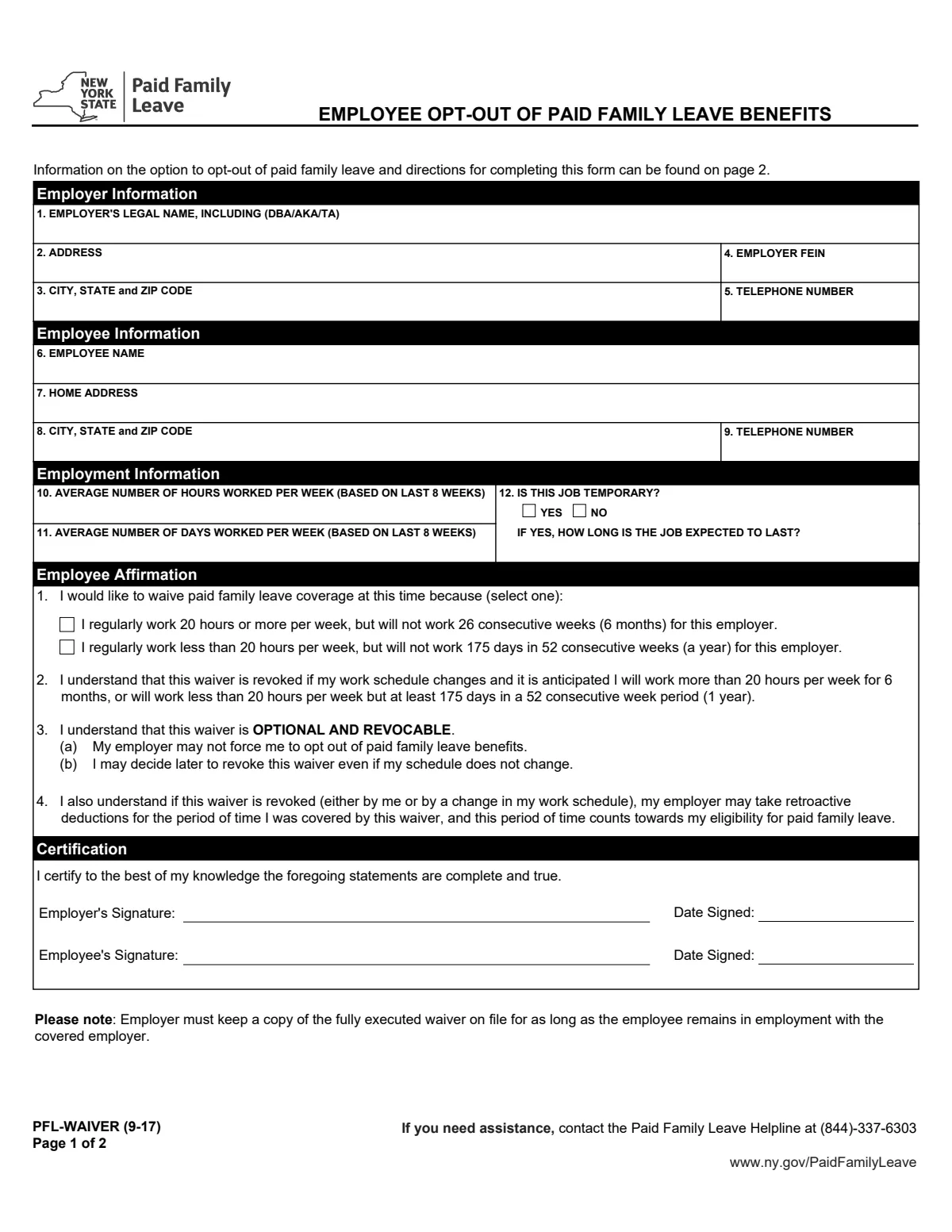
- Items 1 to 5: employer
- Items 6 to 12: employee and schedule
- Employee affirmation
- Certification, signatures and records
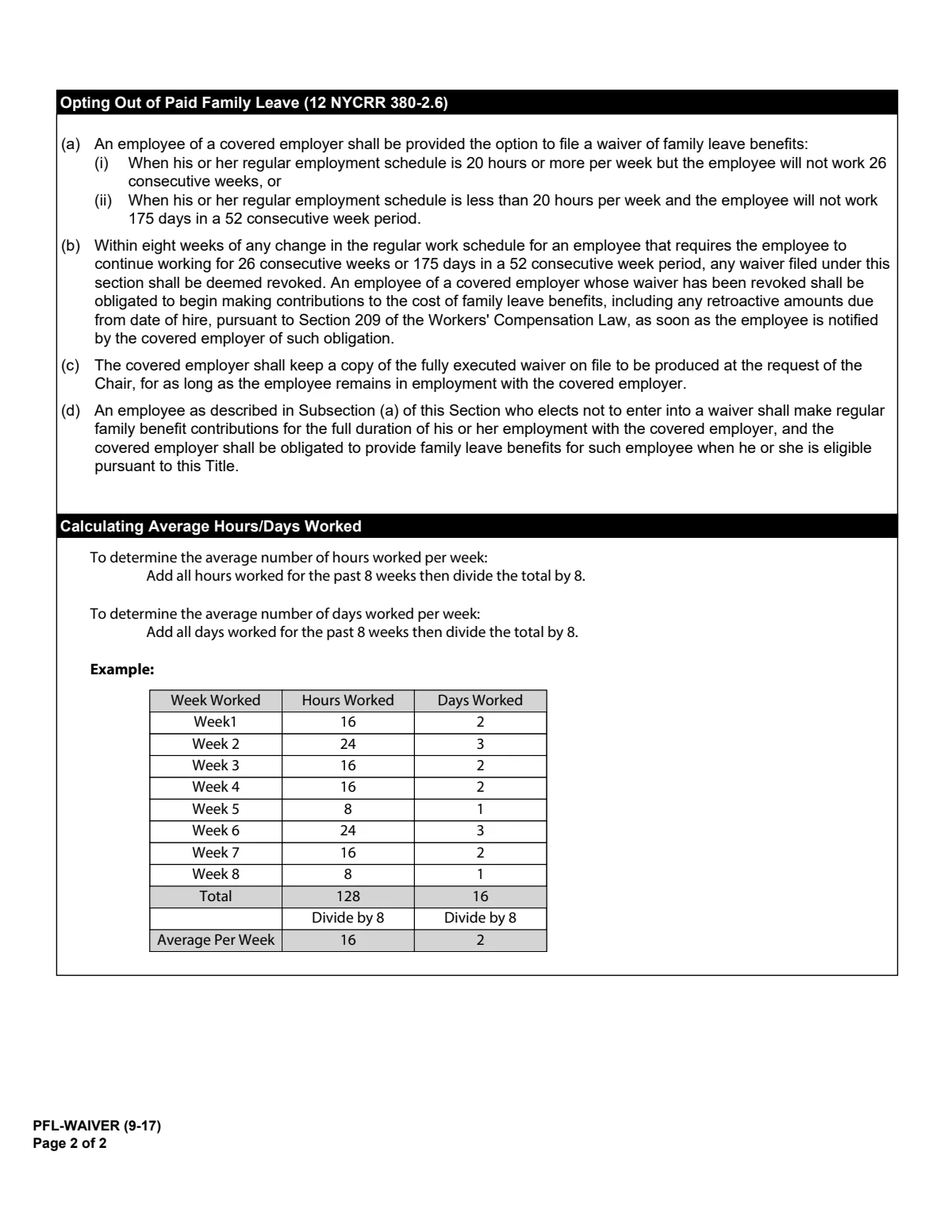
- Page 2: the rule and the averaging method
- When a waiver ends: back deductions
- Rules that trip employers up
- How it connects
- Questions employers ask
- Sources
- Who signs
- The employee and the employer
- When
- When an employee qualifies; the employer must offer it
- Filed with
- Not filed: kept in the employer's records
- Form revision
- PFL-WAIVER (9-17)
- Pages
- 2
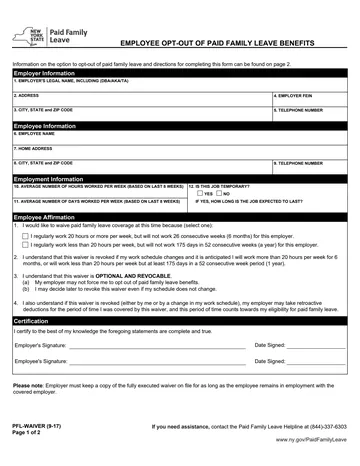
At a glance
The PFL-Waiver is New York's “EMPLOYEE OPT-OUT OF PAID FAMILY LEAVE BENEFITS” form, revision PFL-WAIVER (9-17). The state's Cost and Deductions page calls it the Employee Paid Family Leave Opt-Out and Waiver of Benefits (Form PFL Waiver). An employee who will not work long enough to become eligible for Paid Family Leave (PFL) signs it to stop paying for coverage. The effect is simple: “If an employee waives coverage, they will not make contributions and will not be eligible for Paid Family Leave benefits.” In 2027 the contribution it stops is 0.452% of each paycheck, up to $451.81 for the year (DFS).
- Who signs. The employee and the employer, on page 1.
- When. When the employer identifies an employee who qualifies: usually at hire for seasonal, temporary and short-schedule part-time staff.
- Filed with. No one. The employer keeps it as long as the employee works there.
- Form. PFL-Waiver (PDF), two pages: the form on page 1, and on page 2 the rule it carries out (12 NYCRR 380-2.6) and the method for the averages in items 10 and 11. The state posts translations in Spanish and eleven other languages on its PFL Waiver Form page.
- Not for disability benefits. The waiver covers PFL only. Disability benefits (DBL) cannot be waived: WCB says “any agreement by an employee to waive their right to disability benefits shall be void.”
Tap a box once for its note, again to jump to the line. Zoom in to read the small print.
Who qualifies, and the duty to offer
Only two kinds of employee may opt out, and they are the two who would not reach PFL eligibility with this employer. The state's employer page puts the duty on the employer: “It is your responsibility to identify employees who will not meet the minimum eligibility requirements for Paid Family Leave and offer these employees a waiver.” The eligibility page is just as direct: “Employers must offer a waiver to employees who qualify for one.”
PFL-WAIVER (9-17) and 12 NYCRR 380-2.6(a); Paid Family Leave, Employer Responsibilities and Resources.
Seasonal staff are the common case. The eligibility page explains why a returning seasonal worker usually qualifies each season: “These workers would not be eligible as the days or weeks worked for an employer restart each time the employee is re-hired.” Employees who will meet either time rule cannot opt out, however few hours they work at first.
Items 1 to 5: employer
The employer block identifies the covered employer whose PFL policy the employee is opting out of.
| Item | Label as printed | What goes there |
|---|---|---|
| 1 | 1. EMPLOYER'S LEGAL NAME, INCLUDING (DBA/AKA/TA) | The employer's legal name and any doing-business-as, also-known-as or trading-as name: the employer that holds the PFL policy. |
| 2 | 2. ADDRESS | The employer's street address. |
| 3 | 3. CITY, STATE and ZIP CODE | City, state and ZIP code of the employer's address. |
| 4 | 4. EMPLOYER FEIN | The federal employer identification number, the number the carrier uses to report the policy to the Board. |
| 5 | 5. TELEPHONE NUMBER | A phone number for the employer's payroll or HR contact. |
Items 6 to 12: employee and schedule
Items 10 to 12 are the facts that support the waiver. Use the employee's actual hours and days for the last eight weeks (the form's method), and say whether the job is temporary and for how long.
| Item | Label as printed | What goes there |
|---|---|---|
| 6 | 6. EMPLOYEE NAME | The employee's full name. One form per employee. |
| 7 | 7. HOME ADDRESS | The employee's home street address. |
| 8 | 8. CITY, STATE and ZIP CODE | City, state and ZIP code of the home address. |
| 9 | 9. TELEPHONE NUMBER | The employee's phone number. |
| 10 | 10. AVERAGE NUMBER OF HOURS WORKED PER WEEK (BASED ON LAST 8 WEEKS) | Page 2 gives the method: “Add all hours worked for the past 8 weeks then divide the total by 8.” This is the number that decides which test applies: 20 hours or more, or under 20. For a new hire with no history, the form gives no method; use the regular schedule the employee was hired for (the rule in (a) speaks of the regular employment schedule). |
| 11 | 11. AVERAGE NUMBER OF DAYS WORKED PER WEEK (BASED ON LAST 8 WEEKS) | Add all days worked for the past 8 weeks then divide the total by 8. The days figure matters for the under 20 hours test, which counts 175 days of work. |
| 12 | 12. IS THIS JOB TEMPORARY? YES NO / IF YES, HOW LONG IS THE JOB EXPECTED TO LAST? | Check Yes or No. For a temporary or seasonal job, write the expected length: it supports the 26 week or 175 day reason the employee checks below. |
Employee affirmation
The four numbered statements are what the employee agrees to. Statement 1 is the reason; statements 2 to 4 explain that the waiver can end and what follows when it does.
| Item | Statement as printed | What it means |
|---|---|---|
| A1 | 1. I would like to waive paid family leave coverage at this time because (select one): | The employee checks one of two reasons. Only these two qualify: “Paid Family Leave is not optional for eligible employees.” |
| A1a | I regularly work 20 hours or more per week, but will not work 26 consecutive weeks (6 months) for this employer. | The full-schedule test. The matching eligibility rule: “Part-time employees who work a regular schedule of 20 or more hours a week, are eligible after 26 consecutive weeks of employment for their employer.” |
| A1b | I regularly work less than 20 hours per week, but will not work 175 days in 52 consecutive weeks (a year) for this employer. | The short-schedule test. Without a waiver, such an employee becomes eligible “after working 175 days for their employer, which do not need to be consecutive, unless they qualify for and have executed a waiver.” |
| A2 | 2. I understand that this waiver is revoked if my work schedule changes... | Revocation is automatic when the schedule changes so the employee is expected to meet the time rules. The rule on page 2 gives the timing: within eight weeks of the change (12 NYCRR 380-2.6(b)). |
| A3 | 3. I understand that this waiver is OPTIONAL AND REVOCABLE. | “My employer may not force me to opt out of paid family leave benefits.” I may decide later to revoke this waiver even if my schedule does not change. A revocation by the employee needs no reason. |
| A4 | 4. I also understand if this waiver is revoked... | After a revocation the employer may take retroactive deductions for the period of time I was covered by this waiver, and the waiver period still “counts towards my eligibility for paid family leave.” |
Certification, signatures and records
Both sides sign, and the form stays with the employer. Keep it with the employee's payroll records so the deduction setup and the waiver can be checked together.
| Item | As printed | What goes there |
|---|---|---|
| Cert | I certify to the best of my knowledge the foregoing statements are complete and true. | Both signers certify the facts above, including the average hours and days and the reason checked. |
| Sig-ER | Employer's Signature: / Date Signed: | Signed by someone who can act for the employer, usually payroll or HR, with the date. |
| Sig-EE | Employee's Signature: / Date Signed: | The employee signs and dates. The date matters: the state's employer page measures retroactive deductions from the date the waiver was signed (see below the table). |
| Note | Please note: Employer must keep a copy... | “Employer must keep a copy of the fully executed waiver on file for as long as the employee remains in employment with the covered employer.” It is not sent to the carrier, the Board or the state. |
| Help | PFL-WAIVER (9-17) / If you need assistance... | The form number and revision, and the helpline: “contact the Paid Family Leave Helpline at (844)-337-6303”. |
Page 2: the rule and the averaging method
Page 2 prints the regulation, “Opting Out of Paid Family Leave (12 NYCRR 380-2.6)”, and the worksheet for items 10 and 11. Give the employee both pages, so the employee sees the rule before signing.
| Part | As printed | What it says |
|---|---|---|
| R-a | (a) An employee of a covered employer shall be provided the option to file a waiver of family leave benefits: | The regulation behind items A1a and A1b. Note the verb: the employee shall be provided the option, which the state's employer page turns into a duty to identify qualifying employees and offer the form. |
| R-b | (b) Within eight weeks of any change in the regular work schedule... | A waiver is “deemed revoked” within eight weeks of a schedule change that requires the employee to keep working 26 consecutive weeks or 175 days. The employee then starts contributing, “including any retroactive amounts due from date of hire”, once the employer gives notice of the obligation. |
| R-c | (c) The covered employer shall keep a copy of the fully executed waiver on file... | The record is kept “to be produced at the request of the Chair” of the Workers' Compensation Board, for as long as the employee stays. |
| R-d | (d) An employee ... who elects not to enter into a waiver shall make regular family benefit contributions... | Offering the waiver does not mean the employee must sign. A qualifying employee who declines contributes for the whole employment, and the employer must provide benefits once the employee is eligible. |
| Calc | Calculating Average Hours/Days Worked | Two formulas, one for item 10 and one for item 11: add the last 8 weeks, divide by 8. |
| Example | Example: Week 1 to Week 8, Total, Divide by 8, Average Per Week | The form's example totals 128 hours and 16 days over eight weeks, an average of 16 hours and 2 days a week (we checked the arithmetic). That employee is under 20 hours, so the 175 day test applies. |
When a waiver ends: back deductions
PFL-WAIVER (9-17) and 12 NYCRR 380-2.6; Paid Family Leave, Employer Responsibilities and Resources.
A waiver ends two ways: automatically, when the schedule changes so the employee is expected to meet the time rules, or by the employee's choice at any time. The state's employer page sums it up: “Employees can voluntarily revoke a waiver at any time.” From then on, the employer collects the contribution as for any covered employee.
How far back the deductions go: three wordings. The sources state the catch-up differently:
- The regulation printed on page 2 (12 NYCRR 380-2.6(b)): contributions restart, including any retroactive amounts due from date of hire, once the employer notifies the employee.
- The state's employer page: “you may begin taking payroll deductions and may retroactively collect deductions from the date the waiver was signed”.
- The form's statement 4: deductions for the period of time I was covered by this waiver.
When the waiver was signed at hire, the three come to the same period. When it was signed later, the regulation's "from date of hire" is the widest. The regulation governs over the agency page; the safe course is to tell the employee in writing what will be collected and over how many paychecks before deducting. Without a revoked waiver, the normal limit on catching up applies: a missed deduction may be collected “but not later than one month after payment of wages” (WCL 209(4)). The NY PFL payroll deductions section covers that rule.
Rules that trip employers up
- Waiting for the employee to ask. The duty to identify and offer is the employer's. Build the check into onboarding for seasonal, temporary and short-schedule hires.
- Pressing employees to sign. The form itself says the employer may not force an opt out, and an employee who declines keeps paying and stays covered (rule (d)).
- Waiving the wrong people. A part-timer under 20 hours who will work 175 days, even over several years, cannot waive: the eligibility page notes the 175 days do not need to be consecutive and that accumulation can occur over several years.
- Missing a schedule change. A waiver is revoked within eight weeks of a change that puts the employee on track to qualify. Review waived employees when hours or end dates change.
- Losing the form. Keep the signed waiver as long as the employee stays; the Board may ask for it.
- Using it for disability benefits. DBL has no employee waiver. The only employee exemption WCB lists is the DB-130 for Social Security retirees: “Any employee receiving or entitled to receive Social Security retirement benefits may submit this form at any time to waive any and all benefits under the Disability and Paid Family Leave Benefits Law”.
Construction employees from 2027. A new PFL eligibility standard starts Jan. 1, 2027 for construction employees who work for several employers under a collective bargaining agreement (26 of the last 39 weeks with any covered employer). The state says “There are currently proposed regulations open for public comment and the Board is updating the necessary forms and guidance.” How the waiver applies to these employees is Not listed in the saved sources; see the New York prevailing wage and public works payroll rules for the construction side.
How it connects
- The program the waiver opts out of, with the 2026 and 2027 rates, carriers and notices: New York Paid Family Leave for employers.
- Disability benefits, which cannot be waived, and its own employee notice: New York DBL and the DB-271S Statement of Rights.
- Notices and posters across the states: paid leave posters and notices; the which programs apply tool for employees who work in more than one state.
Questions employers ask
Who can opt out of New York Paid Family Leave?
Only an employee who regularly works 20 or more hours a week but will not work 26 consecutive weeks for the employer, or who regularly works under 20 hours a week but will not work 175 days in 52 consecutive weeks. Everyone else must be covered.
Does the employer have to offer the PFL-Waiver?
Yes. The state says employers must offer a waiver to employees who qualify, and that it is the employer's responsibility to identify them. The employee may decline and stay covered.
Do I send the signed PFL-Waiver to the carrier or the state?
No. The employer keeps the fully executed waiver on file for as long as the employee works there, and produces it if the Workers' Compensation Board asks.
What happens when a waived employee's schedule changes?
The waiver is revoked within eight weeks of a schedule change that requires the employee to keep working 26 consecutive weeks or 175 days. The employee then contributes, including retroactive amounts, once the employer gives notice.
Can an employee take back a PFL waiver?
Yes, at any time, even if the schedule does not change. The employer may then collect the contributions for the waiver period, and that period counts toward PFL eligibility.
Can an employee waive New York disability benefits too?
No. WCL 218 makes an agreement to waive disability benefits void. The only employee exemption is the DB-130 for an employee receiving or entitled to Social Security retirement benefits.
Sources
- WCB, PFL-WAIVER (9-17), Employee Opt-Out of Paid Family Leave Benefits (PDF)
- Paid Family Leave, PFL Waiver Form page (translations)
- Paid Family Leave, Employer Responsibilities and Resources
- Paid Family Leave, Cost and Deductions (opting out and waivers)
- Paid Family Leave, Eligibility (part-time and seasonal employees)
- DFS, 2027 Paid Family Leave rate decision
- WCB, Disability Benefits and Paid Family Leave Insurance for employers
- Workers' Compensation Law 209