Computed from the rows below; each value links to the agency's rate notice or SSA's published base.
How to read the tables
Each row is one program, in order by state, and the program name opens the rates section of its own page. The rate cells link to the page that states the figure: the agency's rate notice, rate page, rate decision or statute. Wage base cells that follow Social Security link to the Social Security Administration's published base. "Not listed" means no saved agency source gave the figure as of Nov. 22, 2026; it does not mean the program has none. The source link at the end of each row opens the agency's own rate page.
The rates are not all the same kind of number, so read the words in each cell. Most are a total rate that the employer and employees share, such as Oregon's 1%, split 60% to employees and 40% to employers, and even that split depends on size: “Employers that employ fewer than 25 employees are not required to pay the employer contributions”. Some are paid by employees alone: California SDI, CT Paid Leave, Rhode Island TDI and the worker side of New Jersey. DC's tax is the reverse: “The Paid Family Leave tax is 100% employer-funded and may not be deducted from a worker's paycheck.” New York DBL and Hawaii TDI have no state rate at all: the employer buys a policy, and the law caps only what may be taken from pay. How each program divides the cost, and the small employer rules, are compared on the employer and employee split page.
Contribution rates for 2026 and 2027
As of Nov. 22, 2026. Rates are percentages of wages up to the wage base in the next table, unless the cell says otherwise.
Five programs change their rate on Jan. 1, 2027. California's rises: “The SDI withholding rate for 2027 is 1.4 percent.” Washington's reaches its ceiling: “STARTING JAN. 1, 2027: The premium rate will be 1.2%.” New York's DFS set PFL at “0.452% of an employee's wages each pay period up to and not to exceed an annual maximum employee contribution of $451.81”. New Jersey's worker rates move to 0.24% each for TDI and FLI on its rate table for “January 1, 2027 to December 31, 2027”. Colorado's goes down: “the premium rate will drop from 0.88% in 2026 to 0.86% starting in 2027”. Maryland starts: “MD Labor set the initial contribution rate at 0.9% of wages up to the Social Security wage cap.”
The rest hold. Minnesota's DEED says “For 2027, the rate will stay at 0.88% of covered wages, and 0.66% for Paid Leave small employers.” Connecticut's board “has voted to maintain the contribution rate at 0.5% for 2027”. Oregon stays at the statutory cap: “The 2027 Paid Leave contribution rate is 1% of subject wages up to $192,300”. Massachusetts keeps the total (“In 2027, the total contribution amount is 0.88% of wages.”) but moves the employer's share from medical to family leave, which changes the payroll setup even though the total does not. Delaware's rates renew under its regulation unless the Division gives 90 days' notice, and none was posted. Rhode Island had not posted its 2027 rate in the saved sources; its statute has the rate computed by Nov. 15 for the next year, so check the Department of Labor and Training's employer tax page before the first 2027 payroll.
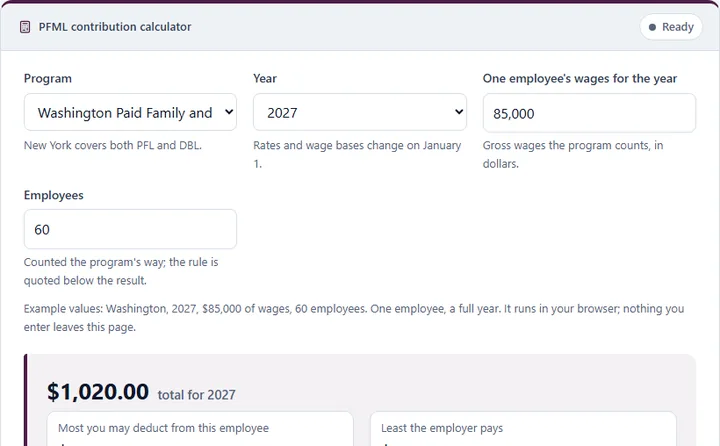
New Jersey's employer TDI rate is the one exception to the calendar year. The rate page explains: “Unemployment and Temporary Disability contribution rates in New Jersey are assigned on a fiscal year basis (July 1st to June 30).” An employer's own rate comes on its notice from NJDOL, while the worker rates change each Jan. 1. The PFML contribution calculator applies these rates to a paycheck, and the PFML changes for 2027 page lists every Jan. 1 change in one place.
Wage bases for 2026 and 2027
A wage base is the most of each employee's yearly wages that the rate applies to. Once an employee's wages for the year pass it, contributions stop for the rest of the year. Most programs borrow the Social Security base, which SSA publishes each fall: “For earnings in 2027, this base is $192,300.” Its table lists “2026 184,500” for 2026. In 2027 it is the cap in 9 of the 20 rows.
Four patterns break from the Social Security base. California and DC have no cap: EDD says “Effective January 1, 2024, all wages are subject to SDI contributions.” DC taxes total gross wages. New Jersey sets its own bases from the state average weekly wage, one for workers and a much lower one for the employer's TDI. Rhode Island and Puerto Rico have fixed or formula bases: Rhode Island's statute sets the base at “the greater of one hundred thousand dollars ($100,000)” or a figure tied to the maximum benefit, and Puerto Rico's DTRH applies “hasta un máximo de $9,000.00 dólares por año natural” (up to $9,000 a calendar year). New York PFL and DBL cap the contribution instead of the wages: “If an employee's contributions reach the annual maximum employee contribution of $451.81 before the end of the calendar year, the employee shall not be liable for any additional contributions for that year.”
Two practical points. The cap usually runs per employer, so an employee with two jobs can pay twice; Connecticut says each employer keeps “remitting the contributions until the employee reaches the Social Security contribution limit with that employer”. And the base counts only wages subject to the program: Delaware, for one, counts only FICA wages earned in the state.
Where the agency and the governing source disagree
Three published figures are known to disagree with the source that controls them. In each case we quote both and use the governing one in the tables.
Colorado: $190,200 on the calculator, $192,300 from SSA
FAMLI's employer page ties the cap to Social Security: “Premiums are paid on wages up to the Federal Social Security Wage Cap.” Its calculator page then prints a different number: “Premiums are paid on wages up to the Federal Social Security Wage Cap, which is $190,200 for earnings in 2027.” SSA's published base is “For earnings in 2027, this base is $192,300.” Because FAMLI defines the cap as the Social Security wage cap, SSA's figure governs, and the calculator's $190,200 is an error in the restatement. The difference is $2,100 of wages for an employee above the cap, $18.06 of premium at 0.86% (our arithmetic). The Colorado FAMLI page has the detail.
Delaware: $183,600 in the guide, $184,500 from SSA
Delaware's statute defines wages as “remuneration for employment as determined for purposes of old-age, survivors, and disability insurance”, so the cap is the Social Security base. The Division's employer guide says the cap “for 2025 it is $176,100 and next year it will rise to $183,600”. SSA's published base for 2026 is $184,500, and that governs: the statute points to FICA, and SSA's figure is what FICA applies. The guide's number reads as an estimate printed before SSA's announcement. For 2027 the base is $192,300. See the Delaware Paid Leave page.
Minnesota: 0.7% in the statute, 0.88% from DEED
Minnesota's premium section still sets “The employer premium rates beginning January 1, 2026, shall be as follows: (1) for an employer participating in both family and medical benefit programs, 0.7 percent”. The next subdivision lets the commissioner change it: “The commissioner may adjust the annual premium rates pursuant to this section prior to January 1, 2026.” DEED did, and charges “There are only two rates: the standard rate of 0.88%, and a small employer rate of 0.66%.” The 0.88% is the adjusted rate the statute authorized, so it governs; the 0.7% is the starting figure, not rewritten in the text. The statute's ceiling still applies: “In no year shall the annual premium rate exceed 1.1 percent of taxable wages paid to each employee.”
Minn. Stat. 268B.14, subd. 6 and 7; 19 Del. C. 3701(24); FAMLI employer and calculator pages; Delaware Paid Leave employer guide; SSA contribution and benefit base.
Other figures that are out of date
Several agency pages still carry an older figure. None changes the tables, but each can mislead a payroll setup:
| Program | What the agency page says | What to use |
|---|---|---|
| New York Paid Family Leave | “For 2025, employees contribute 0.388% of their gross wages per pay period, with a maximum annual contribution of $354.53.” | The DFS decisions: 0.432% for 2026 and 0.452% (up to $451.81) for 2027. DFS sets the rate. |
| Hawaii TDI | The FAQ's deduction cap, “which is $5.51 per week during 2021” | DCD's notice of Dec. 10, 2025: “with the maximum not to exceed $7.50” for 2026. |
| NH Paid Family and Medical Leave | The FAQ's benefit wage cap, “calculated up to the social security wage cap currently at $160,200/annually” | The current Social Security base, which the statute names: $184,500 for 2026 and $192,300 for 2027. This caps benefits, not a contribution. |
| Washington Paid Family and Medical Leave | The small business page's label, “up to the 2025 Social Security cap ($184,500)” | SSA lists $184,500 as the 2026 base, so read the label as 2026. |
| Minnesota Paid Leave | The definition of taxable wages adds a rounding step, “rounded to the nearest $1,000” | Not settled by the sources: the premium section uses the exact base ($192,300), the definition would give $192,000. DEED computes the premium due from the wage detail report. |
When next year's rates are set
Most agencies set the next year's rate in the fall, and a few publish only weeks before Jan. 1. That is why the 2027 column has gaps today and why the January payroll update is a recurring job. The dates below come from each program's statute, regulation or rate notice.
Minn. Stat. 268B.14; DFS 2027 decision; 26 M.R.S. 850-F; Va. Code 60.2-806 (2026 Acts ch. 1093); ESD; UIC 984; C.G.S. 31-49g; Md. Lab. & Empl. 8.3-601; Paid Leave Oregon guidebook; R.I. Gen. Laws 28-40-1.
Two rates are fixed by statute rather than set each year: DC's 0.75% and New York's DBL employee share of 0.5%, up to $0.60 a week. Colorado's Division now sets its rate administratively; CDLE's announcement for 2027 came on Oct. 6, 2026. Delaware's regulation renews the Act's rates each year unless the Department amends it, and “Employers will be provided at least 90 days' notice of any change in the payroll contributions rates for this program.” Hawaii publishes its weekly wage base and deduction cap before Jan. 1; the 2027 notice was not out as of Nov. 22, 2026, so its 2027 cells say Not listed. The PFML quarterly calendar and the deadlines calendar carry these dates with the report due dates.
Programs with no state rate
Four programs in the table have no state-set rate, and two have not started:
- New York DBL: the employer buys a disability policy from a carrier, or self-insures. The law sets only the employee share: “one-half of one per centum of the employee's wages paid to him or her on and after July first, nineteen hundred fifty, but not in excess of sixty cents per week”. The New York PFL premium goes to the same carrier.
- Hawaii TDI: the same model. “The State does not pay TDI benefits; instead, it requires every employer covered by the law to provide benefits to the eligible employees.” The employee may pay half the cost, up to 0.5% of weekly wages and the year's dollar cap.
- New Hampshire and Vermont: voluntary plans sold through the state's partner insurer. “Employer group plans are individually underwritten based on information provided during the quoting process”, and in Vermont “Contributions can be fully paid by the employer, split between the employer and employees, or fully paid for by the employees as a voluntary benefit”.
- Maryland: no 2026 contributions; the first rate applies to wages paid from Jan. 1, 2027.
- Virginia: “By April 1, 2028, the Commission shall begin collecting contributions as provided in this” chapter, at a rate the Commissioner fixes by Oct. 1, 2027.
The state disability programs, including these, are compared on the state disability insurance page, and every program's status is on the paid family leave by state map.
Tools for this topic
Questions employers ask
Which state has the highest paid family leave rate for 2027?
California SDI, at 1.4% of all wages with no cap, paid by employees. Among the programs that share the cost, Washington's 1.2% is the highest and is the most its statute allows.
What is the PFML wage base for 2027?
In most programs it is the Social Security base, $192,300 for 2027. California and DC have no cap, New Jersey's worker base is $177,100, Rhode Island's is at least $100,000, Puerto Rico's is $9,000, and New York caps the PFL contribution at $451.81 a year instead.
Should Colorado employers use $190,200 or $192,300 for 2027?
$192,300. FAMLI's own rule is the Social Security wage cap, and SSA published $192,300 for 2027. The $190,200 on FAMLI's calculator page does not match SSA's figure.
Is Minnesota's premium 0.7% or 0.88%?
0.88% (0.66% for small employers) for 2026 and 2027. The statute's 0.7% is the starting rate that the commissioner was allowed to adjust, and DEED set 0.88%.
When do new rates take effect?
Jan. 1 for almost every program, on wages paid from that date. New Jersey's employer TDI rate runs on a July 1 fiscal year, and Maryland's first rate applies to wages paid from Jan. 1, 2027.
Where do I find my own rate?
On the agency's rate notice: Minnesota's Premium Rate Notice, New Jersey's Notice of Employer Contribution Rates in Employer Access, Oregon's notice in Frances Online. Each row's source link opens the agency's rate page.
Sources
- Each rate and wage base cell links to the agency page, rate notice, rate decision or statute that states it; each row's source link opens the agency's rate page.
- Social Security Administration: Contribution and benefit base
- Quoted for the conflicts: FAMLI premium and benefits calculator; FAMLI employer page; Delaware Paid Leave employer and TPA guide; 19 Del. C. ch. 37; Minn. Stat. 268B.14; 268B.01; DEED Paid Leave employer roles and responsibilities
- Rate setting: Cal. Unemp. Ins. Code 984; C.G.S. ch. 557; Md. Lab. & Empl. 8.3-601; 26 M.R.S. 850-F; R.I. Gen. Laws 28-40-1; N.Y. WCL 209; 2026 Va. Acts ch. 1093