- Who fills it in
- Employer, employee or veteran, provider
- Due
- At least 15 calendar days after you ask
- Returned to
- The employer, through the employee
- Form revision
- Revised June 2020 (expires 8/31/2029)
- Pages
- 4
At a glance
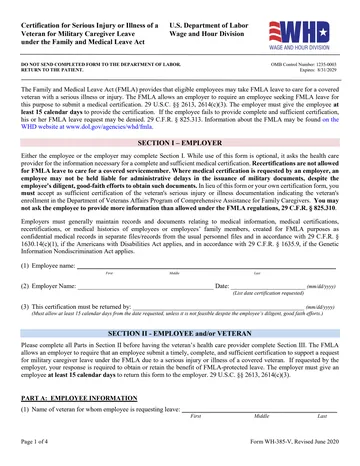
Form WH-385-V, Certification for Serious Injury or Illness of a Veteran for Military Caregiver Leave under the Family and Medical Leave Act, supports military caregiver leave to care for a covered veteran. It mirrors WH-385, with the veteran's discharge in place of current military status and four qualifying conditions in Part B.
- Who fills it in. You (or the employee) complete Section I; the employee and/or the veteran complete Section II; an authorized health care provider completes Section III.
- When. When you require certification; at least 15 calendar days to return it. The veteran must have been discharged within five years before the employee's first day of leave.
- How it is returned. To you, through the employee. Never to the Department of Labor.
- Form. Form WH-385-V (Revised June 2020, OMB Control Number 1235-0003, expires 8/31/2029), four pages; a Spanish version is on the DOL's FMLA forms page.
- Enrollment papers count. The form tells employers: “In lieu of this form or your own certification form, you must accept as sufficient certification of the veteran's serious injury or illness documentation indicating the veteran's enrollment in the Department of Veterans Affairs Program of Comprehensive Assistance for Family Caregivers.”
29 CFR 825.127(b)(2)29 CFR 825.127Code of Federal Regulations, eCFR, (c)(2) and (e); Form WH-385-V (Revised June 2020).
Tap a box once for its note, again to jump to the line. Zoom in to read the small print.
Section I: the employer's part
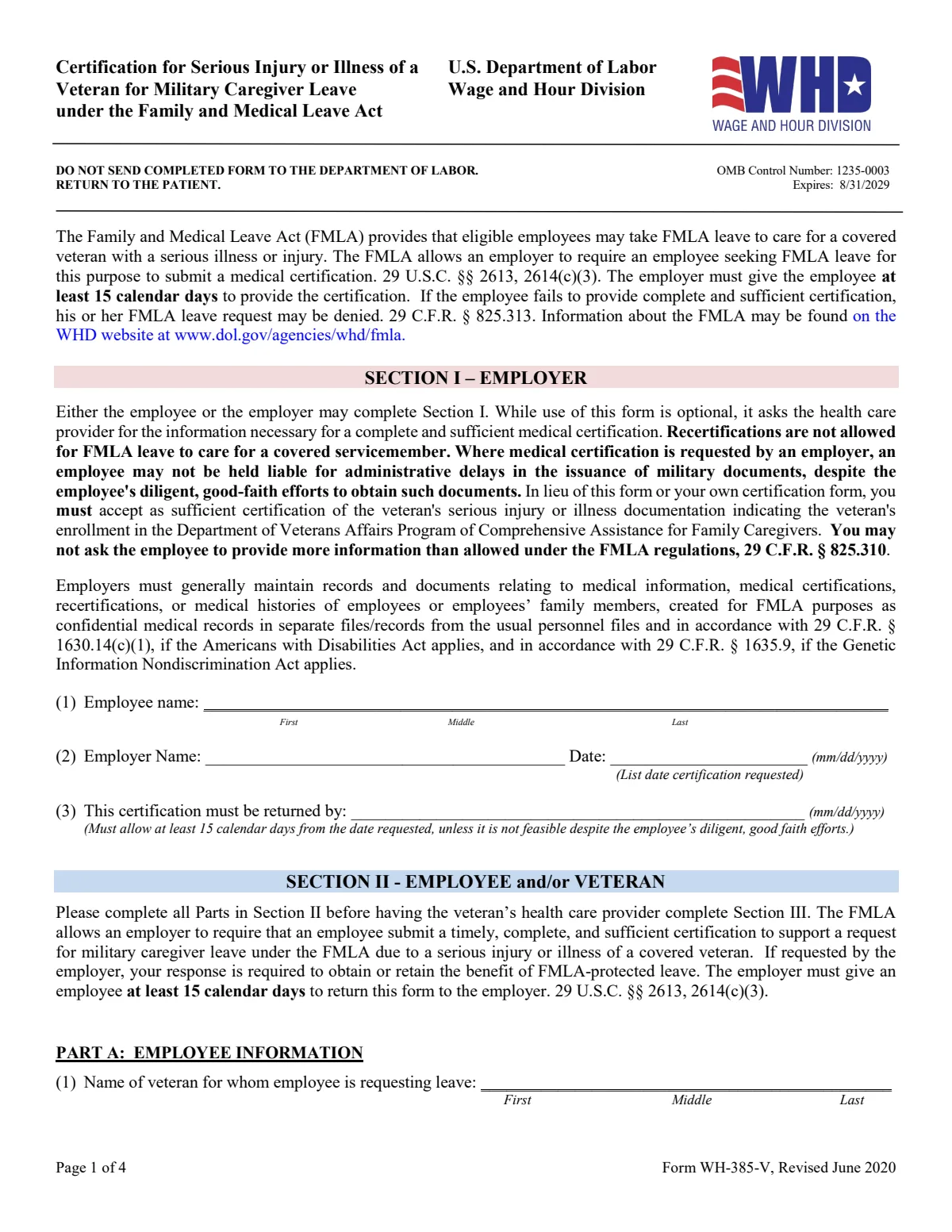
| Line | Label | What goes there |
|---|---|---|
| I-1 | (1) Employee name: First, Middle, Last | Either party may complete Section I. |
| I-2 | (2) Employer Name; Date: (List date certification requested) | The return period runs from this date. |
| I-3 | (3) This certification must be returned by | Section II repeats the rule to the employee: “The employer must give an employee at least 15 calendar days to return this form to the employer.” |
Section II: the employee and the veteran
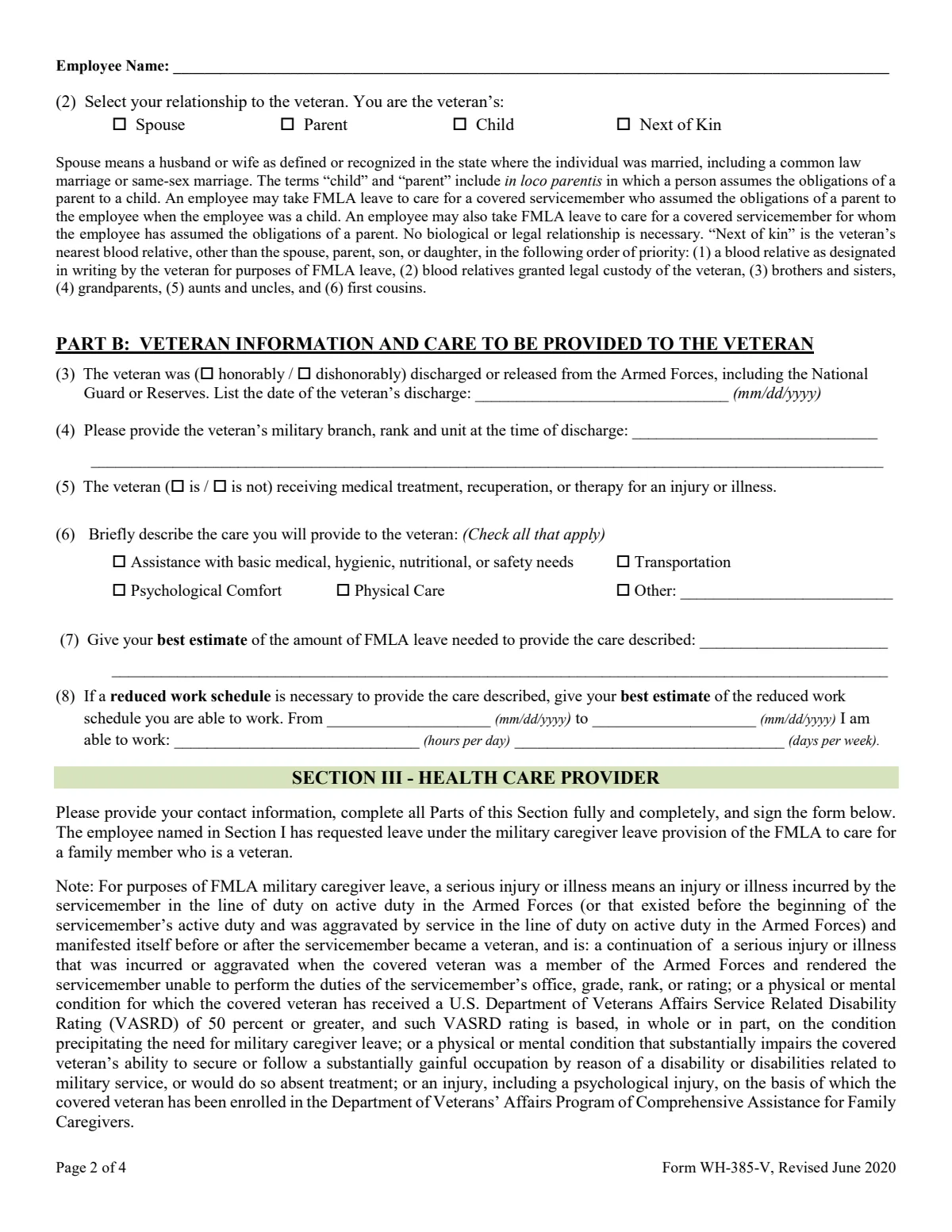
Section II sets out who the veteran is, how and when the veteran left the service, and the care the employee will give.
| Line | Label | What goes there |
|---|---|---|
| II-1 | (1) Name of veteran for whom employee is requesting leave: First, Middle, Last | The veteran, not the employee. |
| EN | Employee Name: | The employee's name. |
| II-2 | (2) Select your relationship to the veteran. You are the veteran's: Spouse; Parent; Child; Next of Kin | Next of kin follows the order the form prints, unless the veteran designated another blood relative in writing (29 CFR 825.127(d)(3))29 CFR 825.127Code of Federal Regulations, eCFR. |
| II-3 | (3) The veteran was (honorably / dishonorably) discharged or released from the Armed Forces, including the National Guard or Reserves. List the date of the veteran's discharge | A covered veteran was “discharged or released under conditions other than dishonorable at any time during the five-year period prior to the first date the eligible employee takes FMLA leave to care for the covered veteran”. You may ask for proof; “an employee may provide a copy of the veteran's Certificate of Release or Discharge from Active Duty issued by the U.S. Department of Defense (DD Form 214) or other proof of veteran status”. |
| II-4 | (4) Please provide the veteran's military branch, rank and unit at the time of discharge | As shown on the discharge papers. |
| II-5 | (5) The veteran (is / is not) receiving medical treatment, recuperation, or therapy for an injury or illness. | A covered veteran must be undergoing treatment, recuperation or therapy for a serious injury or illness (29 CFR 825.127(b)(2))29 CFR 825.127Code of Federal Regulations, eCFR. |
| II-6 | (6) Briefly describe the care you will provide to the veteran: (Check all that apply) | Physical and psychological care both count. |
| II-7 | (7) Give your best estimate of the amount of FMLA leave needed to provide the care described | Up to 26 workweeks in a single 12-month period. |
| II-8 | (8) If a reduced work schedule is necessary to provide the care described, give your best estimate of the reduced work schedule you are able to work. | Only if needed. |
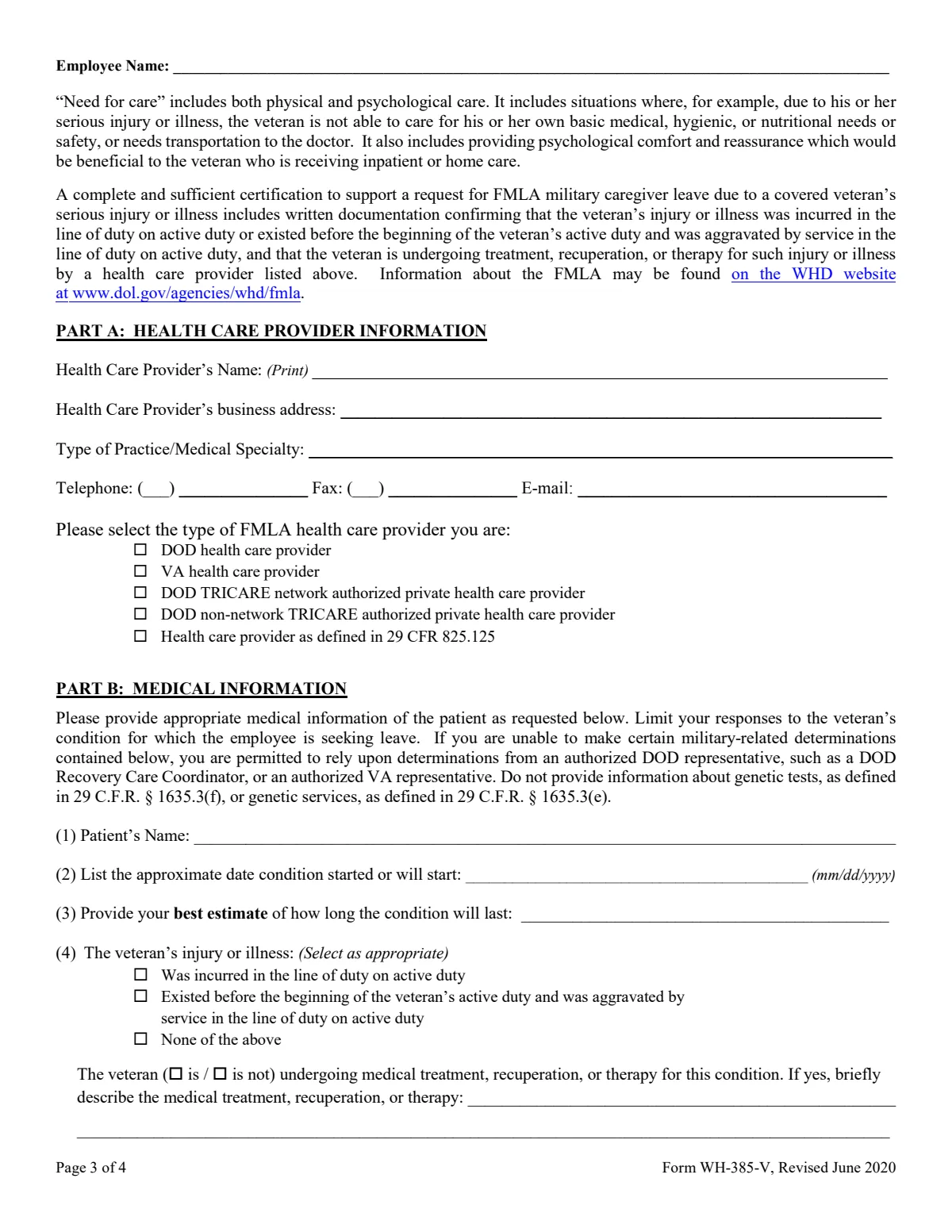
Section III, Part A: the provider
| Line | Label | What goes there |
|---|---|---|
| HCP | Health Care Provider's Name (Print); business address; Type of Practice/Medical Specialty; Telephone; Fax; E-mail | As on WH-385. |
| HCP-type | Please select the type of FMLA health care provider you are | As on WH-385: only a certification from the last type (a health care provider as defined in 29 CFR 825.12529 CFR 825.125Code of Federal Regulations, eCFR) can be tested with a second or third opinion (29 CFR 825.310(d))29 CFR 825.310Code of Federal Regulations, eCFR. |
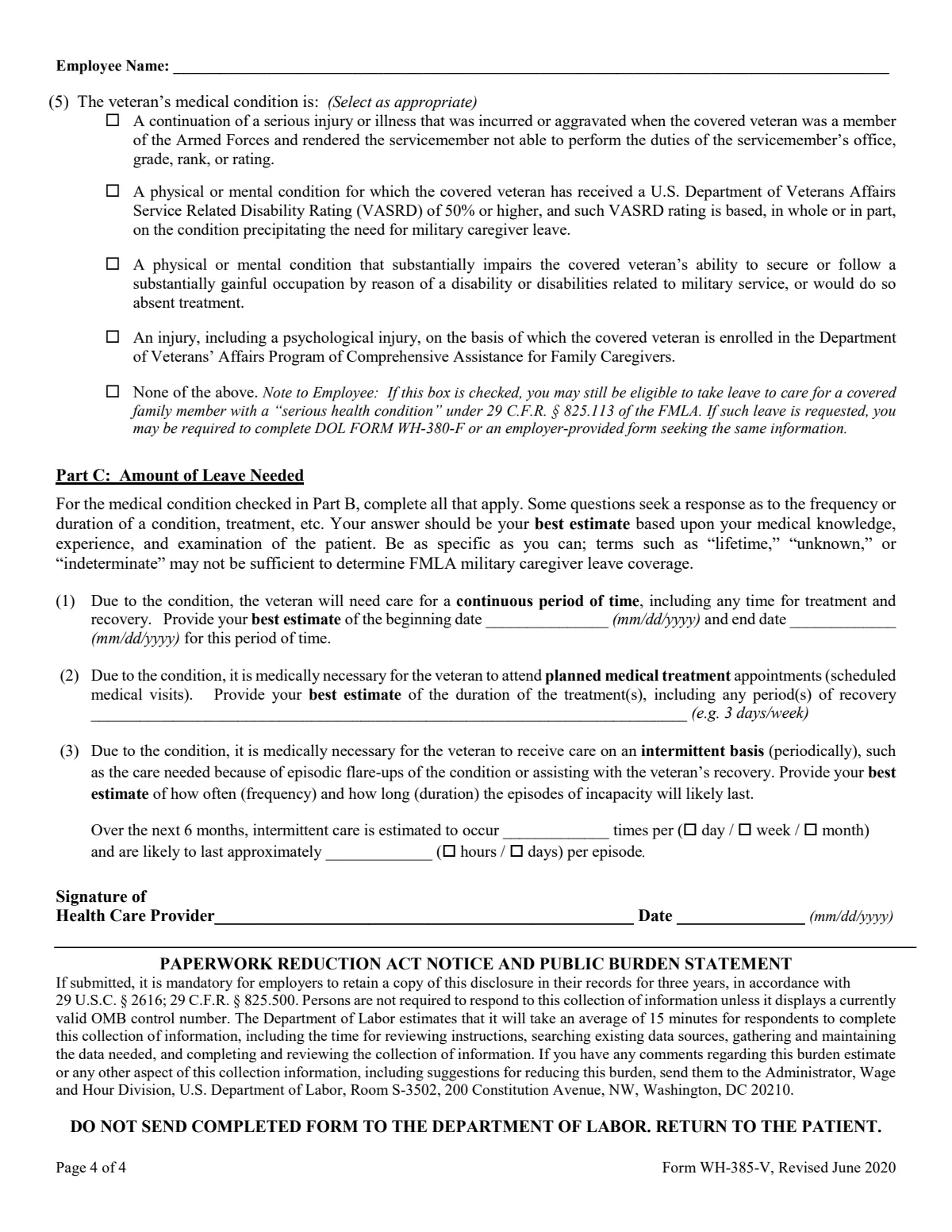
Part B: medical information
Part B numbers its questions (1) to (5), and Part C starts again at (1), so the line ids below carry the part letter.
| Line | Label | What goes there |
|---|---|---|
| B-1 | (1) Patient's Name | The veteran, as in Section II. |
| B-2 | (2) List the approximate date condition started or will start | An approximate date. |
| B-3 | (3) Provide your best estimate of how long the condition will last | The probable duration. |
| B-4 | (4) The veteran's injury or illness: Was incurred in the line of duty on active duty; Existed before the beginning of the veteran's active duty and was aggravated by service in the line of duty on active duty; None of the above | The injury or illness must be incurred or aggravated in the line of duty on active duty, and may have shown itself before or after the member became a veteran (29 CFR 825.127(c)(2))29 CFR 825.127Code of Federal Regulations, eCFR. |
| B-4-tx | The veteran (is / is not) undergoing medical treatment, recuperation, or therapy for this condition. If yes, briefly describe | The question sits under item (4) without its own number; it answers the treatment test in 29 CFR 825.310(b)(4)29 CFR 825.310Code of Federal Regulations, eCFR(ii). |
| B-5 | (5) The veteran's medical condition is: (Select as appropriate) | Any one of the four is enough; they mirror 29 CFR 825.127(c)(2)(i)29 CFR 825.127Code of Federal Regulations, eCFR to (iv). |
| B-5-cont | A continuation of a serious injury or illness that was incurred or aggravated when the covered veteran was a member of the Armed Forces and rendered the servicemember not able to perform the duties of the servicemember's office, grade, rank, or rating. | The first test. |
| B-5-vasrd | A physical or mental condition for which the covered veteran has received a U.S. Department of Veterans Affairs Service Related Disability Rating (VASRD) of 50% or higher... | The form says “Service Related Disability Rating (VASRD) of 50% or higher”; the regulation says 50 percent or greater. Same threshold. |
| B-5-impair | A physical or mental condition that substantially impairs the covered veteran's ability to secure or follow a substantially gainful occupation by reason of a disability or disabilities related to military service, or would do so absent treatment. | The third test. |
| B-5-pcafc | An injury, including a psychological injury, on the basis of which the covered veteran is enrolled in the Department of Veterans' Affairs Program of Comprehensive Assistance for Family Caregivers. | Enrollment papers alone are sufficient certification, “regardless of whether the employee is the named caregiver in the enrollment documentation”. |
| B-5-none | None of the above. Note to Employee: ... you may be required to complete DOL FORM WH-380-F or an employer-provided form seeking the same information. | The leave may still qualify as care for a family member with a serious health condition. |
Part C: amount of leave needed
| Line | Label | What goes there |
|---|---|---|
| C-1 | (1) Due to the condition, the veteran will need care for a continuous period of time, including any time for treatment and recovery. | Part C restarts its numbering at (1). |
| C-2 | (2) Due to the condition, it is medically necessary for the veteran to attend planned medical treatment appointments | Supports intermittent leave for appointments. |
| C-3 | (3) Due to the condition, it is medically necessary for the veteran to receive care on an intermittent basis (periodically) | Episodic flare-ups or help with recovery. |
| Sig | Signature of Health Care Provider; Date | An unsigned form is incomplete. |
Rules that matter
- The five-year window. Leave must start within five years of the veteran's discharge, but “the single 12-month period described in paragraph (e)(1) of this section may extend beyond the five-year period”.
- No second opinion or recertification on enrollment papers. “An employer may not utilize the second or third opinion process outlined in § 825.307 or the recertification process under § 825.308 when the servicemember's serious injury or illness is shown by documentation of enrollment in this program.”
- No recertification at all. Recertification does not apply to military caregiver leave (29 CFR 825.313(c))29 CFR 825.313Code of Federal Regulations, eCFR.
- Discharge proof. You may ask for documentation of a discharge other than dishonorable and its date, such as a DD-214 (29 CFR 825.310(f)(2))29 CFR 825.310Code of Federal Regulations, eCFR.
- 26 weeks, once per injury. The 26 weeks apply per servicemember and per injury, with no more than 26 weeks in any single 12-month period (29 CFR 825.127(e)(2))29 CFR 825.127Code of Federal Regulations, eCFR.
- Records. Confidential medical file, three years.
How it connects
- A current member of the Armed Forces: Form WH-385. If none of the four conditions applies: Form WH-380-F. All the DOL forms: FMLA forms.
- The notices: WH-381 and WH-382; timing in the designation notice guide.
- State family leave programs and the FMLA: FMLA and state paid leave.
Questions employers ask
Who is a covered veteran for WH-385-V?
A former member of the Armed Forces, National Guard or Reserves discharged or released under conditions other than dishonorable within the five years before the employee's first day of leave to care for the veteran, who is undergoing treatment, recuperation or therapy for a serious injury or illness.
Do we have to accept VA caregiver program papers instead of the form?
Yes. Documentation of the veteran's enrollment in the VA Program of Comprehensive Assistance for Family Caregivers is sufficient certification, even if the employee is not the named caregiver, and you may not get a second opinion or recertification on it.
What VA rating qualifies?
A VA Service Related Disability Rating of 50% or higher that rests at least in part on the condition behind the leave. A lower rating may still qualify under one of the other three conditions.
Can we ask for the DD-214?
Yes. You may require documentation that the discharge was other than dishonorable and its date; a DD-214 or other proof of veteran status satisfies it.
Does the 26-week period end when the five years end?
No. The leave must start within the five years, but the single 12-month period may run past the end of them.
Sources
- Form WH-385-V, Certification for Serious Injury or Illness of a Veteran for Military Caregiver Leave (Revised June 2020), DOL Wage and Hour Division
- 29 CFR part 825, eCFR text current as of Nov. 1, 2026: 825.127, 825.307, 825.310, 825.313, 825.500