The map
Status as of Nov. 22, 2026, from each state's own statute, agency pages and rate notices: 12 states and DC with paid family and medical leave in effect, 2 enacted with a later start, 1 with disability insurance only (Puerto Rico has one too, shown under the map), 2 with a voluntary state plan and 33 with no state program. Select a state for its program page; the tables below give each program's 2027 rate, wage base, split and report, with the report linked to the state's own filing system. A value the sources do not give shows as "Not listed" rather than being filled in from elsewhere.
Two kinds of program sit on this map. Paid family and medical leave (PFML) pays benefits for an employee's own serious health condition and for family care and bonding, and is funded by a payroll contribution or premium. State disability insurance (SDI or TDI) is the older form: it covers the employee's own illness or injury off the job, and in California, New Jersey, New York and Rhode Island it now carries a family leave benefit too. The state disability insurance hub compares those six programs.
Paid family and medical leave in effect (13)
Thirteen jurisdictions collect for paid leave now. The newest are Minnesota, where DEED says “For 2026 and 2027, the premium rate is 0.88 percent.”, Delaware, whose claims window opened “January 1, 2026”, and Maine, where “Starting in May 2026, eligible employees can apply for up to 12 weeks of paid leave”. The oldest are the disability insurance states that added family leave: “Paid Family Leave (PFL) is a component of the SDI program.” in California, and New Jersey's family leave insurance, which “is financed 100% by worker payroll deductions”.
The programs differ more than their names suggest. Eight follow the Social Security wage base (“For earnings in 2027, this base is $192,300.”); California and DC tax every dollar of wages; New Jersey and Rhode Island set their own bases. Most file quarterly by the last day of the month after the quarter, but New York has no state report at all: PFL and disability benefits are an insurance policy the employer buys, and the employee contribution offsets its cost. New Jersey's reports are due by the 30th, and “No extensions are granted if the due date falls on a weekend or holiday.”
| State | Status | Program | 2027 rate | 2027 wage base | 2027 split | Report (links to the portal) | Source |
|---|---|---|---|---|---|---|---|
| California | Live paid leave | California SDI (DI and PFL) | 1.4% of all wages (SDI) | No cap: all wages are subject to SDI | Employees pay all; no employer share | DE 9 and DE 9C quarterly, due Apr 1, Jul 1, Oct 1, Jan 1 | edd.ca.gov |
| Colorado | Live paid leave | Colorado FAMLI | 0.86% of wages (set by the FAMLI Division) | $192,300 (SSA base; FAMLI's calculator says $190,200) | 0.43% employer, 0.43% employee | Wage report and premiums quarterly: Apr 30, Jul 31, Oct 31, Jan 31 | cdle.colorado.gov |
| Connecticut | Live paid leave | CT Paid Leave | 0.5% of wages (employee contribution) | $192,300 (Social Security base) | Employee pays 0.5%; no employer match | Quarterly; no penalty if paid by last day of month after quarter | ctpaidleave.org |
| Delaware | Live paid leave | Delaware Paid Leave | 0.8% of wages (rates renew; no 2027 change published) | $192,300 (Social Security base) | Employer may charge employees up to 50% | Hours and Wage report and payment, 30 days after the quarter | laborfiles.delaware.gov |
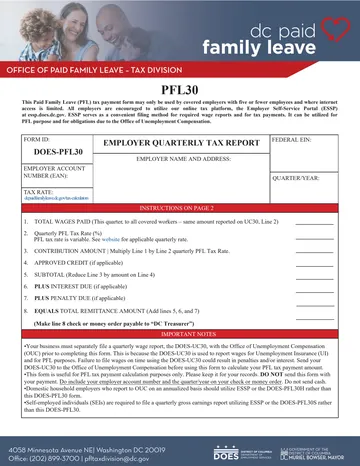
| District of Columbia | Live paid leave | DC Paid Family Leave | 0.75% of wages (D.C. Code 32-541.03; no 2027 table posted) | No cap: total gross wages | Employer pays all; no deduction from pay | Quarterly, due Apr 30, Jul 31, Oct 31, Jan 31 | code.dccouncil.gov |
| Maine | Live paid leave | Maine PFML | 1% of wages (15 or more employees); 0.5% under 15 | $192,300 (Social Security base) | Up to 0.5% from employees; employer pays the rest | Quarterly, by the last day of the month after the quarter | maine.gov |
| Massachusetts | Live paid leave | Massachusetts PFML | 0.88% of wages (25 or more covered individuals); 0.46% under 25 | $192,300 (Social Security base) | 25 or more: employer at least 0.42%, employees up to 0.46% | Quarterly return in MassTaxConnect, by last day of month after quarter | mass.gov |
| Minnesota | Live paid leave | Minnesota Paid Leave | 0.88% of wages (small employer 0.66%) | $192,300 (Social Security base) | Employer at least half; employees up to 0.44% | Wage detail and premiums: Apr 30, Jul 31, Oct 31, Jan 31 | pl.mn.gov |
| New Jersey | Live paid leave | New Jersey TDI and FLI | Worker TDI 0.24%, FLI 0.24%; employer TDI by rate notice | $177,100 (worker TDI and FLI); $46,400 (employer TDI) | Workers pay TDI and FLI; employers pay TDI only | NJ-927 and WR-30 quarterly, by the 30th after the quarter | nj.gov |
| New York | Live paid leave | New York PFL and DBL | PFL 0.452% (max $451.81 a year); DBL up to $0.60 a week | PFL: contributions stop at $451.81 a year | Employees may pay all of PFL; DBL employee max 0.5%, employer rest | Premiums go to the employer's insurance carrier; W-2 Box 14 | dfs.ny.gov |
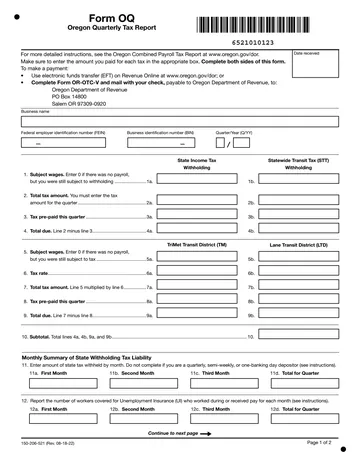
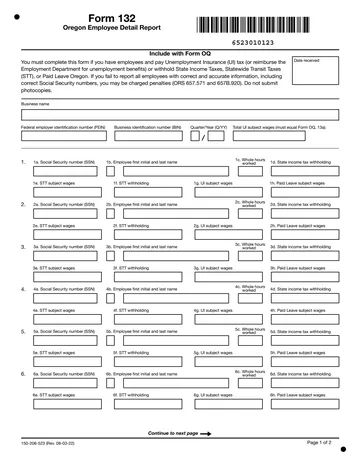
| Oregon | Live paid leave | Paid Leave Oregon | 1% of wages up to $192,300 | $192,300 (Social Security base) | Employees 60% (0.6%), employers 40% (0.4%) | Form OQ and Form 132 quarterly, by last day of month after quarter | oregon.gov |
| Rhode Island | Live paid leave | Rhode Island TDI and TCI | Not listed | At least $100,000 (formula in R.I. Gen. Laws 28-40-1) | Employees pay all through wage deduction | TX-17 quarterly: Jan 31, Apr 30, Jul 31, Oct 31 | dlt.ri.gov |
| Washington | Live paid leave | Washington Paid Family and Medical Leave | 1.2% of wages | $192,300 (Social Security cap) | Employees 70.7%, employers 29.3% (50 or more employees) | Quarterly wage and hours report: Apr 30, Jul 31, Oct 31, Jan 31 | paidleave.wa.gov |
New York's row covers two programs on one policy, Paid Family Leave and the disability benefits law (DBL); each has its own page: NY Paid Family Leave and NY DBL. Rates and wage bases side by side, with 2026 and the effective dates, are on PFML rates by state; the report, form and due dates for each program are on PFML reports and due dates.
Enacted, starts later (2)
Maryland starts on Jan. 1, 2027. The statute says “Beginning January 1, 2027, each employee of an employer and each employer with 15 or more employees shall contribute to the Fund.” The Department of Labor has set the first rate: “MD Labor set the initial contribution rate at 0.9% of wages up to the Social Security wage cap.” “The contribution amount is split equally between employers and employees (0.45% each).” Employers register with FAMLI, and “Starting January 2027, you will collect employee contributions through payroll deductions, add your employer contribution, and remit the total quarterly.” The first report and payment “will be due April 30, 2027”. Benefits follow a year later: “Starting January 1, 2028, eligible employees will be able to take up to 12 weeks of paid, job-protected leave”.
Virginia enacted its program in 2026 (Chapter 1093). The Virginia Employment Commission runs it, and the dates are set by statute: “By April 1, 2028, the Commission shall begin collecting contributions as provided in this” chapter, and claims begin by Dec. 1, 2028. The first rate comes earlier: “No later than October 1, 2027, and annually thereafter, the Commissioner shall fix the contribution rate”. Nothing is filed in 2027.
| State | Status | Program | 2027 rate | 2027 wage base | 2027 split | Report (links to the portal) | Source |
|---|---|---|---|---|---|---|---|
| Maryland | Starting later | Maryland FAMLI | 0.9% of wages | $192,300 (Social Security base) | 0.45% employer, 0.45% employee | Quarterly Wage and Hour Report; first due Apr 30, 2027 | paidleave.maryland.gov |
| Virginia | Starting later | Virginia Paid Family and Medical Leave | None: the 2028 rate is to be fixed by Oct. 1, 2027 | Not listed | Not listed | None yet: collection begins by Apr. 1, 2028 | Va. Acts 2026, ch. 1093 |
Disability insurance only (2)
Hawaii and Puerto Rico have temporary disability insurance but no paid family leave. Hawaii's program is a duty, not a state fund: “The State does not pay TDI benefits; instead, it requires every employer covered by the law to provide benefits to the eligible employees.” The employer buys an insured plan, self-insures with the Division's approval, or covers employees through a bargained sick leave plan, and may withhold part of the cost from pay. Puerto Rico's SINOT is a state fund run by the Department of Labor and Human Resources, financed by a contribution on the first $9,000 of each worker's yearly wages; the DTRH says “Debe pagar contribuciones todo patrono, incluso las corporaciones” (every employer must pay contributions, public corporations included). Puerto Rico sits under the map, not on it, and is not counted in the chips.
| State | Status | Program | 2027 rate | 2027 wage base | 2027 split | Report (links to the portal) | Source |
|---|---|---|---|---|---|---|---|
| Hawaii | Disability insurance only | Hawaii TDI | Employee share up to 0.5% (2027 weekly maximum not yet published) | Not listed | Employee up to half the cost, capped at 0.5%; employer pays the rest | No state return; the carrier files TDI-62 | capitol.hawaii.gov |
| Puerto Rico | Disability insurance only | Puerto Rico SINOT | 0.60% of wages up to $9,000 a year (no change published) | $9,000 a year | Employee share up to 0.30%; employer pays the rest | Quarterly, by the last day of the month after the quarter | trabajo.pr.gov |
Voluntary state plans (2)
New Hampshire and Vermont each sponsor an insurance plan an employer may buy; neither has a payroll tax or a state report. In New Hampshire, “NH Paid Family and Medical Leave (NH PFML) is a voluntary insurance plan”, and “Employers must have a physical location in NH to be eligible for NH PFML insurance.” Vermont's VT-FMLI is “a voluntary paid family and medical leave program” offered to employers “with two or more employees”. In both, the employer picks who pays: all employer, shared, or all employee. The rate is the insurer's premium, not a state rate, so the table shows "Not listed" for it.
| State | Status | Program | 2027 rate | 2027 wage base | 2027 split | Report (links to the portal) | Source |
|---|---|---|---|---|---|---|---|
| New Hampshire | Voluntary plan | NH Paid Family and Medical Leave | No state rate: group plans are underwritten | Not listed | Employer chooses: employer paid, shared or employee paid | No state report; the insurer bills monthly or quarterly | paidfamilymedicalleave.nh.gov |
| Vermont | Voluntary plan | Vermont FMLI | No state rate: the plan's premium, paid as the employer chooses | Not listed | Employer chooses: employer paid, shared or employee paid | Not listed | governor.vermont.gov |
No state program (33)
These states have no state paid family and medical leave or disability insurance program. A state with no program can still have local payroll taxes, which a payroll department withholds or pays the same way; the local pages for each state are listed under its name.
- AlabamaLocal: Alabama Occupational License Taxes
- Alaska
- Arizona
- Arkansas
- Florida
- Georgia
- Idaho
- Illinois
- IndianaLocal: Indiana County Tax Rates
- Iowa
- Kansas
- KentuckyLocal: Kentucky Occupational License Tax, Louisville Occupational License Tax, Lexington Occupational License Fee, Northern Kentucky, Bowling Green and Boone County Taxes
- Louisiana
- MichiganLocal: Michigan City Income Taxes, Detroit City Income Tax
- Mississippi
- MissouriLocal: Kansas City Earnings Tax, St. Louis Earnings and Payroll Expense Taxes for Employers
- Montana
- Nebraska
- Nevada
- New Mexico
- North Carolina
- North Dakota
- OhioLocal: Ohio Municipal Income Tax Withholding, RITA Withholding, CCA and Cleveland Income Tax Withholding for Employers, Columbus and Cincinnati Income Tax Withholding, Ohio School District Income Tax
- Oklahoma
- PennsylvaniaLocal: Philadelphia Wage Tax, PA Local Earned Income Tax, PA Local Services Tax (LST), Pittsburgh Payroll Expense Tax, EIT and LST for Employers
- South Carolina
- South Dakota
- Tennessee
- Texas
- Utah
- West VirginiaLocal: West Virginia City Service Fees
- Wisconsin
- Wyoming
Who pays: the employer and employee shares
Every program sets how its cost is split, and the split decides what payroll withholds. The federal rules follow the split too. Under Rev. Rul. 2025-4, of the employee's share, “Even though these amounts are withheld from the employee's wages, they are included in the employee's gross income”, and the part of a state medical leave benefit paid for by employer contributions is treated as wages that “are third-party payments of sick pay”. Massachusetts and Washington changed their 2027 splits because of it (see PFML changes for 2027).
From the 2027 split for each program in the table below, each from the agency's rate notice or the statute; ESD on retroactive withholding.
Small employer rules change the split, not the duty to withhold. In Washington, “Businesses with fewer than 50 employees are not required to pay the employer portion of the premium”; in Colorado, “Businesses with nine or fewer employees should submit wage reports and send in employee premiums each quarter.” Oregon, Massachusetts, Maine and Maryland have similar rules at 25, 25, 15 and 15 employees, and Minnesota gives employers of 30 or fewer a lower total rate. The row for each state above gives its rule in short; the program page quotes it in full. A missed deduction is hard to fix later; Washington's ESD says “Remember, you cannot retroactively withhold premiums from employees.”
What every program asks of an employer
The steps are much the same everywhere, though the forms and portals differ. Register in the state's system (Minnesota uses the unemployment insurance Employer Account, and Massachusetts collects through MassTaxConnect), post the notice and give the written notice, set the deduction, then report and pay each quarter. California, for example, requires that “All employers must electronically submit employment tax returns, wage reports, and payroll tax deposits to the Employment Development Department (EDD).” Several programs let an employer replace the state plan with a private plan approved by the agency, but the employer usually keeps reporting wages.
Each program page lists the exact portal, notice and due date, quoted from the agency.
For an employer in more than one state, the program follows where the employee works under each state's own rule, and the rules are not uniform. Minnesota, for example, counts a year of work as Minnesota employment when “50 percent or more of the employment during the calendar year is performed in Minnesota”. Each program page sets out its own coverage rule; the multi-state PFML setup checklist lists the accounts, portals, notices and deductions per program.
What changes in 2027
Five programs change their rate on Jan. 1, 2027. California SDI: “The SDI withholding rate for 2027 is 1.4 percent.” New York PFL: “The 2027 Paid Family Leave rate will be set at 0.452% of an employee's wages each pay period”, up to an “annual maximum employee contribution of $451.81”. Washington: “STARTING JAN. 1, 2027: The premium rate will be 1.2%.” Colorado: “the premium rate will drop from 0.88% in 2026 to 0.86% starting in 2027”. New Jersey's worker TDI and FLI rates both move to 0.24%. Maryland starts, Massachusetts and Washington re-split their premiums, the Social Security base rises to $192,300, and the IRS relief for state medical leave benefits ends with 2026: “This notice is effective for medical leave benefits paid from States to individuals during calendar year 2026.” The full list, quoted program by program, is on PFML changes for 2027.
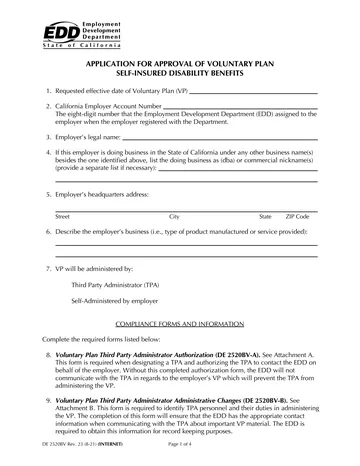
Forms, line by line
Tools for this topic
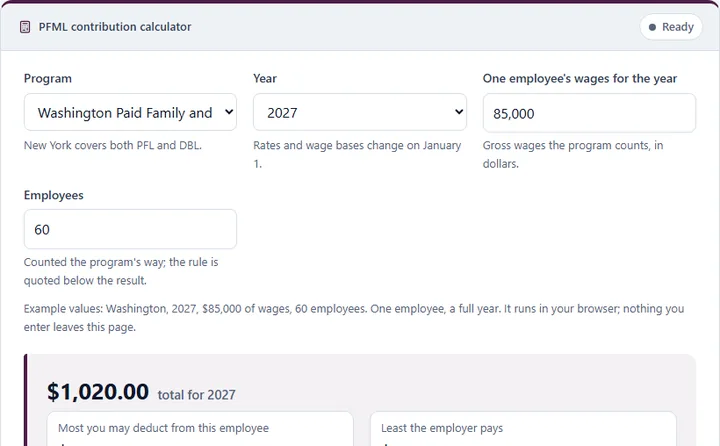
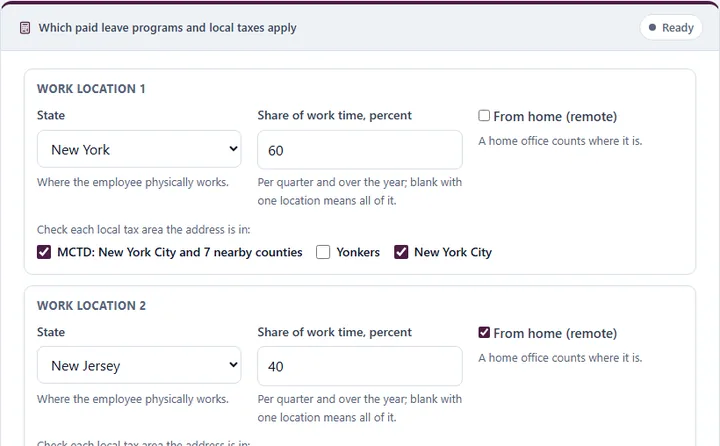
Templates
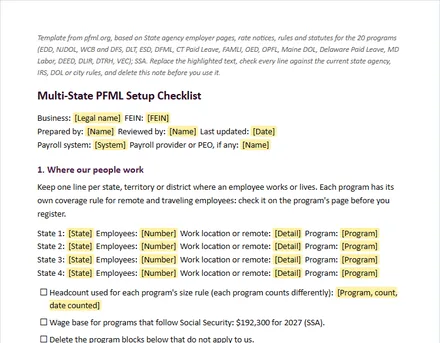
Multi-state setup checklist
One block per state paid leave and disability program: register, set up the portal, load the 2027 rate and deduction, file the report, post the notice and decide on a private plan.
Questions employers ask
Which states have paid family leave in 2027?
Thirteen jurisdictions collect for it now: California, Colorado, Connecticut, Delaware, DC, Maine, Massachusetts, Minnesota, New Jersey, New York, Oregon, Rhode Island and Washington. Maryland starts collecting on Jan. 1, 2027 and Virginia by April 1, 2028. Hawaii and Puerto Rico have disability insurance only, and New Hampshire and Vermont offer voluntary plans.
Is state disability insurance the same as paid family leave?
No. Disability insurance (SDI or TDI) replaces wages when an employee cannot work because of their own illness or injury off the job. Paid family leave also covers caring for a family member and bonding with a new child. California, New Jersey, New York and Rhode Island run both through one payroll deduction or policy.
We have one remote employee in a paid leave state. Are we covered?
Usually yes. Most programs cover an employer with even one employee working in the state, and the duty attaches to where the employee works under that state's rule. Check the coverage section of the program page, which quotes the state's own test.
Do states with no program have any payroll duty like this?
Not a state paid leave or disability tax, but several have local payroll taxes withheld by employers, such as Pennsylvania's local earned income tax, Ohio municipal income tax and Kentucky occupational license taxes. Their pages are listed under each state above.
Where do the rates in the table come from?
Each value is quoted from the state's own rate notice, agency page or statute, with the 2027 Social Security base from the Social Security Administration. The source link in each row opens the page behind its 2027 rate. A value no source gives shows as Not listed.
Sources
- State agencies and statutes for each row, linked in the table's source column and on each program page; the status of each state as of Nov. 22, 2026
- Maryland: Md. Code, Lab. and Empl. 8.3-601, Make contributions; Virginia: 2026 Acts, Chapter 1093; Hawaii: TDI frequently asked questions; Puerto Rico: DTRH, SINOT; New Hampshire: NH PFML overview; Vermont: VT-FMLI
- Social Security Administration: Contribution and benefit base; IRS: Rev. Rul. 2025-4, Notice 2026-6