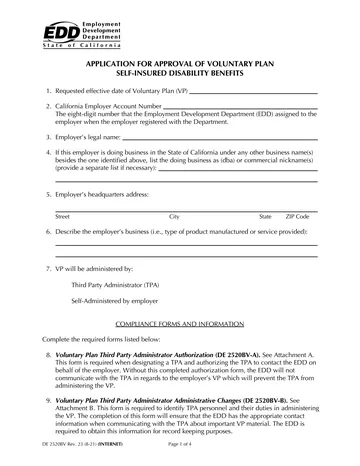
- At a glance
- The form, with hotspots
- Questions 1 to 7: the employer
- Questions 8 to 10: compliance forms
- Questions 11 to 14: plan provisions
- Questions 15 to 17: enrollment
- Questions 18 and 19: security deposit
- Items 20 to 25: required documents
- Certification and signatures
- Rules that trip employers up
- How it connects
- Questions employers ask
- Sources
- Who files
- Employers (or employee groups) setting up a voluntary plan
- Due
- At least 30 days before the plan starts
- Filed with
- EDD Voluntary Plan Group
- Form revision
- DE 2520BV Rev. 23 (8-21)
- Pages
- 4
At a glance
DE 2520BV is the Employment Development Department's “APPLICATION FOR APPROVAL OF VOLUNTARY PLAN SELF-INSURED DISABILITY BENEFITS”, revision DE 2520BV Rev. 23 (8-21). A California employer files it to replace state disability insurance (SDI) with its own self-insured voluntary plan (VP) for the employees who choose it. EDD describes the plan as “a legal alternative to mandatory State Disability Insurance (SDI)”, and it covers both halves of SDI: “If a VP employer provides DI coverage in lieu of the state plan, then it must also provide PFL coverage.”
- Who files. The employer, or an employee group with the employer's consent. EDD: “Employer and employee groups may establish a VP disability insurance program with mutual consent of the employer and a majority of the employees.”
- When. Before the plan starts, with lead time: “You must submit the application 30 days before your requested start date for the plan.”
- What the plan must offer. “Provide all the same benefits as SDI plus at least one that is better.” The plan must also be offered to all eligible California employees of the employer.
- Where. To EDD's Voluntary Plan Group. The guide lists the mail address as Employment Development Department, Disability Insurance Branch, Voluntary Plan Group, MIC 29VP, PO Box 826880, Sacramento, CA 94280-0001, and the VPG phone as 1-916-653-6839.
- Form. DE 2520BV (PDF), four pages: the employer and plan questions on pages 1 to 3, the certification on page 4. EDD's Employers' Guide to Voluntary Plan Procedures (DE 2040) explains each requirement.
EDD, Become a Voluntary Plan Employer; DE 2520BV Rev. 23 (8-21); DE 2040 Rev. 7 (12-20).
Tap a box once for its note, again to jump to the line. Zoom in to read the small print.
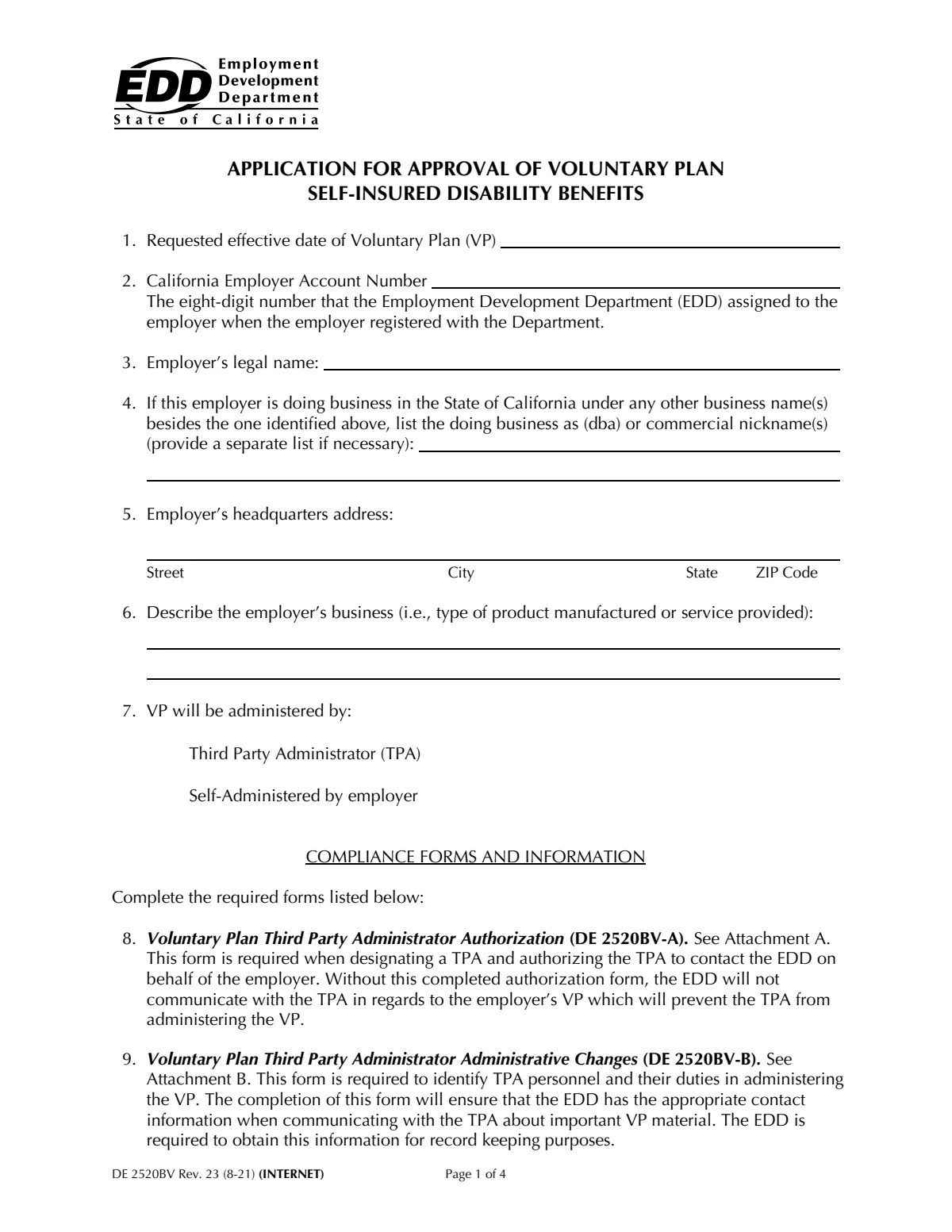
Questions 1 to 7: the employer
Page 1 identifies the employer and says who will run the plan. Use the same account number and legal name EDD has on file for payroll taxes, so the plan ties to the account that stops paying SDI for covered employees once the plan is approved.
| Item | Question as printed | What goes there |
|---|---|---|
| 1 | Requested effective date of Voluntary Plan (VP) | The date coverage under the voluntary plan (VP) should begin. EDD asks for lead time: “You must submit the application 30 days before your requested start date for the plan.” The guide adds that a plan run without approval costs the employer: “Any employer who operates a VP without EDD approval will be responsible for all SDI contributions withheld from the wages of employees.” |
| 2 | California Employer Account Number | The eight-digit number that the Employment Development Department (EDD) assigned to the employer when the employer registered with the Department. A new employer registers for a payroll tax account first, through e-Services for Business. |
| 3 | Employer’s legal name: | The legal name of the entity that holds the EDD account. A trade name goes on line 4. |
| 4 | Other business names (doing business as) | List every dba or commercial nickname used in California. The form allows a separate list if they do not fit. |
| 5 | Employer’s headquarters address: | Street, city, state and ZIP code. Plan mail goes to the contacts on the DE 2520BV-C (line 10). |
| 6 | Describe the employer’s business | A short description: type of product manufactured or service provided. |
| 7 | VP will be administered by: | Check Third Party Administrator (TPA) or Self-Administered by employer. A TPA is optional: An employer is not required to have a TPA to establish a VP. The answer also decides who gets the deposit instructions (line 18). |
Questions 8 to 10: compliance forms
These three attachments keep EDD's contact records current. The guide states the rule plainly: “If the applicant is contracted with a Third Party Administrator, then all of the attachments;” DE 2520BV-A, DE 2520BV-B and DE 2520BV-C must go with the application. A self-administered plan sends only the DE 2520BV-C.
| Item | Form named | When it is required |
|---|---|---|
| 8 | Voluntary Plan Third Party Administrator Authorization (DE 2520BV-A) | Only with a TPA. “Without this completed authorization form, the EDD will not communicate with the TPA in regards to the employer’s VP”. Download the DE 2520BV-A (PDF). |
| 9 | Voluntary Plan Third Party Administrator Administrative Changes (DE 2520BV-B) | Only with a TPA: This form is required to identify TPA personnel and their duties in administering the VP. DE 2520BV-B (PDF). |
| 10 | Voluntary Plan Employer Administrative Changes (DE 2520BV-C) | Every applicant files it. DE 2040: “When submitting a DE 2520BV, it must always be accompanied by the Voluntary Plan Employer Administrative Changes (DE 2520BV-C).” Contact forms are then renewed each year: “These forms need to be completed and submitted to the EDD annually by June 15th.” DE 2520BV-C (PDF). |
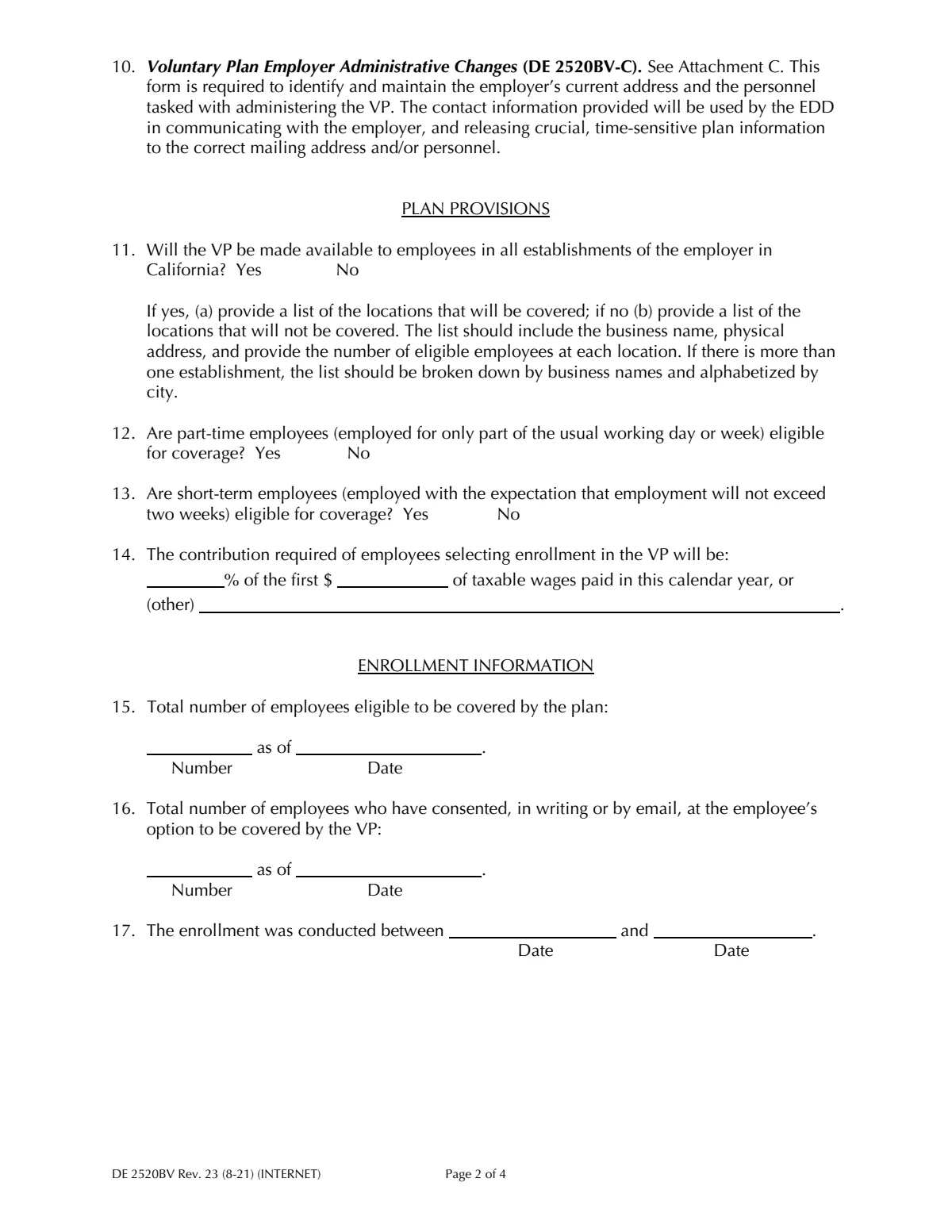
Questions 11 to 14: plan provisions
Page 2 sets who the plan covers and what employees pay. The plan may leave out only the groups DE 2040 names (part-time employees under half the standard workweek, short-term hires of two weeks or less, and employees separated from other units by geography); everyone else must be offered the plan.
| Item | Question as printed | What goes there |
|---|---|---|
| 11 | Will the VP be made available to employees in all establishments of the employer in California? | Check Yes or No, then attach the list the form describes: The list should include the business name, physical address, and provide the number of eligible employees at each location. A plan may cover all California employees or a separate establishment. Employees left out stay in state SDI: “the VP employer must withhold and submit the SDI tax (contribution) to the EDD to provide disability insurance coverage under the SDI program.” |
| 12 | Are part-time employees eligible for coverage? | Yes or No. DE 2040 lets the plan leave out “Part-time employees who work less than half of the employer’s standard workweek.” |
| 13 | Are short-term employees eligible for coverage? | Yes or No. The second exception is “Short-term employees who are hired for a period not expected to exceed two weeks.” |
| 14 | The contribution required of employees selecting enrollment in the VP will be: | Enter the percentage and the wage amount it applies to, or describe another formula on the (other) line. The ceiling: “An employer is authorized to deduct from a VP employee’s wages an amount that does not exceed the current SDI plan contribution rate.” For reference, The SDI withholding rate for 2026 is 1.3 percent. and The SDI withholding rate for 2027 is 1.4 percent. |
Questions 15 to 17: enrollment
The enrollment numbers prove the majority. Keep the signed or emailed consents: certification F promises they stay available for EDD inspection.
| Item | Question as printed | What goes there |
|---|---|---|
| 15 | Total number of employees eligible to be covered by the plan: | The count of eligible employees, with the date of the count. It is the denominator for the majority on line 16. |
| 16 | Total number of employees who have consented, in writing or by email, to be covered by the VP | The count of written or email consents, with its date. Approval needs “A majority of eligible employees have consented to the plan in writing.” Employees may still choose state SDI: “Employees who are eligible for coverage must be given the right to reject the VP and be covered by SDI.” |
| 17 | The enrollment was conducted between | The first and last dates of the enrollment period that produced the consents on line 16. |
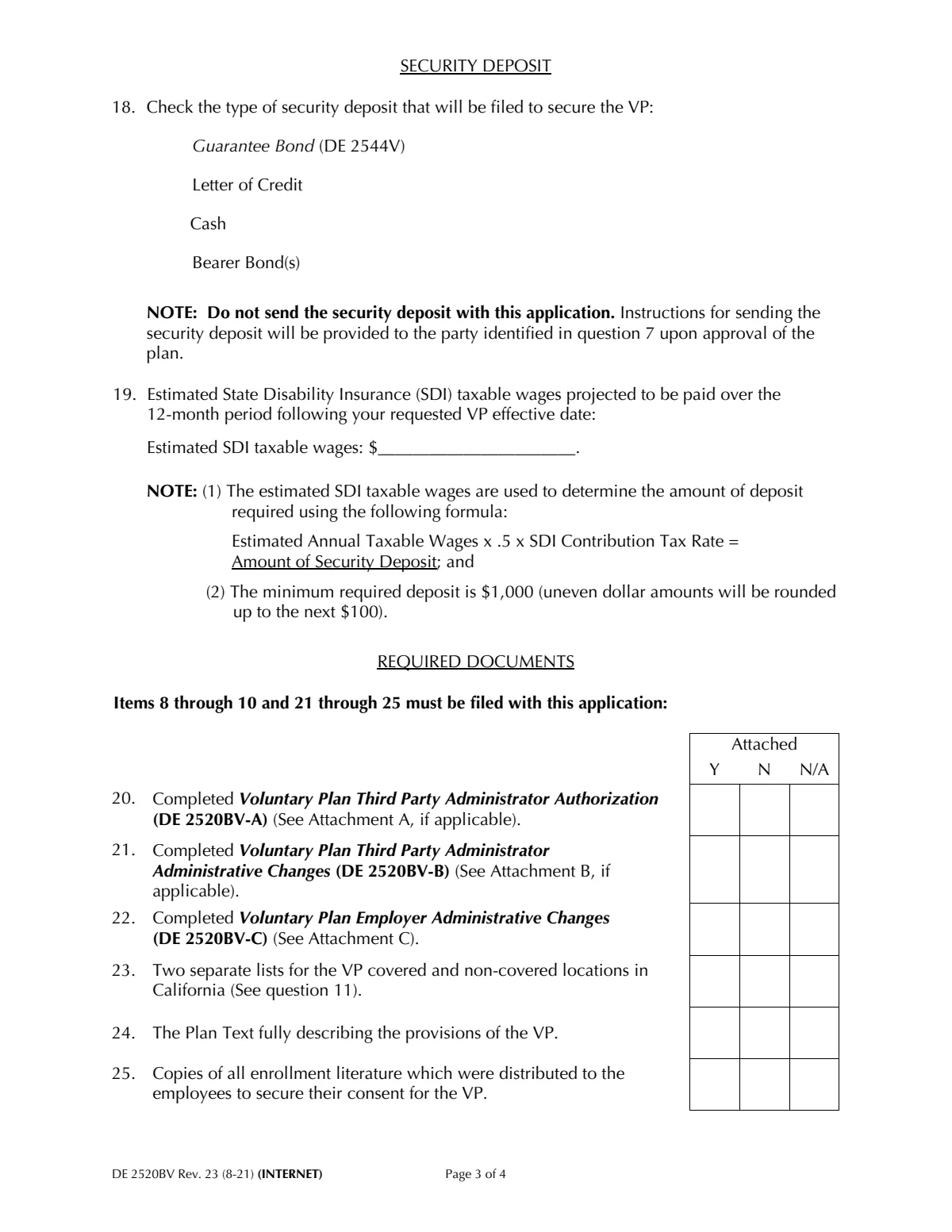
Questions 18 and 19: security deposit
The deposit protects claimants if the employer fails to pay. DE 2040 says it “will be used to reimburse the EDD if the employer fails to pay claims or fails to pay any assessments established in connection with the VP.” EDD may ask for more than the formula: the amount over the $1,000 minimum “is determined by the number of employees covered, the size of the payroll, the class of risks, the financial standing of the employer, and any other relevant factors as determined by the EDD.”
| Item | Question as printed | What goes there |
|---|---|---|
| 18 | Check the type of security deposit that will be filed to secure the VP: | Guarantee Bond (DE 2544V), Letter of Credit, Cash or Bearer Bond(s). Do not send the security deposit with this application. EDD approves the plan conditionally first: “If you meet all VP requirements, we will grant you a conditional approval pending your submission of a security deposit.” |
| 19 | Estimated State Disability Insurance (SDI) taxable wages projected to be paid over the 12-month period following your requested VP effective date | The form's formula: “Estimated Annual Taxable Wages x .5 x SDI Contribution Tax Rate = Amount of Security Deposit”, and “The minimum required deposit is $1,000 (uneven dollar amounts will be rounded up to the next $100).” DE 2040 words the base differently, as “Employers estimated taxable wages from previous year”; see the note below the table. |
Two wordings of the deposit base. The form (Rev. 23, 8-21) asks for wages projected over the 12 months after the requested effective date. DE 2040 (Rev. 7, 12-20) words the same formula as “Employers estimated taxable wages from previous year X 0.5 X current SDI contribution rate = VP security deposit.” Both use half the wages times the SDI rate, with a $1,000 minimum under CUIC section 3258. Answer line 19 as the form asks; EDD sets the final amount when it approves the plan. Since 2024 all wages are subject to SDI (“Effective January 1, 2024, all wages are subject to SDI contributions.”), so "taxable wages" here means all SDI wages.
Items 20 to 25: required documents
Mark each item Y, N or N/A. The heading on the form reads “Items 8 through 10 and 21 through 25 must be filed with this application:” An incomplete package is the common reason EDD asks for more information before it grants conditional approval.
| Item | Document | What to attach |
|---|---|---|
| 20 | Completed DE 2520BV-A (if applicable) | Mark Y, N or N/A. Y when line 7 names a TPA. |
| 21 | Completed DE 2520BV-B (if applicable) | Mark Y, N or N/A. Y when line 7 names a TPA. |
| 22 | Completed DE 2520BV-C | Mark Y. The form lists it with no "if applicable". |
| 23 | Two separate lists for the VP covered and non-covered locations in California | The lists from question 11, with business name, address and eligible employees per location. |
| 24 | The Plan Text fully describing the provisions of the VP. | The plan document. EDD posts a model, Plan Text Provisions (DE 2008), and requires a fresh one every year: “The EDD requires all employers/TPAs to submit new VP text provisions annually by February 15th.” |
| 25 | Copies of all enrollment literature distributed to the employees to secure their consent | Every handout, email and election form used. Covered employees also get a written statement of their rights: “All covered employees must be given a written document that states their rights and benefits under the VP.” |
Certification and signatures
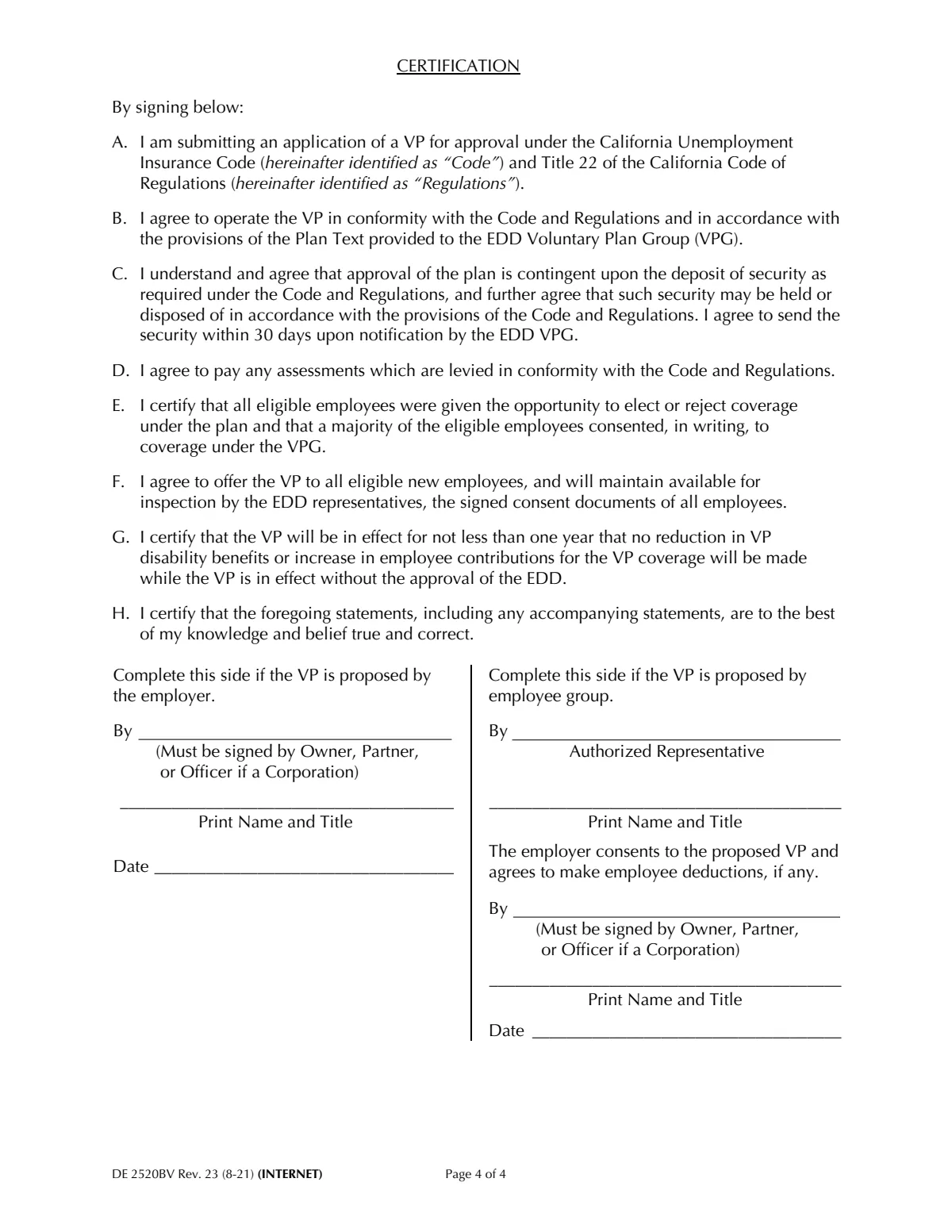
Page 4 holds the employer to the plan's ongoing duties. Sign only one side: the left side when the employer proposes the plan, the right side when an employee group proposes it (and then the employer also signs below the group to consent and agree to the deductions).
| Item | Statement | What it commits you to |
|---|---|---|
| Cert-A | A. Application under the Code and Title 22 | The signer applies under the California Unemployment Insurance Code and Title 22 of the California Code of Regulations. |
| Cert-B | B. Operate in conformity with the Plan Text | The plan must run as the Code, the regulations and the Plan Text given to the Voluntary Plan Group (VPG) say. |
| Cert-C | C. Security deposit | The signer agrees to send the security within 30 days of EDD's notice. Approval is contingent on the deposit. |
| Cert-D | D. Assessments | The signer agrees to pay any assessments levied under the Code and regulations. EDD: “You will need to pay an assessment to us based on the taxable wages of employees participating in the plan.” |
| Cert-E | E. Election and majority consent | Every eligible employee had the chance to elect or reject coverage, and a majority consented in writing. |
| Cert-F | F. New employees and consent records | The plan is offered to all eligible new employees, and the signed consents stay available for EDD inspection. |
| Cert-G | G. One year minimum; no cuts without approval | The plan runs for at least a year, and no benefit cut or contribution increase may be made while it is in effect without EDD approval. DE 2040 lists the only dates on which deductions may rise: On an anniversary of the plan effective date under CUIC, section 3254., or when the SDI rate or wage limit rises. |
| Cert-H | H. True and correct | The statements, with any attachments, are true and correct to the best of the signer's knowledge and belief. |
| Sign-employer | Complete this side if the VP is proposed by the employer | Signed by the owner, a partner or, for a corporation, an officer, with the printed name, title and date. |
| Sign-group | Complete this side if the VP is proposed by employee group | The group's authorized representative signs and prints name and title. Below it the employer signs too: “The employer consents to the proposed VP and agrees to make employee deductions, if any.” |
Rules that trip employers up
- Running the plan before approval. Until EDD grants full approval, keep withholding and paying SDI. A plan run without approval leaves the employer liable for all SDI withheld, and EDD “will not reimburse the employer for any benefits paid while operating under an unapproved VP.”
- Mixing plan money with the business. Employee contributions are trust funds kept in a separate account: “Contributions from covered employees must be set up in a separate bank account, which is credited with plan contributions.”
- Forgetting the employees who opt out. Employees who reject the plan, and those outside its scope, stay in state SDI, so payroll runs two deduction codes. VP employers report both on the Quarterly Contribution Return (DE 3D), which also computes the VP assessment.
- Raising deductions mid-year. Deductions may rise only on the plan anniversary or when the SDI rate or wage limit rises (DE 2040, citing CUIC sections 984, 985 and 3254).
- Letting the plan lag SDI. The plan must “Must be updated to match any increase in benefits that SDI implements as a result of legislation or approved regulation.”
- Withdrawing without notice. VP withdrawals must be requested in writing 30 days prior to the requested withdrawal date.
How it connects
- California SDI rates, the DE 9 and DE 9C, and voluntary plans in the program context: California SDI for employers.
- How voluntary, private and self-insured plans compare across the states: private and equivalent plans and the private plan comparison tool.
- The other state disability programs with a self-insured route: state disability insurance, New York DB-150 and Hawaii TDI-15.
Questions employers ask
How far ahead must DE 2520BV be filed?
At least 30 days before the requested start date, EDD says. Keep withholding and paying SDI until EDD grants full approval, which comes only after the security deposit.
What is the minimum security deposit for a California voluntary plan?
$1,000. The form's formula is estimated annual SDI wages times .5 times the SDI contribution rate, rounded up to the next $100, and EDD may require more based on the employees, payroll, risk and the employer's finances.
Do all employees have to join the voluntary plan?
No. A majority of eligible employees must consent in writing, and any employee may reject the plan and stay in state SDI. The employer keeps withholding SDI for those employees.
Can the plan charge employees more than SDI?
No. Deductions may not exceed the current SDI contribution rate (1.3 percent for 2026 and 1.4 percent for 2027), and may rise only on the plan anniversary or when the SDI rate or wage limit rises.
Do I need a third party administrator?
No. DE 2040 says an employer is not required to have a TPA. If one is used, file the DE 2520BV-A and DE 2520BV-B with the application, or EDD will not deal with the TPA.
Does a voluntary plan have to cover Paid Family Leave too?
Yes. DE 2040: a VP employer that provides disability insurance in place of the state plan must also provide PFL coverage.