- Who files
- Each employer entity seeking to self-insure
- Due
- No deadline; file before the start date
- Filed with
- WCB Office of Self-Insurance, by email
- Form revision
- DB-150 (3-25)
- Pages
- 2
At a glance
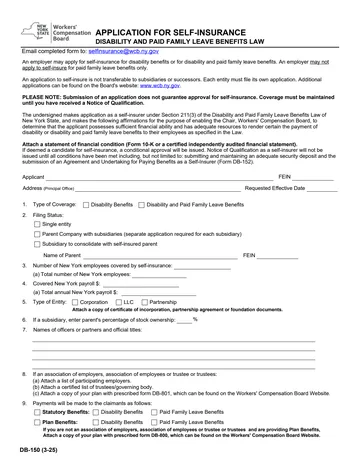
Form DB-150 is the New York Workers' Compensation Board's “APPLICATION FOR SELF-INSURANCE” under the Disability and Paid Family Leave Benefits Law, revision DB-150 (3-25) (WCB's forms list shows it as DB-150 (3/25)). An employer files it to pay New York disability benefits, or disability and Paid Family Leave benefits, itself instead of buying a policy. The applicant applies “as a self-insurer under Section 211(3) of the Disability and Paid Family Leave Benefits Law of New York State”. WCB's own words: “Self-Insurance is a privilege in New York State.”
- Who files. Each employer entity that wants to self-insure; each subsidiary files its own.
- When. WCB's forms list says “No filing deadline”. File well before the requested effective date, and keep insured coverage until approval is final.
- How. By email to selfinsurance@wcb.ny.gov, with the attachments.
- Attach. “Attach a statement of financial condition (Form 10-K or a certified independently audited financial statement).” WCB's page adds the foundation documents and “A copy of the applicant's most recent independently audited financial statement.”
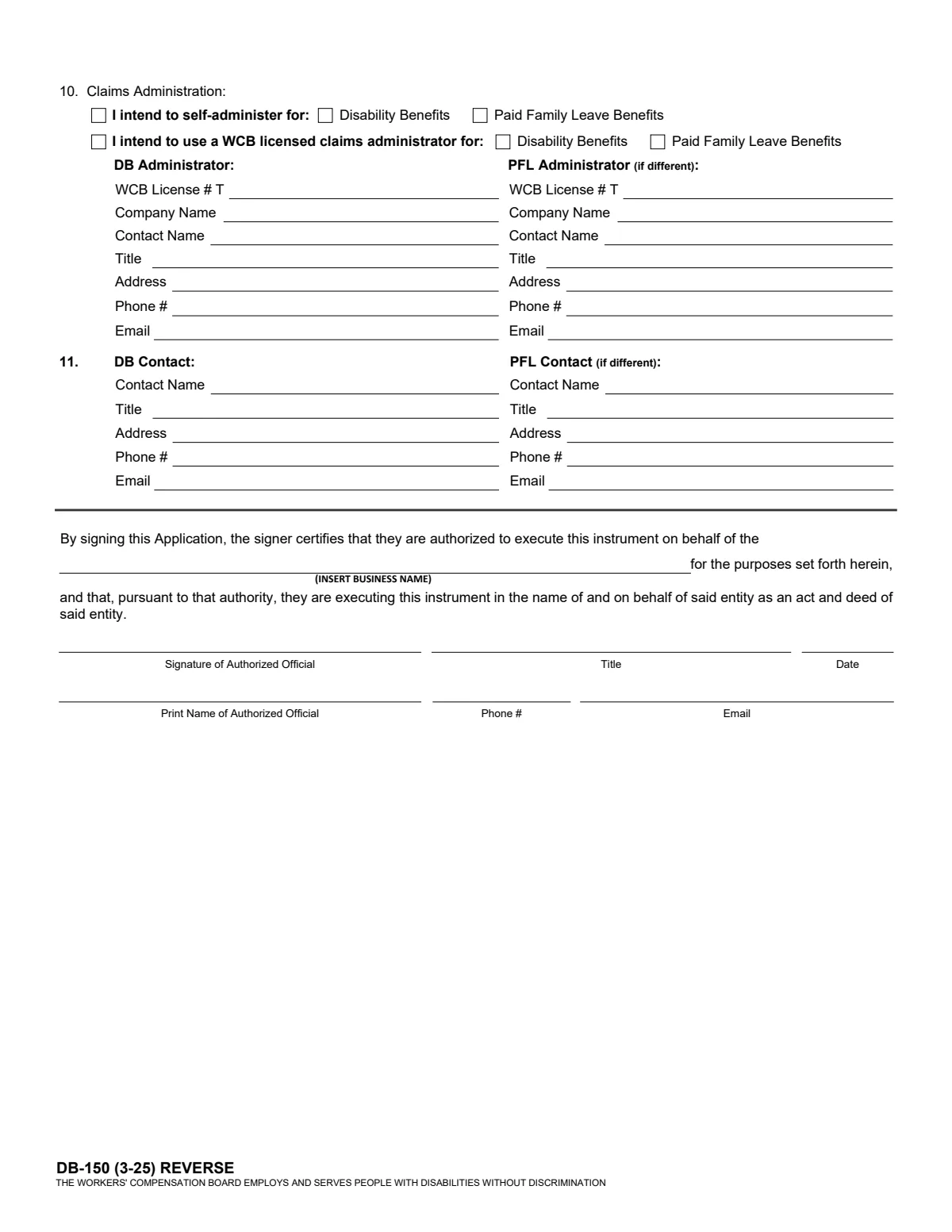
- Form. DB-150 (PDF), two pages: the applicant and items 1 to 9 on page 1, claims administration, contacts and the signature on page 2.
WCB, Individual Self-Insurance, Disability and Paid Family Leave Benefits; WCB, Self-Insured Employers.
Tap a box once for its note, again to jump to the line. Zoom in to read the small print.
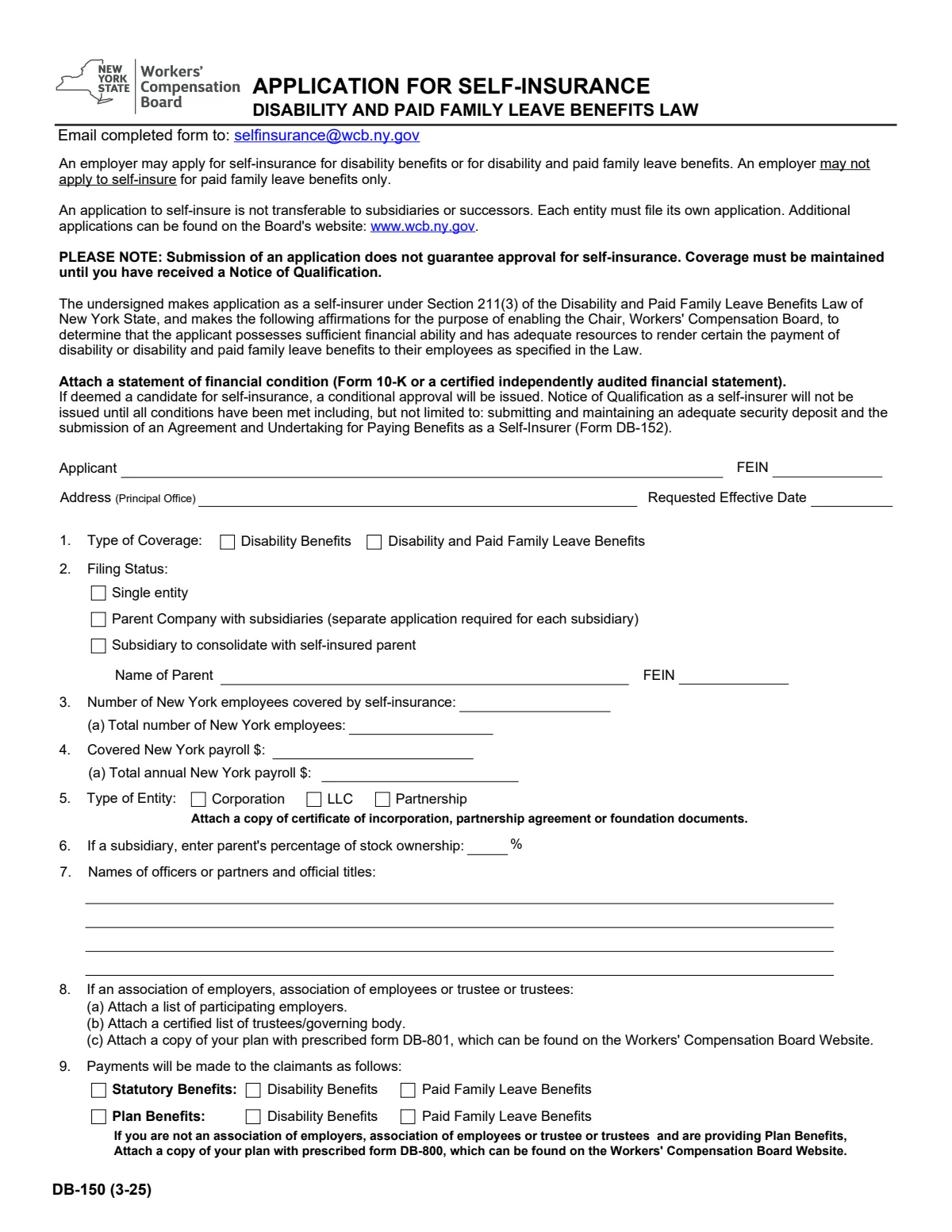
The applicant block
The top of page 1 identifies the one entity applying. A group of related companies is not one applicant: a parent and each subsidiary file separate DB-150s (item 2).
| Box | Label as printed | What goes there |
|---|---|---|
| Applicant | Applicant | The legal name of the applying entity. “An application to self-insure is not transferable to subsidiaries or successors.” WCB repeats it: “Subsidiaries are not automatically covered if their parent company is approved for self-insurance coverage.” |
| FEIN | FEIN | The applicant's federal employer identification number, the number WCB uses to match coverage records. |
| Address | Address (Principal Office) | The principal office address. |
| Effective | Requested Effective Date | The start date you ask for. Until approval is final, keep the insured policy in force: “Coverage must be maintained until you have received a Notice of Qualification.” |
Items 1 to 9: coverage and the entity
These items tell the Board what it is being asked to approve: which benefits, for how many New York employees and how much payroll, through what kind of entity, and whether the employer pays the statutory benefit or a richer plan.
| Item | Label as printed | What goes there |
|---|---|---|
| 1 | 1. Type of Coverage: | Check Disability Benefits, or Disability and Paid Family Leave Benefits. “An employer may not apply to self-insure for paid family leave benefits only.” |
| 2 | 2. Filing Status: | Single entity; parent company with subsidiaries (separate application required for each subsidiary); or subsidiary to consolidate with a self-insured parent, with the parent's name and FEIN on the line below. |
| 3 | 3. Number of New York employees covered by self-insurance: | The employees the self-insurance will cover, and on (a) the total number of New York employees. The deposit depends on this count: “The initial amount of the security deposit will be based, in part, on the number of covered employees.” |
| 4 | 4. Covered New York payroll $ | The payroll of the covered employees, and on (a) the total annual New York payroll. |
| 5 | 5. Type of Entity: | Corporation, LLC or Partnership. Attach a copy of certificate of incorporation, partnership agreement or foundation documents. |
| 6 | 6. If a subsidiary, enter parent's percentage of stock ownership | The parent's ownership percentage. Leave blank for a single entity. |
| 7 | 7. Names of officers or partners and official titles: | Each officer or partner with title. Four lines are printed; attach a list if needed. |
| 8 | 8. If an association of employers, association of employees or trustee or trustees | Only for associations and trustees: attach the participating employers, a certified list of trustees, and the plan on prescribed Form DB-801. |
| 9 | 9. Payments will be made to the claimants as follows: | Check Statutory Benefits or Plan Benefits for Disability Benefits and for Paid Family Leave Benefits. A single employer paying plan benefits attaches its plan on prescribed Form DB-800, DB-800 (PDF), the form for self-insured employers offering a shorter waiting period or a longer duration than the statute requires. |
Items 10 and 11 and the signature
Page 2 names who handles claims and who the Board should call. A self-insurer takes on the carrier's duties, including the 18-day deadline to pay, deny or reject a claim printed on the DB-271S statement of rights, so the administrator choice matters.
| Item | Label as printed | What goes there |
|---|---|---|
| 10 | 10. Claims Administration: | Check self-administer, or use a WCB licensed claims administrator, for Disability Benefits and for Paid Family Leave Benefits. The two may differ. |
| 10-DB | DB Administrator | For a licensed administrator: the WCB license number (printed with a T prefix), company name, contact name, title, address, phone and email. |
| 10-PFL | PFL Administrator (if different) | The same details, only when a different administrator handles Paid Family Leave claims. |
| 11-DB | 11. DB Contact | The applicant's own person for disability benefit matters: name, title, address, phone and email. |
| 11-PFL | PFL Contact (if different) | A separate person for Paid Family Leave, if any. |
| Authority | By signing this Application, the signer certifies that they are authorized to execute this instrument | Insert the business name in the blank. The signer certifies the authority to sign for the entity, as its act and deed. |
| Signature | Signature of Authorized Official; Title; Date; Print Name; Phone #; Email | Sign, date and print. Then email the form: “Email completed form to: selfinsurance@wcb.ny.gov” |
After the application: approval, deposit, annual report
The DB-150 starts a two-stage approval. The form says: “If deemed a candidate for self-insurance, a conditional approval will be issued.” The Notice of Qualification comes only after the conditions are met, “including, but not limited to: submitting and maintaining an adequate security deposit and the submission of an Agreement and Undertaking for Paying Benefits as a Self-Insurer (Form DB-152).” WCB's page lists what follows conditional approval:
- The signed and notarized Agreement and Undertaking for Paying Benefits as a Self-Insurer (Form DB-152).
- A security deposit in a form the Chair prescribes. The minimum is $10,000 for disability only and $11,000 for disability and Paid Family Leave. All self-insurers except political subdivisions post it “in the form of cash, irrevocable letter of credit and/or surety bond.” WCB accepts the surety bond forms DB-179, DB-179.1 and DB-179A with certificate-based electronic signatures.
- Each year after that, the Self-Insurer Annual Report (DB-681), and a deposit review: “Every year that the employer remains self-insured, the security deposit is reviewed for adequacy, based in part on changes in covered employee count.”
Leaving self-insurance works the other way: notify the Office of Self-Insurance, and “The security deposit maintained by the Board for disability and Paid Family Leave benefits may be returned 24 months after the effective date of termination of an employer's status as a self-insurer, if there are no outstanding compliance issues.”
Rules that trip employers up
- Dropping the policy too early. Filing is not approval. “Submission of an application does not guarantee approval for self-insurance.” A gap in coverage brings WCB's penalties: “The Board shall impose upon an employer a penalty not in excess of 1/2 of one percent of the employer's payroll during the period of noncompliance PLUS an additional sum not in excess of $500 for each period of noncompliance.”
- Asking for PFL only. Not allowed: PFL may be self-insured only together with disability benefits.
- One application for the group. Each entity files its own; subsidiaries are not covered by the parent's approval.
- Missing reports. “Failure to meet any of the reporting requirements may result in termination of the employer's status as a self-insurer.”
- Plan benefits without the plan form. A single employer offering more than the statute files the DB-800; an association or trustees file the DB-801.
How it connects
- The program the self-insurer takes on: coverage, the employee contribution and carriers: New York DBL for employers and New York Paid Family Leave.
- The notice every New York employer, insured or self-insured, gives disabled employees: DB-271S.
- Self-insured and private plans in other states: private and equivalent plans, California DE 2520BV and Hawaii TDI-15.
Questions employers ask
Can a New York employer self-insure Paid Family Leave only?
No. The DB-150 says an employer may apply to self-insure for disability benefits, or for disability and Paid Family Leave benefits, but not for Paid Family Leave only.
What is the minimum security deposit for New York DBL self-insurance?
$10,000 for disability only and $11,000 for disability and Paid Family Leave, as WCB states as of November 2026. The Board sets the actual amount, based partly on the number of covered employees, and reviews it every year.
Where do I send the DB-150?
By email to selfinsurance@wcb.ny.gov, with a Form 10-K or certified independently audited financial statement and the foundation documents.
Is there a deadline to file the DB-150?
WCB's forms list says there is no filing deadline. Keep the insured policy until the Board issues the Notice of Qualification.
Does approval for the parent company cover its subsidiaries?
No. Each entity files its own application; a subsidiary can ask to consolidate with a self-insured parent under item 2, but it still files a DB-150.
What must a self-insurer file every year?
The Self-Insurer Annual Report, Form DB-681. WCB also reviews the security deposit each year.
Sources
- WCB, DB-150 (3-25), Application for Self-Insurance, Disability and Paid Family Leave Benefits Law (PDF)
- WCB, Individual Self-Insurance, Disability and Paid Family Leave Benefits
- WCB, Self-Insured Employers
- WCB, Disability and Paid Family Leave forms for employers
- WCB, Penalties for Not Having Disability and Paid Family Leave Benefits Coverage