- Who files
- Hawaii employers self-insuring TDI
- Due
- Before the plan takes effect
- Filed with
- DLIR Disability Compensation Division
- Form revision
- Rev. 06/2026
- Pages
- 2, plus a 2-page instruction sheet
At a glance
Form TDI-15 is the Hawaii Department of Labor and Industrial Relations' “TDI SELF-INSURER’S PLAN CERTIFICATION AND AGREEMENT”, revision Rev. 06/2026. A Hawaii employer files it to provide temporary disability insurance (TDI) through its own self-insured plan instead of buying a policy. DLIR's Disability Compensation Division (DCD) describes the self-insured route: “A self-insured employer pays benefits directly to its disabled employees.”
- Who files. An employer choosing self-insurance under HRS 392-41, one form per benefit schedule.
- When. Before the plan takes effect; DCD must approve it first.
- What to send. “Two completed TDI-15 forms.”, a copy of the self-insured plan, the latest annual report or audited financial statements (with the auditor's opinion and notes) and, if any, the collective bargaining agreement.
- Where. Department of Labor and Industrial Relations, Disability Compensation Division, 830 Punchbowl Street, Room 209, Honolulu, Hawaii 96813.
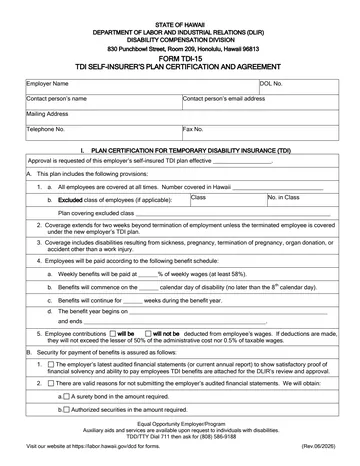
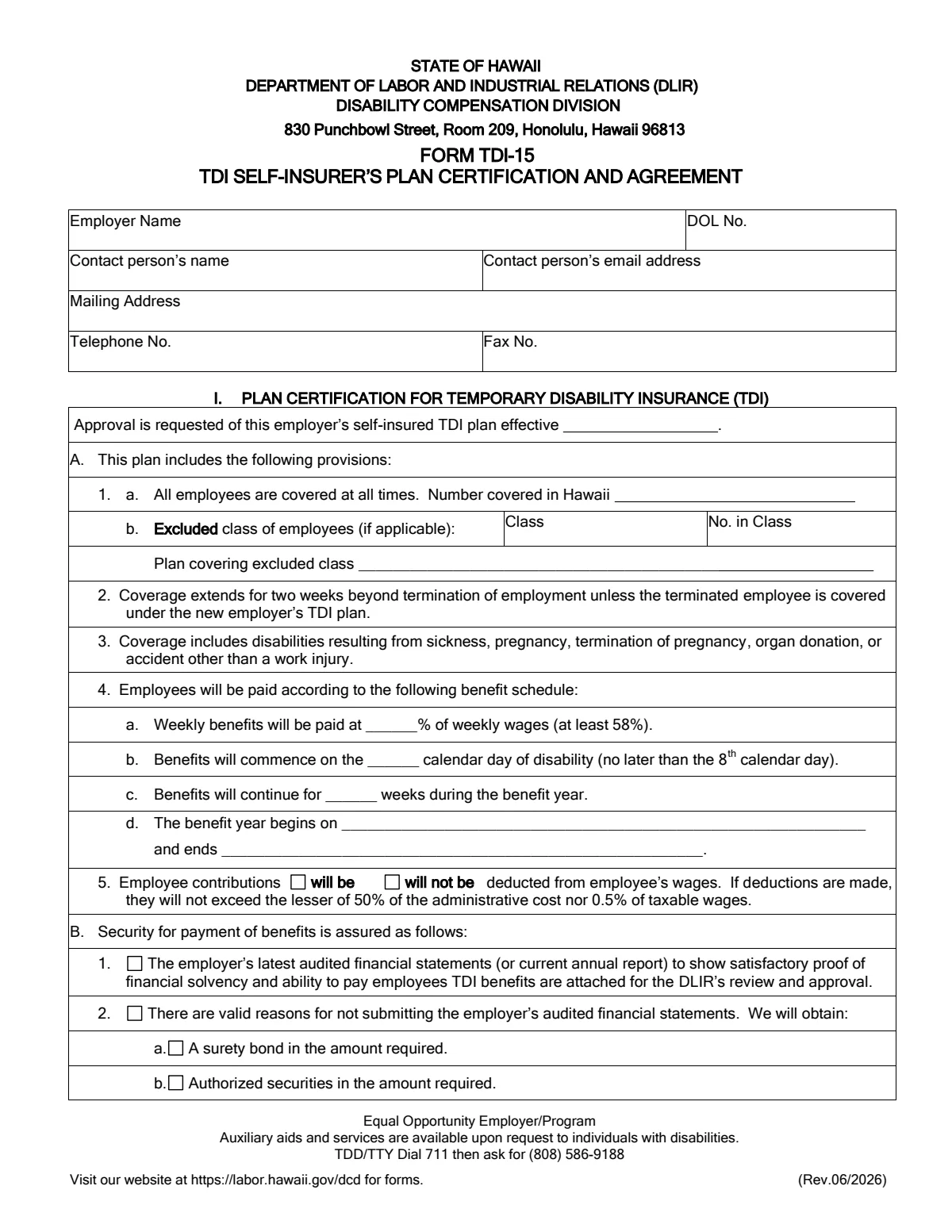
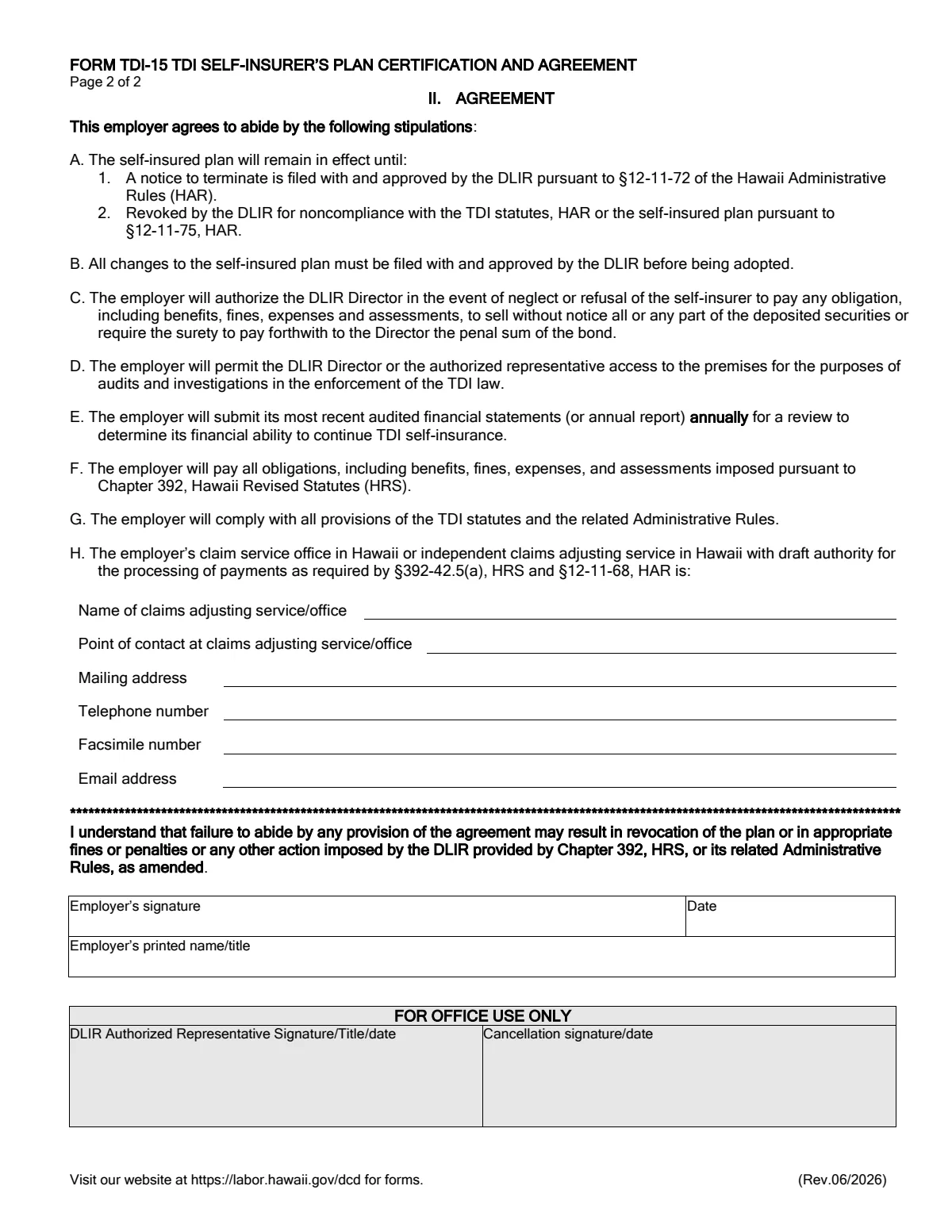
- Form. TDI-15 (PDF): PDF pages 1 and 2 are the instruction sheet and pages 3 and 4 the form shown below.
Instruction Sheet for Form TDI-15 (Rev. 06/2026).
Tap a box once for its note, again to jump to the line. Zoom in to read the small print.
The header
The header identifies the employer and the person DCD will contact during the review, and asks for the effective date.
| Box | Label as printed | What goes there |
|---|---|---|
| Employer | Employer Name | The employer's legal name. A separate TDI-15 is needed for each benefit schedule: “If you have a different schedule of benefits for separate classes of employees, complete one Form TDI-15 for each plan.” |
| DOL-No | DOL No. | The employer's Hawaii Department of Labor and Industrial Relations number. |
| Contact | Contact person's name | The person DCD should contact about the plan review. |
| Contact-email | Contact person's email address | The contact's email. |
| Address | Mailing Address | The mailing address. DCD returns the approved copy here. |
| Phone | Telephone No. | The contact's phone number. |
| Fax | Fax No. | Fax number, if any. |
| Effective | Approval is requested of this employer’s self-insured TDI plan effective | The requested start date. DLIR: “All self-insured plans must be submitted (FormTDI-15) to this Division for review and approval before they can be put into effect.” |
Part I.A: plan provisions
The instruction sheet is blunt: “Your TDI plan must contain all items under section A.” Items 1 to 3 are fixed terms; item 4 is the benefit schedule; item 5 is the employee contribution.
| Item | Label as printed | What goes there |
|---|---|---|
| A1a | All employees are covered at all times. Number covered in Hawaii | The number of Hawaii employees the plan covers. |
| A1b | b. Excluded class of employees (if applicable): Class; No. in Class; Plan covering excluded class | Only if some employees are outside this plan. The instructions: “indicate the classes and the number of employees in each class who are excluded.” Name the insurer and policy number of the plan that covers them, and send the collective bargaining agreement if it has sick leave terms. HRS 392-41(c) keeps the law's requirements for every employee a plan leaves out. |
| A2 | Coverage extends for two weeks beyond termination of employment unless the terminated employee is covered under the new employer’s TDI plan. | A required provision: the plan keeps covering a former employee for two weeks after the job ends. |
| A3 | 3. Coverage includes disabilities resulting from sickness, pregnancy, termination of pregnancy, organ donation, or accident other than a work injury. | A required provision. Work injuries belong to workers' compensation. |
| A4 | Employees will be paid according to the following benefit schedule: | Fill in a to d. For the statutory plan the instructions list Weekly benefits at 58% of weekly wages., benefits from the 8th day, and 26 weeks in the benefit year. A different schedule must be at least as favorable, judged by the TDI-14 Equivalency Tables. |
| A4a | a. Weekly benefits will be paid at ____% of weekly wages (at least 58%). | The percentage, 58 or more. For the statutory plan the weekly benefit is capped; DCD's notice “2026 MAXIMUM WEEKLY WAGE BASE AND MAXIMUM WEEKLY BENEFIT AMOUNT” sets the 2026 maximum at $871.00. |
| A4b | b. Benefits will commence on the ____ calendar day of disability (no later than the 8th calendar day). | The first day of benefits. The statutory waiting period is not more than 7 consecutive calendar days. |
| A4c | c. Benefits will continue for ____ weeks during the benefit year. | The number of weeks. The TDI-14 tables do not credit anything past 26 weeks: “Benefits payable for periods beyond 26 weeks cannot be used to either reduce or make up any deficiency” |
| A4d | d. The benefit year begins on ____ and ends ____. | The plan's benefit year dates, for example the calendar year. |
| A5 | Employee contributions will be / will not be deducted from employee's wages | Check one. The instructions: “Under the TDI law, an employer is authorized, but not required, to withhold contributions from the eligible and covered employees.” The form caps deductions at the lesser of 50% of the administrative cost nor 0.5% of taxable wages; the rule reads “The employees' contributions shall not exceed one-half the cost but not more than 0.5 per cent of the employees' weekly wage”, where the cost includes administrative expenses. The 2026 maximum weekly deduction is $7.50. |
Statutory or equivalent benefits
A plan either matches the statutory schedule (58 percent of wages, from the 8th day, for 26 weeks) or proves equivalence with the TDI-14 tables. The tables score the statutory plan at 104: “Actuarial values shown in the Tables relate to the statutory benefit schedule on the basis of the component statutory benefits having a value of 104.” The TDI-15 instructions give examples that reach that score, such as 67 percent from the 8th day for 16 weeks, 70 percent from the 1st day for 7 weeks, or 100 percent from the 1st day for 3 weeks. Two floors apply: “Benefits less than 58% cannot be considered in computing equivalency, nor will plans with less than three weeks of wage replacement be considered.”
Part I.B: security
Check B.1 or B.2. Most self-insurers prove solvency with audited financial statements, which HAR 12-11-69(3) allows in place of a deposit. Without them, the employer posts a surety bond or deposits securities in an amount DLIR sets.
| Item | Label as printed | What goes there |
|---|---|---|
| B1 | B.1 The employer's latest audited financial statements (or current annual report) are attached | The usual route. Attach the statements, with the auditor's opinion and notes. DLIR: “Following the initial approval, the audited financial statements must be submitted annually for continued approval of the employer’s self-insured plan” |
| B2 | B.2 There are valid reasons for not submitting the employer's audited financial statements | Check only when statements will not be submitted; then choose a or b. The amount is set by the director: “The number of employees involved, the exposure, the financial standing of the applicant, and other factors which the director may deem proper shall be given effect in fixing the amount.” |
| B2a | a. A surety bond in the amount required. | A bond of a surety company authorized in Hawaii, in the name of the Director of Labor and Industrial Relations. |
| B2b | b. Authorized securities in the amount required. | Government securities deposited with the State director of finance, “in an amount acceptable to the director, but in no event less than $2,000.” |
Part II: the agreement
Page 2 is the agreement HAR 12-11-68 requires every self-insurer to sign. The instructions: “Continuation of self-insured status is contingent upon adherence to the stipulations.”
| Item | Label as printed | What it commits you to |
|---|---|---|
| II-A | A. The self-insured plan will remain in effect until: 1. a notice to terminate is approved (HAR 12-11-72); 2. revoked by the DLIR (HAR 12-11-75) | The plan runs until DLIR approves a termination or revokes it. The deposit comes back later: “may have the security deposit returned after 24 months from termination as specified in Section 12-11-72 of the Hawaii Administrative Rules.” |
| II-B | All changes to the self-insured plan must be filed with and approved by the DLIR before being adopted. | Benefit changes, new classes and contribution changes all go to DCD first. |
| II-C | C. Authority to sell deposited securities or require the surety to pay | If the self-insurer does not pay, the Director may sell the securities without notice or call on the bond (HAR 12-11-68(4)). |
| II-D | D. Access to the premises for audits and investigations | DLIR's representatives may examine operations and records. |
| II-E | The employer will submit its most recent audited financial statements (or annual report) annually | A yearly filing; continued self-insured status depends on it. |
| II-F | F. Pay all obligations, including benefits, fines, expenses, and assessments imposed pursuant to Chapter 392, HRS | Including the assessments HRS 392-41(b) requires a plan to pay. |
| II-G | G. Comply with all provisions of the TDI statutes and the related Administrative Rules | A general promise; revocation is the remedy for breaking it. |
| II-H | H. Claim service office in Hawaii or independent claims adjusting service in Hawaii with draft authority | Required by HRS 392-42.5(a) and HAR 12-11-68: the self-insurer must “maintain a complete claims service office or engage an independent claims adjusting service as a claims agent in the State of Hawaii” with draft authority for payments. |
| H-name | Name of claims adjusting service/office | The in-state office or adjusting service. |
| H-contact | Point of contact at claims adjusting service/office | The person who handles TDI claims. |
| H-address | Mailing address | The office's mailing address in Hawaii. |
| H-phone | Telephone number | Its phone number. |
| H-fax | Facsimile number | Its fax number. |
| H-email | Email address | Its email. |
| Ack | I understand that failure to abide by any provision of the agreement may result in revocation of the plan or in appropriate fines or penalties | The penalty for having no valid TDI coverage at all is steep: “a penalty of not less than $500 or of $100 for each employee for every day during which such failure continues, whichever sum is greater” (HRS 392-47). |
| Signature | Employer's signature; Date; Employer's printed name/title | Sign and date both copies: “Please remember to sign and date the form before submitting it.” |
| Office | FOR OFFICE USE ONLY: DLIR Authorized Representative Signature/Title/date; Cancellation signature/date | Leave blank. DCD signs here and returns one copy as the approval. |
Rules that trip employers up
- One copy. Send two signed forms; DCD returns one as the approval.
- One form for several schedules. Each separate benefit schedule needs its own TDI-15.
- Starting before approval. The plan cannot take effect until DCD approves it; keep insured coverage until then.
- Over-collecting from employees. Contributions are capped at half the cost and 0.5 percent of weekly wages, kept in a separate fund, and any excess over half the cost at year end is refunded or credited (HAR 12-11-76).
- No Hawaii claims office. A mainland payroll office does not meet item II.H; the claims office or adjuster must be in Hawaii with draft authority.
- Skipping the annual statements. Item II.E makes them a yearly condition of keeping the plan.
- Not posting the notice. HAR 12-11-66 requires a self-insurer to post notices that it provides disability benefits directly, in the form the director prescribes.
How it connects
- Hawaii TDI for employers: coverage, the 0.5 percent employee share, carriers and the 2026 maximums: Hawaii TDI.
- The other disability programs with a self-insured route: state disability insurance, California DE 2520BV and New York DB-150.
- Comparing private and self-insured plans across states: private and equivalent plans.
Questions employers ask
What is Form TDI-15 used for?
To get DLIR approval for a self-insured temporary disability insurance plan in Hawaii. It certifies the plan's terms and is the employer's agreement to the self-insurer's obligations.
How many copies of the TDI-15 do I send?
Two completed forms, with a copy of the plan, the latest annual report or audited financial statements and any collective bargaining agreement. DCD returns one approved copy or asks for changes.
What benefits must a self-insured Hawaii TDI plan pay?
At least the statutory schedule, 58 percent of weekly wages from the 8th day of disability for 26 weeks, or a schedule DLIR finds at least as favorable using the TDI-14 equivalency tables.
Do I need a bond to self-insure TDI in Hawaii?
Not if DLIR accepts your audited financial statements as proof of solvency. Otherwise you post a surety bond or deposit securities, at least $2,000, in an amount DLIR sets.
Can employees contribute to a self-insured plan?
Yes, if the employer chooses. Contributions may not exceed half the cost of the plan or 0.5 percent of weekly wages, $7.50 a week at most for 2026.
How do I end a self-insured plan?
File a notice to terminate under HAR 12-11-72 and get DLIR approval. The security deposit may be returned 24 months after termination, once all claims and obligations are settled.
Sources
- DLIR DCD, Form TDI-15 (Rev. 06/2026), TDI Self-Insurer's Plan Certification and Agreement, with instruction sheet (PDF)
- DLIR DCD, TDI-14 Equivalency Tables (Rev. 06/2026) (PDF)
- DLIR DCD, About Temporary Disability Insurance
- DLIR DCD, TDI frequently asked questions
- Hawaii Administrative Rules chapter 12-11 (PDF)
- Hawaii Revised Statutes chapter 392