- Who fills it in
- The employee receiving third-party sick pay
- When
- Any time; withholding starts within 8 days
- Given to
- The payer of the sick pay, not the employer or the IRS
- Form revision
- 2026 (2027 is a draft, posted Sept. 14, 2026)
- Pages
- 2 (the form and worksheet are page 1)
At a glance
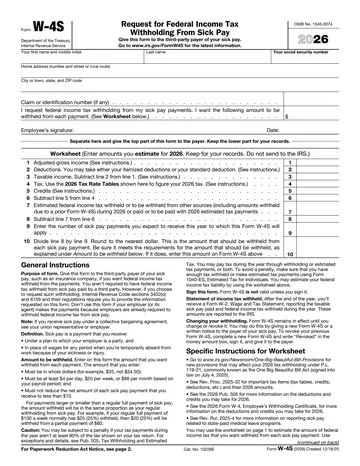
Form W-4S, Request for Federal Income Tax Withholding From Sick Pay, is the employee's request to an insurer or other third party to withhold federal income tax from sick pay. It is the third-party counterpart of Form W-4, with one difference that matters: the employee asks for a flat dollar amount per payment. The form's own first line says it: “Give this form to the third-party payer of your sick pay.”
- Who fills it in. The employee who receives sick pay from a third party that is not the employer's agent: an insurance company paying short or long-term disability, and, from 2027 unless the IRS extends its relief, a state paying the employer-funded part of medical leave benefits.
- When. Any time. The payer withholds from payments made 8 or more days after it receives the form, and the form stays in effect until the employee changes or revokes it.
- How it is returned. The top part goes to the payer of the sick pay. It is not sent to the IRS and not to the employer's payroll.
- Form. Form W-4S (2026), created Dec. 18, 2025, from the IRS's About Form W-4S page. The 2027 revision is a draft (see below).
Form W-4S (2026); Pub. 15-A (2026), section 6; Instructions for Forms W-2 and W-3 (2026).
Who uses it, and who does not
Withholding on third-party sick pay is voluntary. Sick pay from a third party that is not the employer's agent “is not wages under section 3401(a) and thus is not subject to mandatory income tax withholding under section 3402(a)”. The same notice continues that under the regulations employees “may request withholding, and if such a request is made, the third-party payer must deduct and withhold as requested” (Notice 2015-6). So the payer cannot refuse a valid request, and it withholds nothing without one.
The form is not for sick pay the employer pays itself or pays through an agent. The form says “Don’t use this form if your employer (or its agent) makes the payments because employers are already required to withhold federal income tax from sick pay.” An agent is a third party that bears no insurance risk and is reimbursed on a cost-plus-fee basis; it withholds on the employee's Form W-4 and may treat the sick pay as supplemental wages, at a flat 22% if it pays no regular wages (Pub. 15-A, section 6). Whether a payer is an agent depends on the contract: an insurer paid a premium is not an agent.
Sick pay, for the form, is a payment made under a plan to which the employer is a party and paid “In place of wages for any period when you’re temporarily absent from work because of your sickness or injury.” Disability retirement payments, workers' compensation and payments for medical expenses are not sick pay. Employees covered by a union plan are told to ask their union representative or employer.
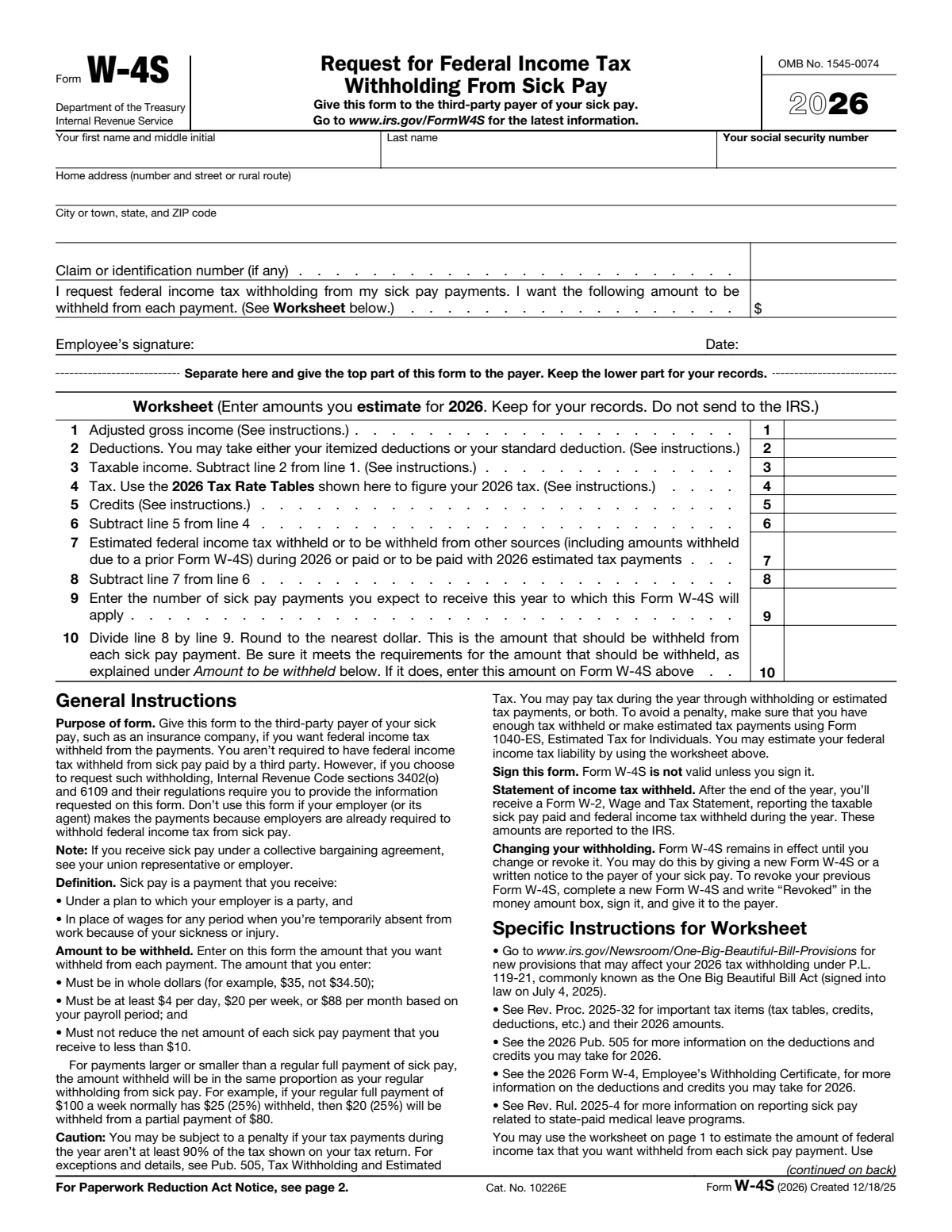
Tap a box once for its note, again to jump to the line. Zoom in to read the small print.
The part the payer gets
The top of the page, above the "Separate here" line, is the request itself. It has eight entries, and only the claim number is optional.
| Line | Label | What goes there |
|---|---|---|
| name | Your first name and middle initial | The employee who receives the sick pay. The information is required once withholding is requested: the form cites Internal Revenue Code sections 3402(o) and 6109 and their regulations. |
| last-name | Last name | The employee's last name, as on the claim. |
| ssn | Your social security number | The withheld tax is reported on the employee's Form W-2 under this number. When the third party shifts the employer share of the taxes to the employer, it sends the employer a yearly sick pay statement that lists each employee's SSN if tax was withheld (Pub. 15-A, section 6). |
| address | Home address (number and street or rural route) | The employee's home address. |
| city | City or town, state, and ZIP code | City or town, state and ZIP code of the home address. |
| claim | Claim or identification number (if any) | The insurer's or state program's claim number, if there is one. It is optional on the form, but it lets the payer match the request to the claim. A state program that takes the election on its own claim application may not need the form at all (see below). |
| amount | I request federal income tax withholding from my sick pay payments. I want the following amount to be withheld from each payment. (See Worksheet below.) | A flat dollar amount per payment, not a percentage or a filing status. The amount you enter “Must be in whole dollars (for example, $35, not $34.50);” “Must be at least $4 per day, $20 per week, or $88 per month based on your payroll period”; and “Must not reduce the net amount of each sick pay payment that you receive to less than $10.” If a payment would drop below $10 net, the payer withholds nothing from that payment (Pub. 15-A). Partial payments are withheld in proportion: $20 from an $80 partial payment when $25 comes out of a full $100 payment. To stop withholding, write "Revoked" in this box, sign and give the form to the payer. |
| signature | Employee's signature: / Date: | “Form W-4S is not valid unless you sign it.” The date starts the clock: under Pub. 15-A the third party “should withhold federal income tax on all payments of sick pay made 8 or more days after receiving the form.” It may start sooner. The employee tears off the top part for the payer and keeps the worksheet. |
The worksheet the employee keeps
The ten-line worksheet works out a per-payment amount that covers the year's expected tax. It uses 2026 amounts (Rev. Proc. 2025-32) and is optional: the employee may enter any amount that meets the rules. The instructions add that “You may not want to use Form W-4S if you already have your total tax covered by estimated tax payments or other withholding.”
| Line | Label | What goes there |
|---|---|---|
| 1 | Adjusted gross income (See instructions.) | An estimate for the whole year. The instructions suggest last year's return as a starting point: use “your tax return from last year and the worksheet as a basis for estimating your tax, tax credits, and withholding for this year.” Joint filers include both spouses' income, deductions, credits and payments. |
| 2 | Deductions. You may take either your itemized deductions or your standard deduction. (See instructions.) | The 2026 standard deductions printed on page 2: $32,200 for married filing jointly and surviving spouses, $24,150 for heads of household, and $16,100 for unmarried individuals and married individuals filing separately. Page 2 also gives the dependent, aged and blind amounts, and lists who gets no standard deduction. |
| 3 | Taxable income. Subtract line 2 from line 1. (See instructions.) | Line 1 minus line 2. |
| 4 | Tax. Use the 2026 Tax Rate Tables shown here to figure your 2026 tax. (See instructions.) | Use the four 2026 rate tables on page 2, one per filing status, taken from Rev. Proc. 2025-32. |
| 5 | Credits (See instructions.) | The instructions list the child tax credit and credit for other dependents, higher education credits, the credit for child and dependent care expenses, the earned income credit and the credit for the elderly or the disabled. |
| 6 | Subtract line 5 from line 4 | Line 4 minus line 5: the expected tax for the year. |
| 7 | Estimated federal income tax withheld or to be withheld from other sources (including amounts withheld due to a prior Form W-4S) during 2026 or paid or to be paid with 2026 estimated tax payments | The instructions: “Enter the federal income tax that you expect will be withheld this year on income other than sick pay and any payments made or to be made with 2026 estimated tax payments.” Wage withholding from the employer before and after the leave belongs here. |
| 8 | Subtract line 7 from line 6 | What withholding on the sick pay needs to cover. |
| 9 | Enter the number of sick pay payments you expect to receive this year to which this Form W-4S will apply | The number of payments expected this year that the form will cover. For a weekly state benefit, the weeks of leave approved; for a monthly disability policy, the months left in the year. |
| 10 | Divide line 8 by line 9. Round to the nearest dollar. This is the amount that should be withheld from each sick pay payment. | The result goes on the amount line of the top part, if it meets the amount rules. The worksheet itself is “Keep for your records. Do not send to the IRS.” If the numbers change during the year, the employee gives the payer a new form. |
Amount rules and timing
Three rules govern the amount, and the payer applies them to every payment. The amount is in whole dollars, it meets a minimum tied to the payment period, and it never brings a payment below $10 net.
Form W-4S (2026), Amount to be withheld. Whole dollars only.
Timing: the third party withholds on all payments made 8 or more days after it receives the form, and “The third party may, at its option, withhold federal income tax before 8 days have passed.” The form then stays in place: “Form W-4S remains in effect until you change or revoke it.” A new form or a written notice to the payer changes it. Pub. 15-A's worked example shows the scale: an insurer pays $2,000 a month under a policy the employer funded 70%, so $1,400 of each payment is subject to voluntary withholding, and the employee's W-4S asks for $210 a payment. The 30% funded by the employee's after-tax premiums is not taxable sick pay at all.
Withholding is not the only way to pay. The form warns that the employee may owe a penalty if tax payments during the year are not at least 90% of the tax on the return, and points to estimated tax on Form 1040-ES as the alternative.
State medical leave benefits
Since Rev. Rul. 2025-4, the part of a state's paid medical leave benefit that the employer's required contributions paid for is third-party sick pay: holding 4 calls those amounts “third-party payments of sick pay, as defined in § 3402(o)”. Income tax withholding on them is therefore voluntary, at the employee's request, as for an insurer. The 2026 form points employees to the ruling: “See Rev. Rul. 2025-4 for more information on reporting sick pay related to state-paid medical leave programs.” Our guide to whether paid family leave is taxable walks through all seven holdings.
Two limits apply. First, family leave benefits are not sick pay: they are taxable income reported on Form 1099-G, and the ruling notes that “There are no comparable rules for third-party payments of family leave benefits under laws like the PFML Act.” The part of a medical benefit paid for by the employee's own contributions is not sick pay either. Second, for benefits paid in 2025 and 2026, the IRS does not require the sick pay steps: under Notice 2026-6, “a State or an employer is not required to follow the income tax withholding and reporting requirements applicable to third-party sick pay”. That relief covers 2026 payments only; DC says “Starting January 1, 2027, DC Paid Family Leave Medical Leave benefits are treated as third-party sick pay under IRS Revenue Ruling 2025-4.”
Each program takes the employee's withholding election in its own way, and not every one uses Form W-4S:
- New Jersey TDI. The state plan already treats disability benefits as third-party sick pay, and the employer handbook says a federal income tax deduction may be made “Upon the claimant’s completion of Form W4S”; the amount appears on Form DS-7C, and “The employer is not required to match this withholding amount.” See NJ TDI and FLI.
- New Hampshire. The voluntary program's FAQ says “Workers will need to submit a W-4S tax form to MetLife for taxes to be withheld.” The FAQ applies this to the family leave portion and still says the IRS has not provided rules; the ruling's holdings on family leave govern the federal treatment, and the FAQ describes only how the carrier takes a request. See New Hampshire Paid Family Leave.
- Massachusetts. The election is part of the claim: “When you apply for leave through DFML, you can choose to have state and federal income taxes withheld from your weekly medical or family leave benefit payments.” See Massachusetts PFML.
- Maine. The statute tells the department to advise new claimants that “The individual may elect to have federal income tax deducted and withheld from the individual's payment of benefits” (26 M.R.S. 850-M).
- Delaware. The rule is a flat rate, not an election: “The Division shall withhold state and federal income tax from authorized benefit payments”, at a single percentage set each December (Delaware PFML regulations, 15.1).
So an employee on state medical leave should follow the program's own claim instructions; Form W-4S is the IRS form for the request, and a program may take it or its own election. Payroll does not collect either one.
The 2027 draft
Form W-4S is revised every year because the worksheet carries that year's tax tables. The IRS draft forms listing shows “Request for Federal Income Tax Withholding From Sick Pay 2027 09/14/2026”, with the standing warning “Do not file draft forms and do not rely on information in draft instructions or publications.” The 2027 draft (PDF) keeps the same lines and the same amount rules. Two changes show: the request line is reworded to “I request the following amount of federal income tax withheld from each sick pay payment”, and the worksheet amounts and the revenue procedure are still placeholders (“See Rev. Proc. XXXX-XX for important tax items”). It keeps the pointer to Rev. Rul. 2025-4. The image above is the final 2026 form; use the final 2027 form for 2027 estimates once the IRS posts it.
What the employer does
Nothing with the form itself: the employee gives it to the payer. But the withholding it causes shows up in the employer's year-end reporting when the third party has shifted the employer share of the taxes to the employer and the employer files the W-2s for the sick pay:
- Form W-2, box 2 includes the income tax the third party withheld, and box 13 has the "Third-party sick pay" box checked (Instructions for Forms W-2 and W-3).
- Form W-3, box 14 shows it again, separately: “Show the total income tax withheld by third-party payers on payments to all of your employees.”
- Form 941, line 3 leaves it out, because the third party reports it on its own 941: “Don't include any income tax withheld by a third-party payer of sick pay even if you reported it on Forms W-2.” See the Form 941 instructions.
That gap between the W-2s and the 941s is expected. The IRS's wage reconciliation (CAWR) procedures say of income tax withheld by a third party: “This type of discrepancy cannot be avoided and does not indicate a reporting error by the employer.” (IRM 4.19.4.3.16) W-3 box 14 is how examiners see it. The Social Security and Medicare side is reconciled differently, on Form 8922.
Rules that trip people up
- Giving it to payroll. The form goes to the payer of the sick pay. Payroll cannot act on it, and for sick pay the employer pays itself, Form W-4 governs instead: “The employee can’t choose how much federal income tax will be withheld by giving you or your agent a Form W-4S”.
- A percentage or a filing status. The form takes a whole dollar amount per payment, nothing else.
- No signature. An unsigned form is not valid.
- Expecting withholding on state family leave benefits under it. Family leave benefits are not sick pay; ask the program how it takes a withholding request.
- Forgetting to revoke. A form stays in effect until changed. To stop, write "Revoked" in the money box, sign and give it to the payer.
- Using last year's worksheet. The tables change each year; the 2026 worksheet uses 2026 amounts.
How it connects
- When state medical leave benefits become third-party sick pay, and the employer's Form 941 line 8 and Form 940 steps: third-party sick pay and state medical leave benefits.
- The yearly reconciliation of sick pay between the W-2s and the 941s: Form 8922 line by line.
- How state benefits and contributions show on pay stubs and W-2s: SDI and PFL on pay stubs and W-2s.
- The federal tax treatment of state paid leave, holding by holding: is paid family leave taxable; and what changes on Jan. 1, 2027: PFML changes for 2027.
Questions employers ask
Does the employer have to give employees Form W-4S?
No. The employee chooses whether to ask for withholding and gives the form to the insurer or state program paying the sick pay. Payroll neither collects nor files it.
Can an employee use Form W-4S for sick pay the employer pays?
No. Sick pay the employer or its agent pays is wages, withheld on the employee's Form W-4. Form W-4S is only for a third party that is not the employer's agent.
Is withholding on state medical leave benefits required from 2027?
Not income tax withholding. The employer-funded part of state medical leave benefits is third-party sick pay, and income tax withholding on third-party sick pay is voluntary at the employee's request. Social Security and Medicare are a different matter: see the third-party sick pay guide.
How soon does withholding start?
On payments made 8 or more days after the payer receives the form. The payer may start sooner.
Why do my W-2s show more income tax than my Forms 941?
If you file the W-2s for third-party sick pay, box 2 includes the tax the third party withheld, which the third party reports on its own Form 941. Show the same amount in W-3 box 14; the IRS treats that difference as expected.
Which year's form should an employee use?
The form for the year of the payments: the 2026 form for 2026. The 2027 form is a draft as of Nov. 22, 2026; the IRS says not to file drafts.
Sources
- Form W-4S (2026) and its 2027 draft (IRS draft forms listing); About Form W-4S
- Notice 2015-6, Reporting Sick Pay Paid by Third Parties; Pub. 15-A (2026), section 6
- Rev. Rul. 2025-4 (holding 4); Notice 2026-6; Instructions for Form 941 (Rev. March 2026), line 3; 2026 Instructions for Forms W-2 and W-3, W-3 box 14; IRM 4.19.4.3.16
- State programs: NJDOL employer handbook, TDI and FLI; NH PFML FAQ; DFML overview and benefits; 26 M.R.S. 850-M; Delaware PFML regulations