- Who fills it in
- Employer (Section I), health care provider
- Due
- At least 15 calendar days after you ask
- Returned to
- The employer, through the employee; never the DOL
- Form revision
- Revised June 2020 (expires 8/31/2029)
- Pages
- 4
At a glance
Form WH-380-E, Certification of Health Care Provider for Employee's Serious Health Condition under the Family and Medical Leave Act, is the DOL's optional form for asking an employee's own health care provider to support a request for FMLA leave for the employee's serious health condition. You decide whether to require a certification; if you do, you may use this form or your own with the same content.
- Who fills it in. You (or the employee) complete Section I; the employee's health care provider completes Section II and signs.
- When. When you require certification. “The employer must give the employee at least 15 calendar days to provide the certification.”
- How it is returned. The provider returns it to the employee, who gives it to you. It is never sent to the Department of Labor.
- Form. Form WH-380-E (Revised June 2020, OMB Control Number 1235-0003, expires 8/31/2029), four pages; a Spanish version is on the DOL's FMLA forms page. It is a fillable PDF.
- Not for bonding leave. The form's Section I instruction: “you may not request a certification for FMLA leave to bond with a healthy newborn child or a child placed for adoption or foster care”.
29 CFR 825.300(d)29 CFR 825.300Code of Federal Regulations, eCFR, 825.305(b) and (c); Forms WH-380-E and WH-382.
Tap a box once for its note, again to jump to the line. Zoom in to read the small print.
Section I: the employer's part
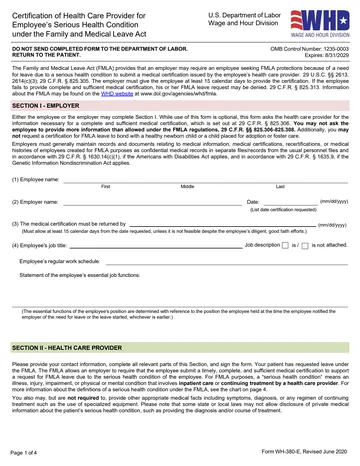
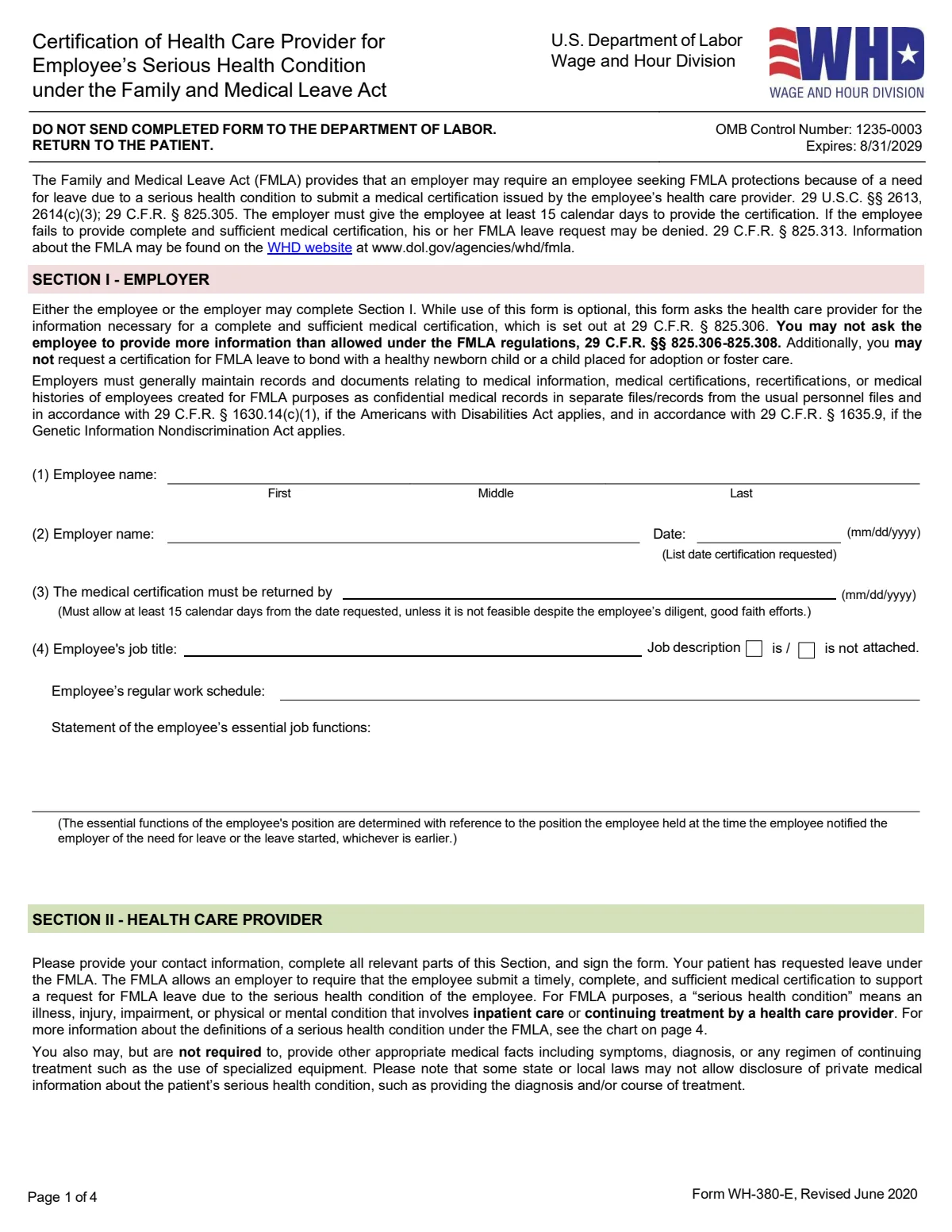
Four items set up the request. The two dates matter most: they start and end the employee's time to return the certification.
| Line | Label | What goes there |
|---|---|---|
| I-1 | (1) Employee name: First, Middle, Last | The employee's full name. Section I is the employer's part of the form, but “Either the employee or the employer may complete Section I.” Filling it in yourself before you hand the form over keeps the request in line with your eligibility notice. |
| I-2 | (2) Employer name; Date: (List date certification requested) | Your name as employer and the date of your request. Under the regulation the employee has at least 15 calendar days after your request, so date the form the day you give it out. Ask early: in most cases the request goes with the employee's notice of leave or within five business days after it, or within five business days after unforeseen leave starts (29 CFR 825.305(b))29 CFR 825.305Code of Federal Regulations, eCFR. |
| I-3 | (3) The medical certification must be returned by | The printed rule under the line: “(Must allow at least 15 calendar days from the date requested, unless it is not feasible despite the employee’s diligent, good faith efforts.)” You may give more time. A certification never returned is not incomplete; it is a failure to certify, handled under 29 CFR 825.31329 CFR 825.313Code of Federal Regulations, eCFR. |
| I-4 | (4) Employee's job title; Job description is / is not attached; Employee's regular work schedule; Statement of the employee's essential job functions | The provider uses this to answer question 10, whether the employee can perform the job's essential functions. The form fixes the point in time: “The essential functions of the employee's position are determined with reference to the position the employee held at the time the employee notified the employer of the need for leave or the leave started, whichever is earlier.” If you leave it blank, the provider answers from the employee's own description of the job. |
Section II: the provider's details
Section II belongs to the health care provider. It opens with the provider's contact block and a reminder that the provider may, but need not, give symptoms or a diagnosis.
| Line | Label | What goes there |
|---|---|---|
| EN | Employee Name: | The same name as item (1). The header repeats on pages 2 to 4; filled in on each page, it keeps the pages together in the medical file. |
| HCP | Health Care Provider's name (Print); business address; Type of practice / Medical specialty; Telephone; Fax; E-mail | The provider's details, the first item a certification may require (29 CFR 825.306(a)(1))29 CFR 825.306Code of Federal Regulations, eCFR. They also tell you whom to call if you need to authenticate the form or understand an answer. That call must come from a health care provider, a human resources professional, a leave administrator or a management official, and the regulation is blunt: “Under no circumstances, however, may the employee's direct supervisor contact the employee's health care provider.” |
Part A: medical information
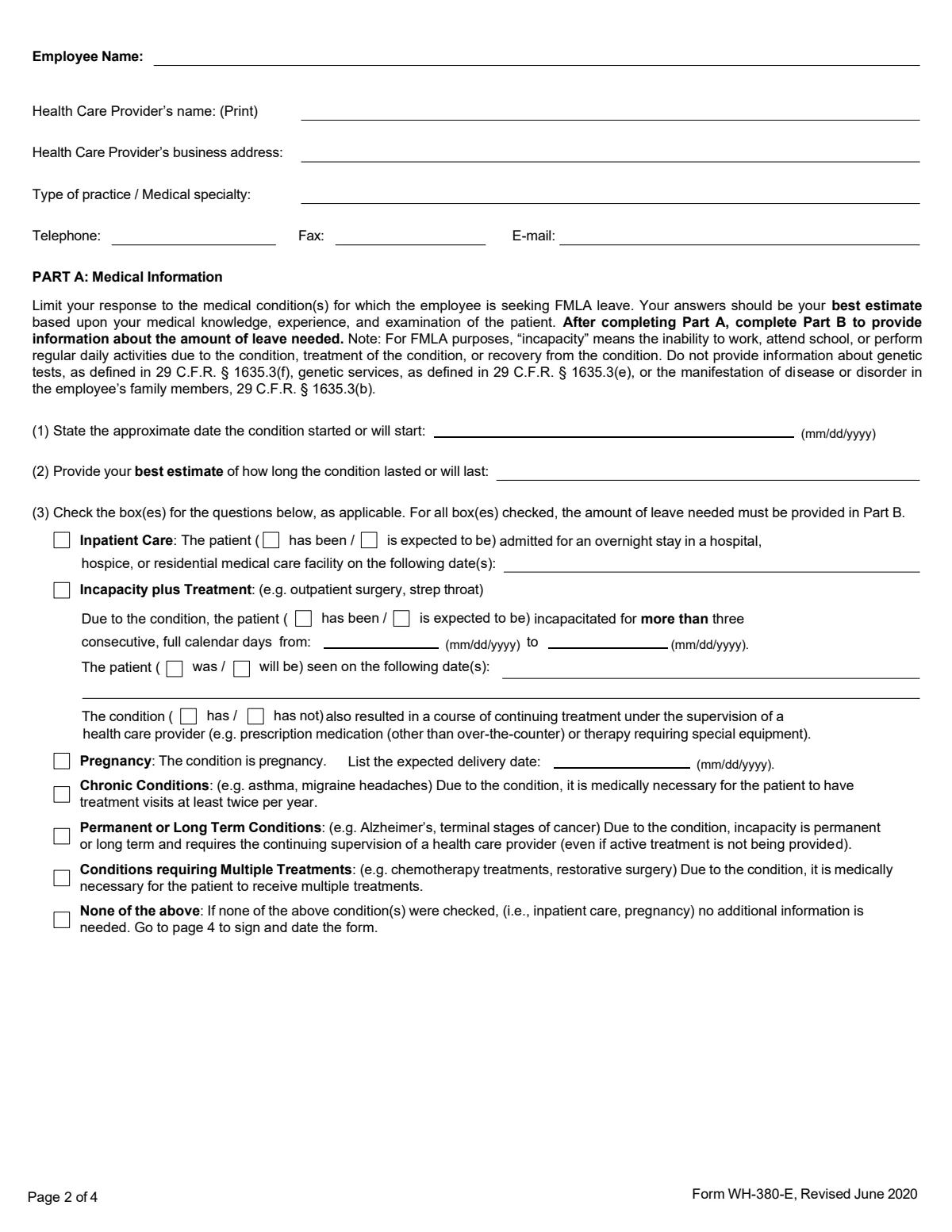
Part A answers one question: is this a serious health condition under the FMLA? The provider dates the condition and checks the category boxes that match the definitions chart on page 4.
| Line | Label | What goes there |
|---|---|---|
| 1 | (1) State the approximate date the condition started or will start | An approximate date is enough; the regulation asks for the approximate date the condition commenced (29 CFR 825.306(a)(2))29 CFR 825.306Code of Federal Regulations, eCFR. |
| 2 | (2) Provide your best estimate of how long the condition lasted or will last | The probable duration. It also sets your recertification clock: if the certification shows a minimum duration over 30 days, you wait until it ends before asking again, subject to the six-month rule (29 CFR 825.308(b))29 CFR 825.308Code of Federal Regulations, eCFR. |
| 3 | (3) Check the box(es) for the questions below, as applicable. For all box(es) checked, the amount of leave needed must be provided in Part B. | The boxes follow the definitions chart on page 4 (29 CFR 825.113 to 825.115)29 CFR 825.113Code of Federal Regulations, eCFR29 CFR 825.115Code of Federal Regulations, eCFR. The form's own definition: for FMLA purposes, “‘incapacity’ means the inability to work, attend school, or perform regular daily activities due to the condition, treatment of the condition, or recovery from the condition.” |
| 3-inpatient | Inpatient Care: The patient (has been / is expected to be) admitted for an overnight stay... | An overnight stay, with its dates. Inpatient care covers any period of incapacity and any later treatment connected with the stay (chart, page 4). |
| 3-incapacity | Incapacity plus Treatment: incapacitated for more than three consecutive, full calendar days from ... to ...; seen on the following date(s); the condition (has / has not) also resulted in a course of continuing treatment | The most common category, and the one most often incomplete. It needs the incapacity dates, the in-person visit dates and the continuing-treatment answer. Either two or more visits within 30 days, or one visit that starts a regimen of continuing treatment; and “The first (or only) in-person treatment visit must take place within seven days of the first day of incapacity.” |
| 3-pregnancy | Pregnancy: The condition is pregnancy. List the expected delivery date | Any period of incapacity due to pregnancy or for prenatal care is a serious health condition (chart, page 4). Leave to bond with the healthy newborn after birth is a different reason, and you may not ask for a certification for it. |
| 3-chronic | Chronic Conditions: ... it is medically necessary for the patient to have treatment visits at least twice per year | Asthma, diabetes and migraines are the form's examples. A chronic condition may cause episodic absences, so it usually pairs with question 9 (intermittent leave). An absence for a chronic condition qualifies even without treatment during the absence and even if it lasts less than three days (29 CFR 825.115(f))29 CFR 825.115Code of Federal Regulations, eCFR. |
| 3-permanent | Permanent or Long Term Conditions: ... incapacity is permanent or long term and requires the continuing supervision of a health care provider | Alzheimer's and the terminal stages of cancer are the form's examples. Active treatment is not required, only continuing supervision. |
| 3-multiple | Conditions requiring Multiple Treatments: ... it is medically necessary for the patient to receive multiple treatments | Restorative surgery after an accident or injury, or a condition that would likely cause more than three consecutive, full calendar days of incapacity without treatment (chart, page 4). |
| 3-none | None of the above: ... no additional information is needed. Go to page 4 to sign and date the form. | A certification with only this box checked does not show a serious health condition. Before you deny, make sure the form is complete and sufficient; if anything is unclear, ask in writing for what is missing (Form WH-382, Section II). |
| 4 | (4) If needed, briefly describe other appropriate medical facts related to the condition(s) for which the employee seeks FMLA leave. | The provider may, but need not, give a diagnosis or symptoms. Some state or local laws do not allow the provider to disclose a diagnosis, and the form tells providers so. The form also tells them not to give genetic test results or family medical history, which GINA protects. |
Part B: amount of leave needed
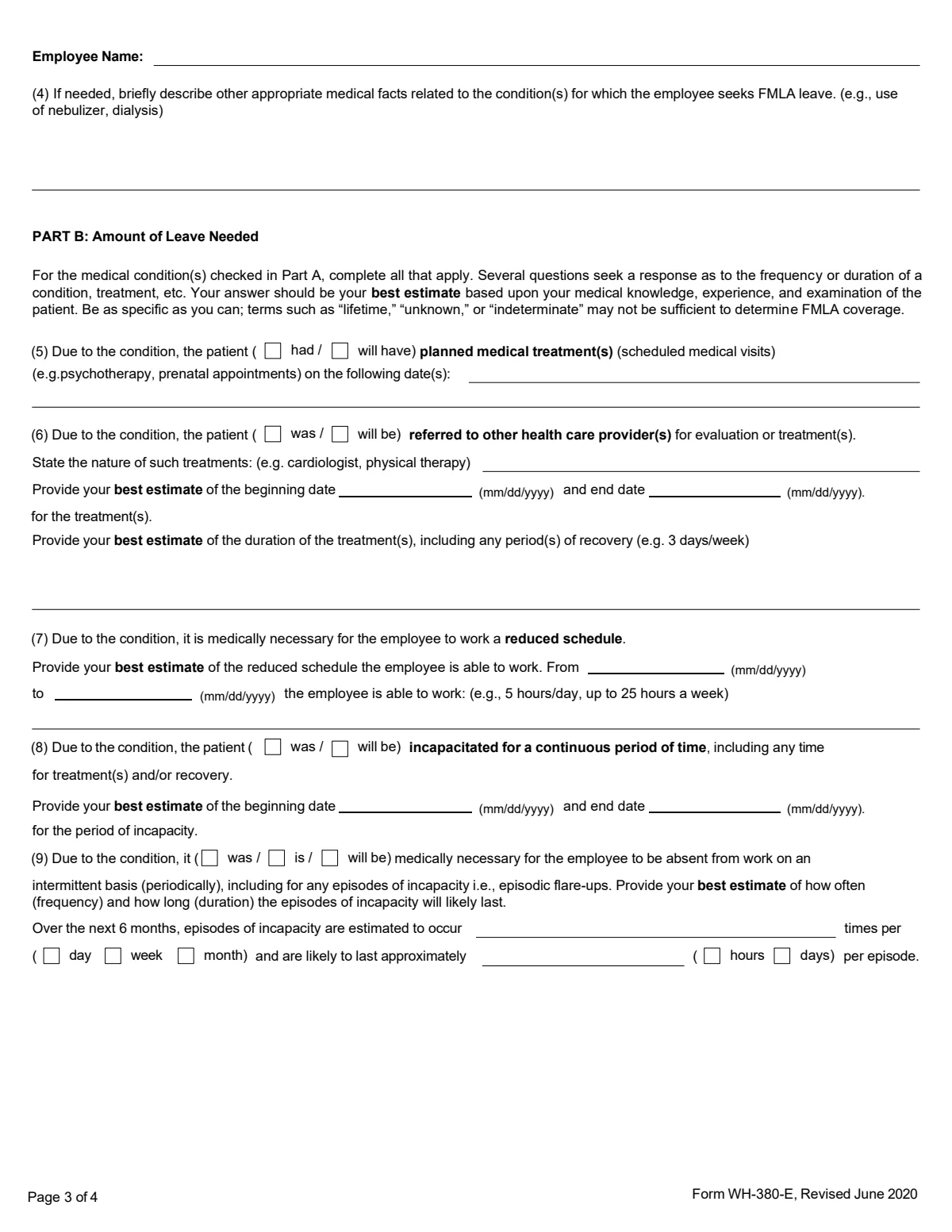
Part B turns the condition into leave: appointments, referrals, a reduced schedule, a continuous block or intermittent episodes. The form warns providers that vague answers fail: “terms such as ‘lifetime,’ ‘unknown,’ or ‘indeterminate’ may not be sufficient to determine FMLA coverage.”
| Line | Label | What goes there |
|---|---|---|
| 5 | (5) Due to the condition, the patient (had / will have) planned medical treatment(s) (scheduled medical visits) on the following date(s) | Dates of planned treatment support intermittent leave for appointments. The employee must try to schedule planned treatment so it does not unduly disrupt your operations (29 CFR 825.302)29 CFR 825.302Code of Federal Regulations, eCFR. |
| 6 | (6) Due to the condition, the patient (was / will be) referred to other health care provider(s) for evaluation or treatment(s); nature of treatments; beginning and end dates; duration | A referral (a cardiologist, physical therapy) with begin and end dates and an estimate such as 3 days a week, including any recovery periods (29 CFR 825.306(a)(6))29 CFR 825.306Code of Federal Regulations, eCFR. |
| 7 | (7) Due to the condition, it is medically necessary for the employee to work a reduced schedule. | The dates and the hours the employee can work. Only the hours not worked count against the employee's FMLA entitlement (29 CFR 825.205)29 CFR 825.205Code of Federal Regulations, eCFR. |
| 8 | (8) Due to the condition, the patient (was / will be) incapacitated for a continuous period of time, including any time for treatment(s) and/or recovery. | The block of leave, with its estimated start and end. If the employee asks to extend it, you may ask for recertification sooner than 30 days (29 CFR 825.308(c)(1))29 CFR 825.308Code of Federal Regulations, eCFR. |
| 9 | (9) ... medically necessary for the employee to be absent from work on an intermittent basis (periodically) ... Over the next 6 months, episodes of incapacity are estimated to occur ___ times per (day / week / month) and are likely to last approximately ___ (hours / days) per episode. | The frequency and duration answer is what lets you test later absences against the certification. If absences run well past the estimate, that is a significant change that allows a recertification request sooner than 30 days (29 CFR 825.308(c)(2))29 CFR 825.308Code of Federal Regulations, eCFR. |
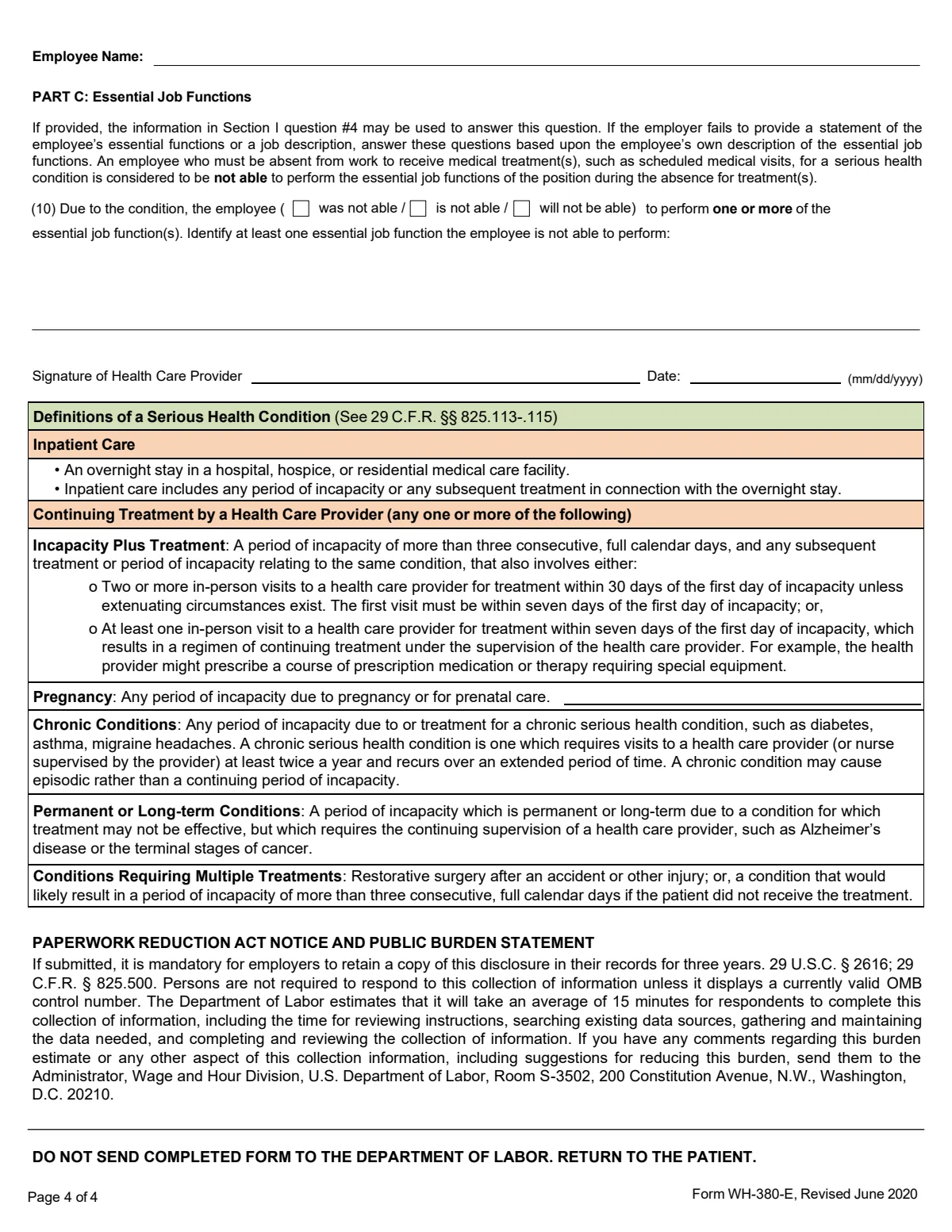
Part C: essential job functions
| Line | Label | What goes there |
|---|---|---|
| 10 | (10) Due to the condition, the employee (was not able / is not able / will not be able) to perform one or more of the essential job function(s). Identify at least one essential job function the employee is not able to perform: | The employee's own condition qualifies only if it makes the employee unable to perform one or more essential functions. The form settles the treatment case: “An employee who must be absent from work to receive medical treatment(s), such as scheduled medical visits, for a serious health condition is considered to be not able to perform the essential job functions of the position during the absence for treatment(s).” |
| Sig | Signature of Health Care Provider; Date | The provider's signature and the date. The employee returns the signed form to you; the form says at the top and bottom not to send it to the Department of Labor. |
When the form comes back
When the form comes back, read it against the regulation, not against your own wish list. You may not ask for more than the certification rules allow: “no information may be required beyond that specified in §§ 825.306, 825.307, and 825.308”. If an entry is blank or an answer is vague, the rule is “The employer shall advise an employee whenever the employer finds a certification incomplete or insufficient, and shall state in writing what additional information is necessary to make the certification complete and sufficient.” The employee then has seven calendar days to cure it, unless that is not practicable despite diligent good faith efforts (29 CFR 825.305(c))29 CFR 825.305Code of Federal Regulations, eCFR. Form WH-382, Section II, has the boxes for that letter. If you doubt a complete certification, you may require a second opinion at your expense from a provider you do not regularly use, and a binding third opinion if the two differ (29 CFR 825.307(b) and (c))29 CFR 825.307Code of Federal Regulations, eCFR. Recertification is limited: “An employer may request recertification no more often than every 30 days and only in connection with an absence by the employee”, with longer waits for longer certified durations, and every six months in any case (29 CFR 825.308)29 CFR 825.308Code of Federal Regulations, eCFR.
Then decide, and tell the employee in writing within five business days of having enough information: that is the Form WH-382 designation notice.
Rules that trip employers up
- Asking for a diagnosis. The form does not require one, and some state laws bar the provider from giving it.
- Letting the supervisor call the doctor. Contact for clarification or authentication goes through a health care provider, HR, a leave administrator or a management official, never the direct supervisor.
- Short return dates. Fewer than 15 calendar days is not allowed, and a good-faith delay extends it.
- Denying for a gap without a cure letter. Incomplete or insufficient answers get a written list and seven calendar days first.
- Filing it with personnel records. The form says certifications must be kept “as confidential medical records in separate files/records from the usual personnel files”, and retained for three years (29 CFR 825.500)29 CFR 825.500Code of Federal Regulations, eCFR.
- Using it for a family member. Leave to care for a spouse, child or parent uses Form WH-380-F.
How it connects
- Which DOL form fits which leave, and the forms in Spanish: FMLA forms.
- The eligibility and rights notice that goes out before (or with) this request: Form WH-381. The decision after it: Form WH-382 and the designation notice guide.
- State paid leave claims run on the state's own claim forms; how a state-paid absence is also designated as FMLA leave: FMLA and state paid leave.
- Coverage and eligibility, the 50-employee and 75-mile tests: FMLA for small businesses.
Questions employers ask
Do we have to use Form WH-380-E?
No. Its use is optional. You may use your own form if it asks for the same basic information and no more, and the employee may also provide the information in another format, such as on the provider's letterhead.
How long does the employee have to return it?
At least 15 calendar days from your request, longer if the employee could not meet it despite diligent, good faith efforts, or if you give more time.
Can we call the employee's doctor?
Only to clarify or authenticate a complete certification, after giving the employee a chance to cure any deficiency, and only through a health care provider, HR, a leave administrator or a management official. The direct supervisor may never make the call, and you may not ask for more information than the form requires.
Can we ask for a certification for maternity leave?
For the pregnancy and the mother's own incapacity, yes. For leave to bond with a healthy newborn or a newly placed child, no.
How often can we ask for recertification?
Generally no more often than every 30 days and only with an absence; if the certified duration is longer, wait until it ends, but you may ask every six months in any case. You may ask sooner if the employee asks for more leave, circumstances change significantly, or you receive information that casts doubt on the absence.
Does a state paid leave medical form replace WH-380-E?
Not automatically. State programs use their own claim forms for benefits. Whether a state form contains everything you need for FMLA certification depends on what it asks; WH-380-E sets out the FMLA content.
Sources
- Form WH-380-E, Certification of Health Care Provider for Employee’s Serious Health Condition (Revised June 2020), U.S. Department of Labor, Wage and Hour Division
- FMLA: Forms (DOL WHD); Help for health care providers
- 29 CFR part 825, eCFR text current as of Nov. 1, 2026: 825.113 to 825.115, 825.305 to 825.308, 825.313, 825.500