- Who files
- Eligible employers; partnerships and S corporations always
- Due
- With the income tax return
- Filed with
- The return; total to Form 3800, Part III, line 4j
- Form revision
- Rev. December 2026 (DRAFT; Jan. 2021 is final)
- Pages
- 1
At a glance
Form 8994, Employer Credit for Paid Family and Medical Leave, figures the section 45S credit an employer earns for paying family and medical leave under a written policy. From 2026 it also figures the credit on premiums for a paid leave insurance policy. The form is one page, attached to the employer's income tax return; the credit then moves to Form 3800.
- Who files. An eligible employer claiming the credit. “Partnerships and S corporations must file this form to claim the credit.” Partners and shareholders whose only credit comes from a K-1 skip Form 8994 and report it on Form 3800.
- When. With the return for the tax year the leave wages or premiums were paid or incurred. The election is open for three years: “An eligible employer can claim or elect not to claim the employer credit for paid family and medical leave any time within 3 years from the due date of the eligible employer’s return.”
- How. Attached to the employer's income tax return and filed with it, as the form's heading says. Form 8994 has no filing address of its own.
- Form. The draft Form 8994 (Rev. December 2026) with its draft instructions (Rev. December 2026); the current final Form 8994 (Rev. January 2021) and its Instructions for Form 8994 (Rev. December 2024) cover tax years before 2026.
Form 8994 (Rev. December 2026) and its instructions, both drafts.
A draft, and which revision to use
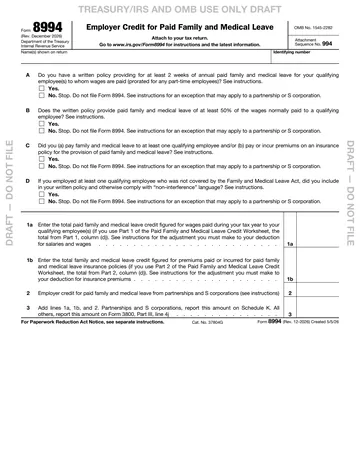
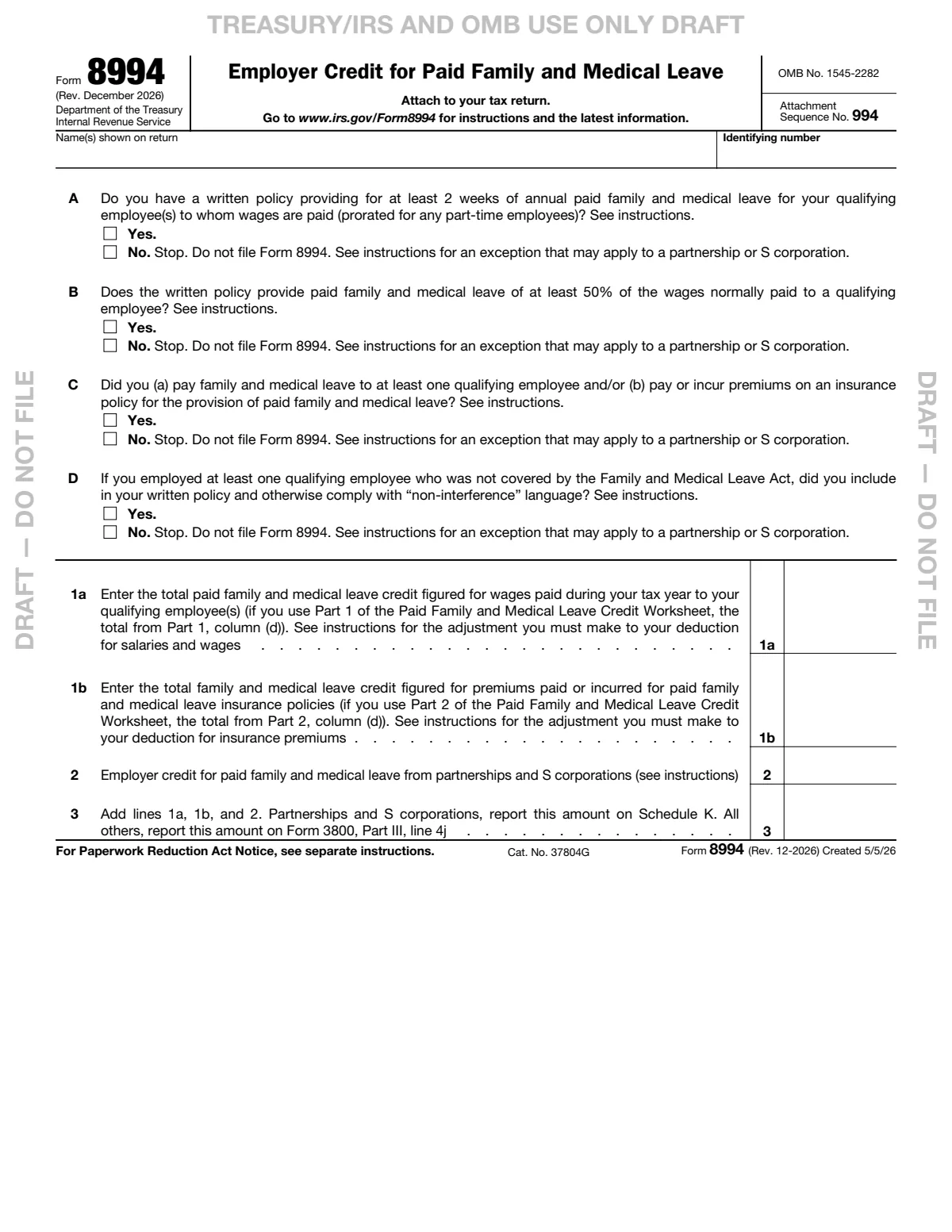
The December 2026 revision is a draft: the IRS prints a draft cover sheet on it and a do-not-file warning down both margins. The IRS draft listing shows “Employer Credit for Paid Family and Medical Leave Dec 2026 05/11/2026” for the form, the instructions posted Nov. 13, 2026, and its standing warning: “Do not file draft forms and do not rely on information in draft instructions or publications.” The image below is that draft. Once final, the instructions say “Use the December 2026 revision of Form 8994 and its instructions for tax years beginning in 2026 or later, until a later revision is issued.” For 2025 and earlier years, use the January 2021 form and the December 2024 instructions. Check the final form before you file a 2026 return; line numbers may still change.
Two IRS texts disagree with these instructions, and our 45S credit page quotes both sides: Pub. 5327 prints an $87,000 compensation limit for 2025 where both revisions of the instructions show “2025 $155,000 $93,000”, and one sentence of the draft's premium rules reads as if it dropped the word "not" that Notice 2026-28 uses. Use the $93,000 figure, and follow the notice on the premium rule until the final instructions are out.
Tap a box once for its note, again to jump to the line. Zoom in to read the small print.
Name and identifying number
| Line | Label | What goes there |
|---|---|---|
| Name | Name(s) shown on return | The name on the return the form goes with. The form's heading tells you to attach it to your tax return; it is not filed on its own. |
| ID | Identifying number | The identifying number shown on that return. |
Questions A to D: is the employer eligible
The four questions are the eligibility test of section 45S(c). A No to any of them ends the form for a direct claimant. Each answer turns on the written policy, so pull it out before you start.
| Line | Label | What goes there |
|---|---|---|
| A | Do you have a written policy providing for at least 2 weeks of annual paid family and medical leave for your qualifying employee(s) to whom wages are paid (prorated for any part-time employees)? | The instructions: “Answer ‘Yes’ if you have a written policy providing at least 2 weeks of annual paid family and medical leave for all of your qualifying employee(s) to whom wages are paid (prorated for any part-time employees).” The policy must be in place before the leave is taken, and it is in place on the later of its adoption date and its effective date. It may not leave out any class of qualifying employees, such as collectively bargained employees. For this test, state paid leave counts: “Leave paid by a state or local government or required by state or local law is taken into account when determining the amount of paid family and medical leave provided by the employer”. If you answer No, do not file, unless you are a partnership or S corporation passing through a credit on line 2. |
| B | Does the written policy provide paid family and medical leave of at least 50% of the wages normally paid to a qualifying employee? | Wages normally paid leave out overtime (other than regularly scheduled overtime) and discretionary bonuses. State benefits help here too. In the instructions' Example 9, a state fund pays 50% for 6 weeks and the employer's policy adds 30%, for 80% in all, and the IRS concludes: “Your policy satisfies the requirement that the rate of payment be at least 50% of the wages normally paid to an employee.” Different rates for different FMLA purposes are allowed, but each purpose you claim for must meet the minimums. |
| C | Did you (a) pay family and medical leave to at least one qualifying employee and/or (b) pay or incur premiums on an insurance policy for the provision of paid family and medical leave? | Part (b) is new on the December 2026 revision: it reflects the premium method that P.L. 119-21 added for tax years after 2025. A qualifying employee has worked for you at least 1 year (or, if you elect, 6 months), is customarily employed at least 20 hours a week, and earned no more than the prior-year limit: $96,000 for 2026 (60% of the $160,000 prior-year 414(q) amount). Leave counts only if it is for an FMLA purpose; general PTO that can be used for anything does not. |
| D | If you employed at least one qualifying employee who was not covered by the Family and Medical Leave Act, did you include in your written policy and otherwise comply with “non-interference” language? | This reaches every employer too small for the FMLA and many part-time staff, because an employee under 1,250 hours is not covered by Title I of the FMLA. The instructions give sample wording: [Employer] “will not interfere with, restrain, or deny the exercise of, or the attempt to exercise, any right provided under this policy.” Answer Yes if every employee was FMLA-covered, or if the language is in the policy and you complied with it. |
Lines 1a to 3: the credit
Line 1a is the wage method, the only method before 2026. Line 1b is the premium method, which Notice 2026-28 explains; taxpayers may rely on that notice until proposed regulations issue. You may use both methods for different leave, but not for the same instance of leave.
| Line | Label | What goes there |
|---|---|---|
| 1a | Enter the total paid family and medical leave credit figured for wages paid during your tax year to your qualifying employee(s) | Figure it on the Paid Family and Medical Leave Credit Worksheet, Part 1: for each qualifying employee, the leave wages (column (b)) times the applicable percentage (column (c)). Wages are FUTA wages without the $7,000 cap, and only up to 12 weeks of leave per employee per year count. State benefits never count here: “Leave paid by a state or local government or required by a state or local law isn’t taken into account when figuring the credit.” Then the deduction rule: “you must reduce your deduction for salaries and wages by the amount on line 1a.” |
| 1b | Enter the total family and medical leave credit figured for premiums paid or incurred for paid family and medical leave insurance policies | Use worksheet Part 2: the insurer, the premiums for qualifying employees, and the applicable percentage. A premium for state-required leave is out: “A premium (or portion thereof) is not paid or incurred for creditable coverage if it is for coverage with respect to leave that is required by state or local law or paid for by a state or local government.” A blended premium must be split by a reasonable, documented method, and the same leave cannot earn both a wage credit and a premium credit. The form also tells you to reduce your deduction for insurance premiums. One sentence in the draft instructions appears to drop a "not"; see where the IRS texts disagree. |
| 2 | Employer credit for paid family and medical leave from partnerships and S corporations | Partners and shareholders get this credit on Schedule K-1 (Form 1065) box 15 or Schedule K-1 (Form 1120-S) box 13, code BB. A filer whose only credit is from a K-1 reports it directly on Form 3800, Part III, line 4j, without Form 8994. Line 2 is only for filers who also have an amount on line 1a or 1b. |
| 3 | Add lines 1a, 1b, and 2. | The form's own routing: “Partnerships and S corporations, report this amount on Schedule K.” All others carry it to Form 3800, Part III, line 4j, where it joins the general business credit and its limits and carryovers. |
The worksheet and the applicable percentage
The credit is a percentage of the leave wages (or creditable premiums). The base rate is 12.5% when the policy pays exactly half of normal wages, and it rises with the policy's rate: “If the rate of payment under the policy is greater than 50%, the applicable percentage is increased by 0.25 percentage points for each percentage point by which the rate of payment exceeds 50%, up to a maximum applicable percentage of 25%.” A policy with two rates needs two calculations; the instructions' Applicable Percentage Worksheet is completed once for each rate.
IRC 45S(a)(2)IRC 45SInternal Revenue Code, Cornell LII; draft Instructions for Form 8994 (Rev. December 2026), Examples 14 and 15.
In Example 16 of the draft, an employee normally paid $1,000 a week takes 4 weeks at 75%, so the employer pays $3,000 and claims $562.50 (18.75% of $3,000). Keep the support: the instructions list each qualifying employee's name and social security number, the wages paid to each, each qualifying employer's name and EIN, the applicable percentage and the leave policy. The worksheet is not filed; keep it with your records.
How state paid leave counts
State programs work in two directions on this form. They help the employer qualify: state benefits count toward the 2-week minimum (line A) and toward the 50% rate (line B). But they never earn the credit: leave the state pays or requires is left out of line 1a, and premiums for state-required coverage are left out of line 1b. So in a state with a paid leave program, the credit comes from what the employer adds on top, such as a top-up policy paid from its own funds. Employer contributions to a state fund are not leave wages and are not creditable premiums. The state programs and their rates are on the paid family leave by state map; our 45S credit guide works through the state rules.
Rules that trip filers up
- Counting state benefits as credit wages. They count for eligibility (lines A and B), never for the amount (lines 1a and 1b).
- A general PTO bank. Leave that may be used for vacation or any reason is not family and medical leave, even when an employee uses it for an FMLA purpose (Example 6). The leave must be set aside for FMLA purposes.
- Hours tests. A policy may not require a minimum number of hours a year; the FMLA's 1,250-hour rule does not apply to the credit. But employees under 1,250 hours bring in line D's non-interference language.
- Forgetting the deduction cut. The line 1a amount reduces the wage deduction even if the credit is carried back or forward.
- Leave before the employee qualifies. Only wages for leave taken after the employee becomes a qualifying employee count (Example 20).
- Filing the draft. Wait for the final December 2026 revision.
How it connects
- The credit itself, the premium method, the compensation limits and the IRS conflicts: the 45S credit for paid family and medical leave.
- The FMLA purposes the policy must cover and how FMLA leave runs with state leave: FMLA and state paid leave. The FMLA notices and certifications: FMLA forms.
- The federal tax treatment of state benefits and contributions: is paid family leave taxable.
Questions employers ask
Which Form 8994 do I use for 2026?
The December 2026 revision, once the IRS releases it as final. As of Nov. 22, 2026 it is a draft (form posted May 11, 2026; instructions posted Nov. 13, 2026), and the IRS says not to file drafts. Use the January 2021 form for 2025 and earlier.
Can I claim the credit on my state PFML contributions?
No. Premiums for coverage of leave that state law requires, or that a state pays, are not creditable, and state contributions are not leave wages. The credit comes from leave the employer pays itself, or from premiums on a policy that is not state-required.
Does state paid leave help me qualify?
Yes. State benefits count toward the policy's 2 weeks and its 50% rate. In the IRS example, a 50% state benefit plus a 30% employer top-up meets the 50% test, and the employer can claim the credit on its 30% top-up.
What is the 2026 compensation limit for a qualifying employee?
Compensation in the prior year of no more than $96,000 for 2026 claims (60% of the $160,000 prior-year 414(q) amount), and $93,000 for 2025 claims.
Do partners file Form 8994?
Not if the K-1 credit is their only one. They report it on Form 3800, Part III, line 4j. A partner that also has its own credit on line 1a or 1b uses line 2 for the K-1 amount.
What does line D mean for a small employer?
If any qualifying employee is not covered by the FMLA, for example because the employer has fewer than 50 employees or the employee worked under 1,250 hours, the written policy must promise not to interfere with leave rights or retaliate, and the employer must follow it.
Sources
- Form 8994 (Rev. December 2026), DRAFT and Instructions for Form 8994 (Rev. December 2026), DRAFT dated Nov. 12, 2026; IRS draft forms listing for 8994
- Form 8994 (Rev. January 2021) and Instructions for Form 8994 (Rev. December 2024), final; About Form 8994
- Notice 2026-28 (premium method); 26 U.S.C. 45S; Pub. 5327 (Rev. 9-2026)