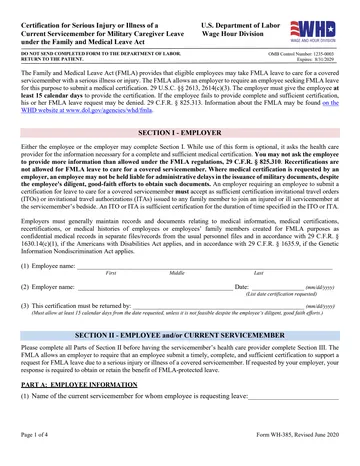
- Who fills it in
- Employer, employee or servicemember, provider
- Due
- At least 15 calendar days after you ask
- Returned to
- The employer, through the employee
- Form revision
- Revised June 2020 (expires 8/31/2029)
- Pages
- 4
At a glance
Form WH-385, Certification for Serious Injury or Illness of a Current Servicemember for Military Caregiver Leave under the Family and Medical Leave Act, supports military caregiver leave to care for a current member of the Armed Forces, National Guard or Reserves with a serious injury or illness. Military caregiver leave is the one FMLA reason with 26 weeks.
- Who fills it in. You (or the employee) complete Section I; the employee and/or the servicemember complete Section II; an authorized health care provider completes Section III.
- When. When you require certification; at least 15 calendar days to return it. “An eligible employee is entitled to 26 workweeks of leave to care for a covered servicemember with a serious injury or illness during a single 12-month period.”
- How it is returned. To you, through the employee. Never to the Department of Labor.
- Form. Form WH-385 (Revised June 2020, OMB Control Number 1235-0003, expires 8/31/2029), four pages; a Spanish version is on the DOL's FMLA forms page.
- Orders count as certification. “An ITO or ITA is sufficient certification for the duration of time specified in the ITO or ITA.”
29 CFR 825.310(d)29 CFR 825.310Code of Federal Regulations, eCFR and (e); Form WH-385 (Revised June 2020).
Tap a box once for its note, again to jump to the line. Zoom in to read the small print.
Section I: the employer's part
| Line | Label | What goes there |
|---|---|---|
| I-1 | (1) Employee name: First, Middle, Last | Either party may complete Section I. |
| I-2 | (2) Employer name; Date: (List date certification requested) | The regulation lets you ask for the employer's name and address on the certification (29 CFR 825.310(c)(1))29 CFR 825.310Code of Federal Regulations, eCFR. |
| I-3 | (3) This certification must be returned by | At least 15 calendar days; the employee is not liable for military paperwork delays. |
Section II: the employee and the servicemember
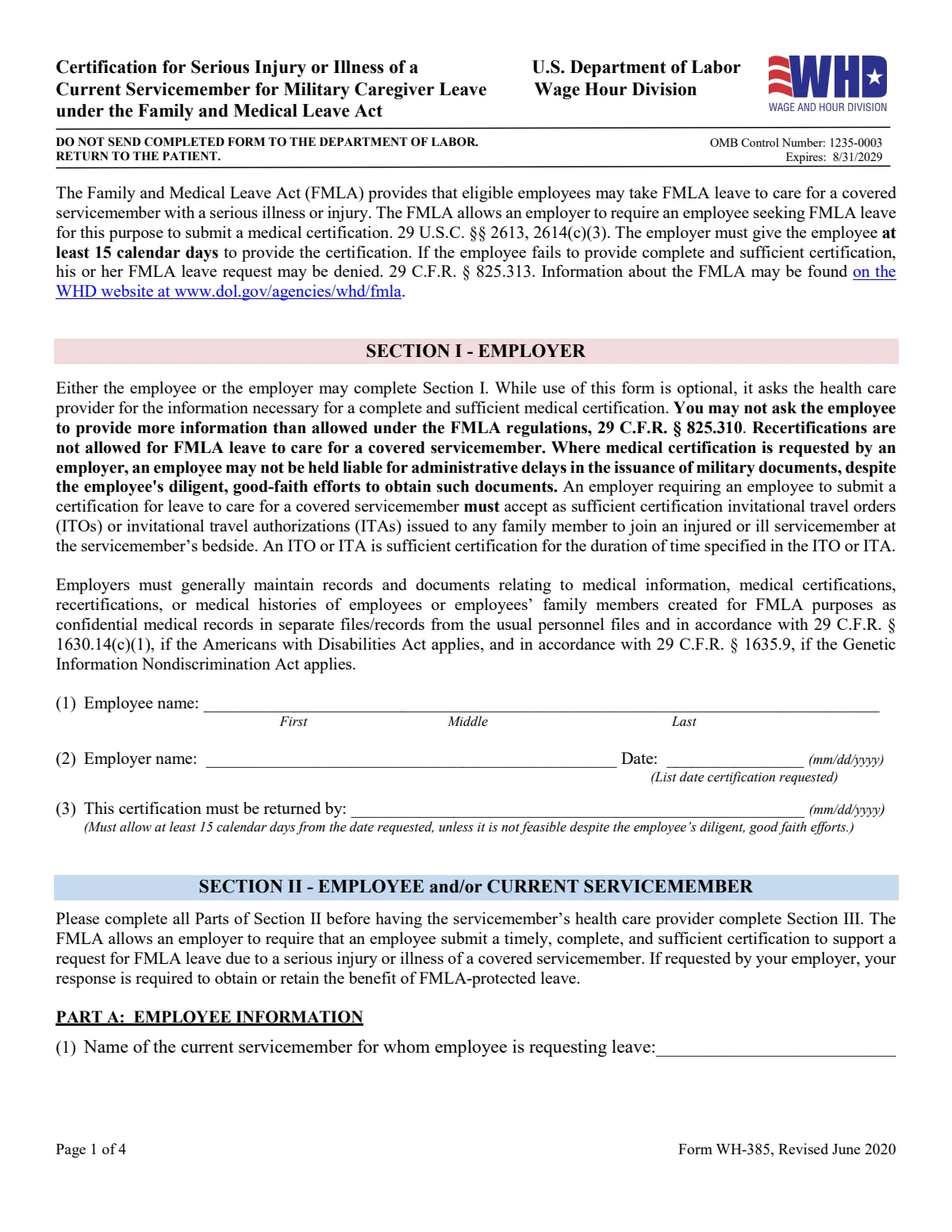
Section II is completed before the provider sees the form. It establishes the relationship and the servicemember's status.
| Line | Label | What goes there |
|---|---|---|
| II-1 | (1) Name of the current servicemember for whom employee is requesting leave | The servicemember, not the employee. |
| EN | Employee Name: | The employee's name. |
| II-2 | (2) Select your relationship to the current servicemember: Spouse; Parent; Child; Next of Kin | Next of kin is the nearest blood relative after spouse, parent and child, in the order the form prints, “unless the covered servicemember has specifically designated in writing another blood relative as his or her nearest blood relative for purposes of military caregiver leave under the FMLA”. A child may be of any age. “This term does not include parents ‘in law.’” |
| II-3 | (3) The servicemember (is / is not) a current member of the Regular Armed Forces, the National Guard or Reserves. If yes, provide the servicemember's military branch, rank and unit currently assigned to | If the servicemember is a veteran instead, use Form WH-385-V. |
| II-4 | (4) The servicemember (is / is not) assigned to a military medical treatment facility as an outpatient or to a unit established for the purpose of providing command and control of members of the Armed Forces receiving medical care as outpatients | Outpatient status is one way a current member is a covered servicemember (29 CFR 825.127(b)(1))29 CFR 825.127Code of Federal Regulations, eCFR. |
| II-5 | (5) The servicemember (is / is not) on the Temporary Disability Retired List (TDRL). | A member on the TDRL for a serious injury or illness is also covered. |
| II-6 | (6) Briefly describe the care you will provide to the servicemember: (Check all that apply) | Need for care includes physical and psychological care, as the form explains in Section III. |
| II-7 | (7) Give your best estimate of the amount of leave needed to provide the care described | Up to 26 workweeks in a single 12-month period. |
| II-8 | (8) If a reduced work schedule is necessary to provide the care described, give your best estimate of the reduced work schedule you are able to work. | Only if needed. |
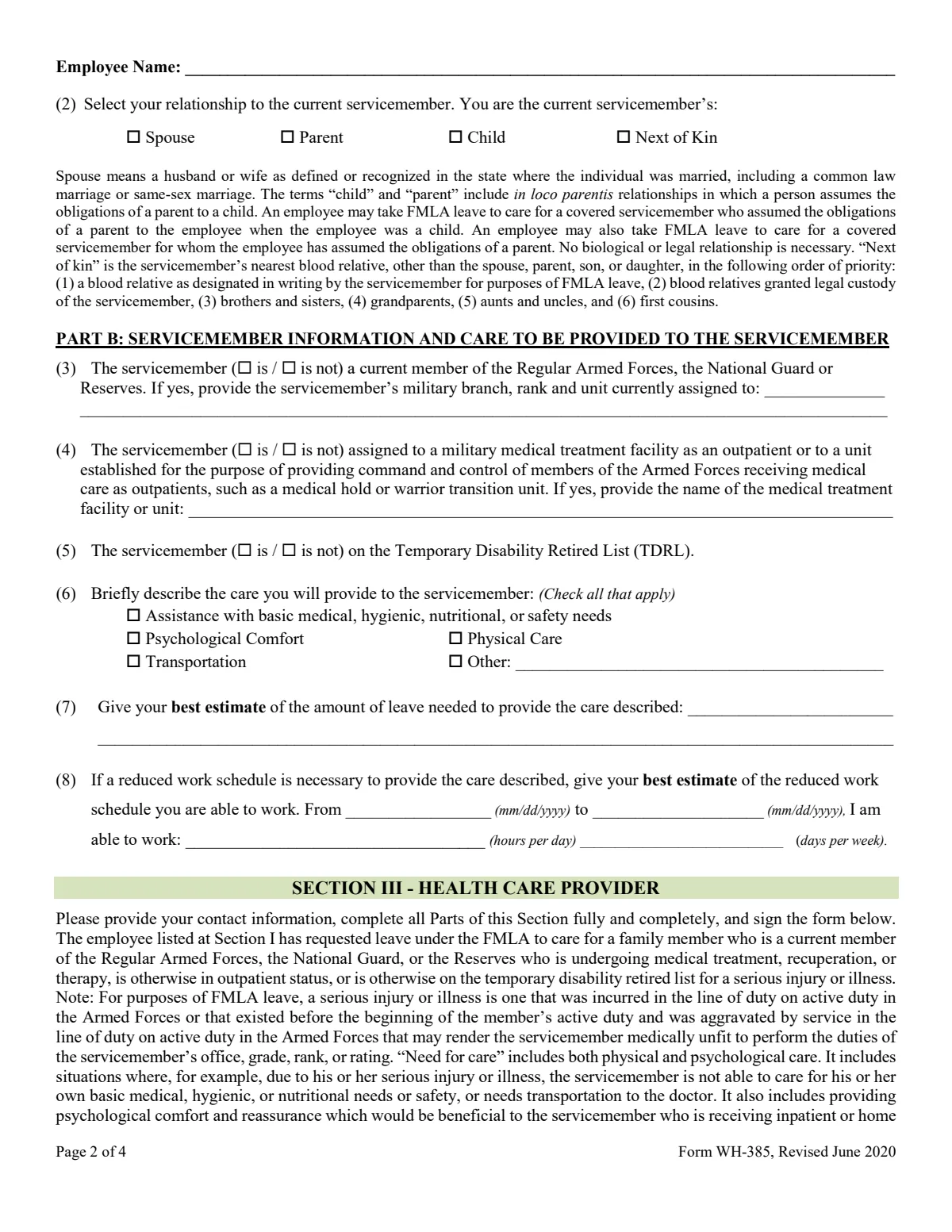
Section III, Part A: the provider
| Line | Label | What goes there |
|---|---|---|
| HCP | Health Care Provider's Name (Print); business address; Type of practice/Medical specialty; Telephone; Fax; E-mail | As on the other certifications; contact for clarification or authentication follows 29 CFR 825.307(a)29 CFR 825.307Code of Federal Regulations, eCFR. |
| HCP-type | Please select the type of FMLA health care provider you are: DOD health care provider; VA health care provider; DOD TRICARE network authorized private health care provider; DOD non-network TRICARE authorized private health care provider; Health care provider as defined in 29 C.F.R. § 825.125 | This box decides whether you may seek a second opinion. “Second and third opinions under § 825.307 are not permitted for leave to care for a covered servicemember when the certification has been completed by one of the types of health care providers identified in § 825.310(a)(1)-(4).” Only the last type allows them. |
Part B: medical information
| Line | Label | What goes there |
|---|---|---|
| 1 | (1) Patient's Name | The servicemember, as in Section II. |
| 2 | (2) List the approximate date condition started or will start | Or the date it was aggravated (29 CFR 825.310(b)(3))29 CFR 825.310Code of Federal Regulations, eCFR. |
| 3 | (3) Provide your best estimate of how long the condition will last | The probable duration. |
| 4 | (4) The servicemember's injury or illness: Was incurred in the line of duty on active duty; Existed before the beginning of the servicemember's active duty and was aggravated by service in the line of duty on active duty; None of the above. | A serious injury or illness must be incurred or aggravated in the line of duty on active duty. The provider “may rely on determinations from an authorized DOD representative (such as a DOD Recovery Care Coordinator) or an authorized VA representative”. |
| 5 | (5) The servicemember (is / is not) undergoing medical treatment, recuperation, or therapy for this condition. | For a current member, the medical facts must say whether the member is receiving treatment, recuperation or therapy (29 CFR 825.310(b)(4)(i))29 CFR 825.310Code of Federal Regulations, eCFR. |
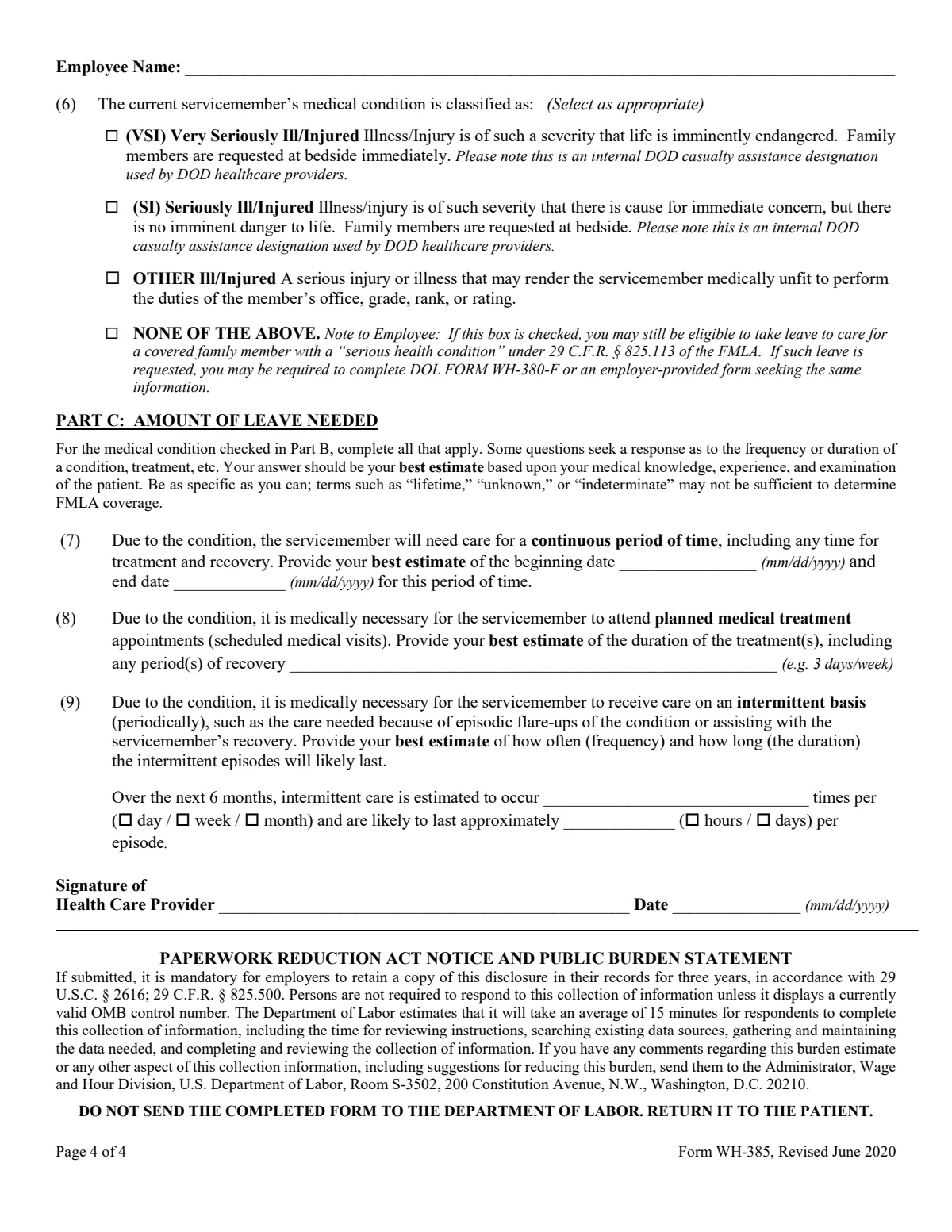
| 6 | (6) The current servicemember's medical condition is classified as: (Select as appropriate) | The first two are DOD casualty designations; the third is the FMLA definition. |
| 6-vsi | (VSI) Very Seriously Ill/Injured | The form's note for VSI and SI alike: “Please note this is an internal DOD casualty assistance designation used by DOD healthcare providers.” |
| 6-si | (SI) Seriously Ill/Injured | A DOD designation, like VSI. |
| 6-other | OTHER Ill/Injured | The FMLA test for a current member (29 CFR 825.127(c)(1))29 CFR 825.127Code of Federal Regulations, eCFR. |
| 6-none | NONE OF THE ABOVE. Note to Employee: ... you may be required to complete DOL FORM WH-380-F or an employer-provided form seeking the same information. | Military caregiver leave does not apply, but leave to care for a family member with a serious health condition may. |
Part C: amount of leave needed
| Line | Label | What goes there |
|---|---|---|
| 7 | (7) Due to the condition, the servicemember will need care for a continuous period of time | The block of care with its dates. |
| 8 | (8) Due to the condition, it is medically necessary for the servicemember to attend planned medical treatment appointments | Supports intermittent leave for appointments. |
| 9 | (9) Due to the condition, it is medically necessary for the servicemember to receive care on an intermittent basis (periodically) | Episodic flare-ups or help with recovery. |
| Sig | Signature of Health Care Provider; Date | An unsigned form is incomplete. |
Rules that matter
- No recertification. The form says it plainly: “Recertifications are not allowed for FMLA leave to care for a covered servicemember.”
- Military paperwork delays. The employee “may not be held liable for administrative delays in the issuance of military documents”, if the employee is diligent and acting in good faith (29 CFR 825.310(g))29 CFR 825.310Code of Federal Regulations, eCFR.
- The single 12-month period. It starts on the first day of military caregiver leave and runs 12 months, “regardless of the method used by the employer to determine the employee's 12 workweeks of leave entitlement for other FMLA-qualifying reasons”. Unused weeks are forfeited at the end of it.
- Which reason to designate. Leave that qualifies both as military caregiver leave and as care for a family member with a serious health condition must be designated as military caregiver leave first, never as both (29 CFR 825.127(e)(4))29 CFR 825.127Code of Federal Regulations, eCFR.
- Relationship proof. You may ask for confirmation of the family relationship, including when the employee relies on an ITO or ITA (29 CFR 825.310(e)(3))29 CFR 825.310Code of Federal Regulations, eCFR.
- Records. Confidential medical file, three years (29 CFR 825.500(g))29 CFR 825.500Code of Federal Regulations, eCFR.
How it connects
- A servicemember who has left the military: Form WH-385-V. A deployment rather than an injury: Form WH-384. All the DOL forms: FMLA forms.
- The notices: WH-381 (note the military caregiver 12-month start date in Part A) and WH-382.
- State family leave programs that cover care for a family member: paid family leave by state; how they run with the FMLA: FMLA and state paid leave.
Questions employers ask
How much leave does WH-385 support?
Up to 26 workweeks in a single 12-month period that starts on the first day of military caregiver leave. During that period the employee has 26 weeks in total for all FMLA reasons, with no more than 12 for the other reasons.
Can we get a second opinion on a WH-385?
Not when a DOD, VA, DOD TRICARE network or non-network TRICARE provider completed it. Only when another health care provider completed it. You may still authenticate and clarify.
Do we have to accept invitational travel orders instead of the form?
Yes. An ITO or ITA issued to any family member to join the servicemember at the bedside is sufficient certification for the time it covers, whether or not the employee is named.
Who counts as next of kin?
The servicemember's nearest blood relative other than a spouse, parent or child: relatives with legal custody, then siblings, grandparents, aunts and uncles, and first cousins, unless the servicemember designated another blood relative in writing.
What if the provider checks NONE OF THE ABOVE?
The leave is not military caregiver leave, but the employee may still qualify for leave to care for a family member with a serious health condition, using Form WH-380-F.
Sources
- Form WH-385, Certification for Serious Injury or Illness of a Current Servicemember for Military Caregiver Leave (Revised June 2020), DOL Wage and Hour Division
- 29 CFR part 825, eCFR text current as of Nov. 1, 2026: 825.127, 825.200(f), 825.307, 825.310, 825.313, 825.500