2026 General Instructions for Forms W-2 and W-3, What's New.
What SDI means on a pay stub
SDI on a pay stub is state disability insurance: a deduction for a state program that pays workers who cannot work because of a non-work illness or injury, and in some states also paid family leave. Six places run one: California, New Jersey, New York, Rhode Island, Hawaii and Puerto Rico. California's is the one most people see. EDD says “The SDI withholding rate for 2026 is 1.3 percent.” and “The SDI withholding rate for 2027 is 1.4 percent.”, with no wage cap: “Effective January 1, 2024, all wages are subject to SDI contributions.” California SDI includes Paid Family Leave, so one deduction covers both.
SDI is not OASDI. OASDI is Social Security. SSA describes “Social Security's Old-Age, Survivors, and Disability Insurance (OASDI) program” and says “The OASDI tax rate for wages paid in 2027 is set by statute at 6.2 percent for employees and employers, each.” A pay stub can show both lines; they are different taxes paid to different governments.
The newer paid family and medical leave programs (Washington, Massachusetts, Connecticut, Oregon, Colorado and others) take their own deductions, often labeled with the program's name. Each program page has its rate and wage base; this page is about how the deductions show on the W-2.
Rev. Rul. 2025-4, holdings 1 and 5; 2026 General Instructions for Forms W-2 and W-3 (What's New, box 14a, boxes 15 to 20); the state pages in the table below.
The deduction stays in wages
The key W-2 point: the state deduction is not a pre-tax benefit. Rev. Rul. 2025-4 holds that an employee's withheld contribution is the employee's own state tax, and “Even though these amounts are withheld from the employee's wages, they are included in the employee's gross income (and wages for Federal employment tax purposes under §§ 3121(a), 3306(b), and 3401(a))” (holding 1). The 2026 W-2 instructions say it directly in What's New: “You must include the employee contribution and the employer voluntary payment as wages on the Form W-2.” So boxes 1, 3 and 5 are figured before the SDI or PFML deduction, as if it were not there.
The "employer voluntary payment" in that sentence is a pick-up: an employer that pays the employee's share instead of deducting it. That payment is extra wages (holding 5), and the 2025 relief for it was not extended: Notice 2026-6 “contemplates that employers will treat contribution amounts they voluntarily pay on behalf of their employees to a State PFML program as wages for Federal employment tax purposes” and report them on the W-2. California's own instruction lines up for box 14: “If you paid SDI taxes without withholding SDI from the employee's wages, you should show the SDI taxes as if they were withheld” and increase the amount by the formula in EDD's DE 231Q information sheet.
New York adds a state law point that agrees with the federal rule: “Paid Family Leave contributions are deducted from employees' after-tax wages.” Our page Is paid family leave taxable? walks through all seven holdings of the ruling.
Box 14a on the 2026 Form W-2
The 2026 Form W-2 changed box 14. The instructions say “Box 14 has been split into box 14a and box 14b.” What used to go in box 14, Other, now goes in box 14a. Box 14b is not for state deductions: “Box 14b was created to report the Treasury Tipped Occupation Code(s).” So in 2026, CASDI, VPDI, MAPFML and the rest go in box 14a, and nothing about SDI goes in 14b.
Box 14a is for information, and the IRS names state disability as an example: “You may also use this box for any other information that you want to give to your employee. Label each item.” “Examples include state disability insurance taxes withheld, union dues, uniform payments, health insurance premiums deducted”. The IRS does not set codes for box 14a and does not mention paid family leave contributions there; the labels come from the states. Where a state asks for a label, use it exactly; where it does not, a short plain label that names the state and the program serves the employee.
If a W-2 has more entries than box 14a can hold, California says “If no boxes are available for SDI, you are required to provide your employees with a separate written” statement with the employer's name, address, FEIN and EDD account number, the employee's details and the SDI withheld. State wages and state income tax go in boxes 15 to 17, and the instructions add: “Contact your state or locality for specific reporting information.”
Box 14 labels by state
These are the box 14 instructions the state agencies publish, quoted from their own pages. A "Not listed" row means we found no box 14 instruction in that agency's saved employer pages, not that the state forbids one.
| Program | What the agency says | Note |
|---|---|---|
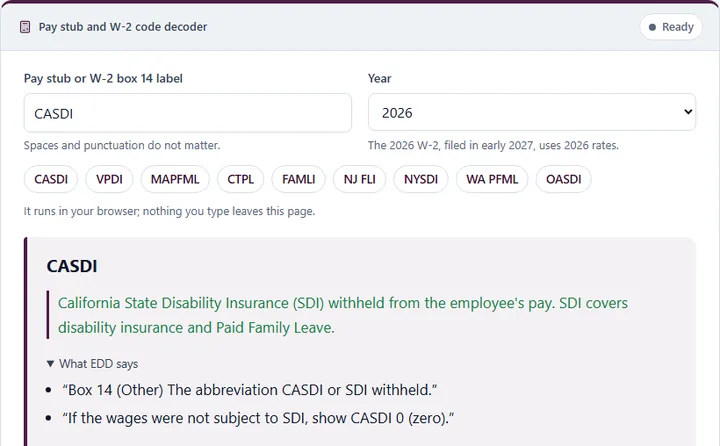
| California SDI (DI and PFL) | “Box 14 (Other) The abbreviation CASDI or SDI withheld.” | Required by EDD; “If the wages were not subject to SDI, show CASDI 0 (zero).” |
| California Voluntary Plan | “If you are covered under an authorized Voluntary Plan Disability Insurance (VPDI), enter VPDI and the VPDI amount withheld in Box 14.” | Required by EDD for VP employers |
| Massachusetts PFML | “In both cases, the boxes should be labeled ‘MAPFML.’” | “The amounts in the Boxes should include the combined total for Family and Medical Leave.” |
| Connecticut Paid Leave | “employers may utilize Box 14, with the reference code ‘CTPL’.” | Optional (CT Paid Leave Authority policy CTPL-003-CTRB (e)) |
| New York DBL and PFL | “Reporting employee contributions on tax Form W-2 using Box 14” | The page names the box “State disability insurance taxes withheld.” but sets no abbreviation |
| New Jersey TDI, FLI and UI | W-2 used for excess contribution credits “must show separately the worker's contribution amounts for unemployment and temporary disability insurance for the tax year” | No label given; private plan number if any |
| Colorado FAMLI | “Employers should report such deductions on IRS form W-2 in Box 14, and list ‘FAMLI’ as the label.” | FAMLI Division employer guide (written for the 2023 start) |
| Washington, Oregon, Delaware, DC, Maine, Minnesota, Rhode Island, Hawaii, Puerto Rico | Not listed | No box 14 instruction found in the saved agency pages |
Two points on the table. California's zero rule means an employee exempt from SDI still gets a CASDI line, showing 0. And Massachusetts asks for the employee's share only: “The amounts in Box 14 (on the W-2) and Box 16 (on the 1099-MISC) reflect the employee's year-end PFML contributions, not the employer's.” New York's page names the box but sets no abbreviation, so a label such as NYSDI or NYPFL is the employer's choice under the W-2 instruction to label each item. Program details: California SDI, Massachusetts PFML, CT Paid Leave, NY Paid Family Leave and NJ TDI and FLI.
What is withheld, by program
The amount in box 14a is the year's total of the employee deductions. For the disability programs, the employee rates for 2026 and 2027 are below, each with its authority. A "Not listed" cell means the agency had not published the figure in the sources we read as of Nov. 22, 2026.
| Program | 2026 employee share | 2027 employee share | Authority |
|---|---|---|---|
| California SDI | 1.3% of all wages (no cap) | 1.4% of all wages (no cap) | EDD rates page |
| New Jersey TDI and FLI (worker) | TDI 0.19% and FLI 0.23% on the first $171,100 | TDI 0.24% and FLI 0.24% on the first $177,100 | NJDOL employer hub and rate table |
| New York DBL | Up to 0.5% of wages, at most $0.60 a week | Same (statute) | N.Y. Workers' Comp. Law 209 |
| New York PFL | 0.432%, at most $411.91 a year | 0.452%, at most $451.81 a year | DFS rate decisions |
| Rhode Island TDI | 1.1% on the first $100,000 | Not listed | DLT employer tax unit |
| Hawaii TDI | Up to half the cost, at most 0.5% of weekly wages ($7.50 a week) | Not listed | DLIR 2026 wage base notice |
| Puerto Rico SINOT | Up to 0.30% of the first $9,000 a year | Not listed | DTRH SINOT page (no year stated) |
Puerto Rico's page gives the 0.30% employee maximum and the $9,000 base without a year; the DTRH tax page uses the same base. New York's DBL deduction is capped by statute at “sixty cents per week”, and the employer pays the rest of the premium to its carrier. More on each program is on our state disability insurance hub.
Disability benefits on the W-2
Disability and medical leave benefits can reach the W-2 too, as third-party sick pay. When an insurer or a state pays sick pay and shifts the employer share of the taxes to the employer, the employer files the W-2 for it unless the two agree that the payer will (Pub. 15-A, section 6). The box 13 checkbox is for that: “Third-party sick pay. Check this box only if you are a third-party sick pay payer filing a Form W-2 for an insured's employee or are an employer reporting sick pay payments made by a third party.”
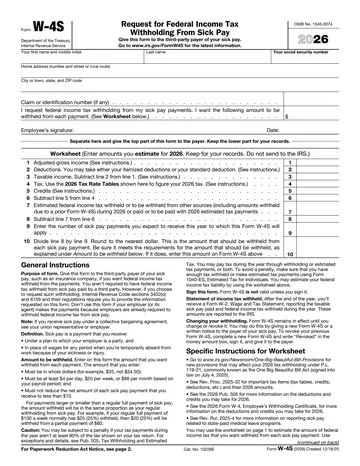
Box 12 code J shows the part that is not taxable because the employee paid for it: “Show any sick pay that was paid by a third party and was not includible in income (and not shown in boxes 1, 3, and 5) because the employee contributed to the sick pay plan.” Then: “Do not include nontaxable disability payments made directly by a state.” Pub. 15-A (2026) prints the same rule with a different preposition, nontaxable disability payments “made directly to a state”. The W-2 instructions are the instructions for the form itself, so follow their wording ("by a state") when filling in box 12; the two IRS texts have not been reconciled in the sources we read. On Form W-3, box 14 shows “Income tax withheld by payer of third-party sick pay.” That withholding happens only at the employee's request on Form W-4S: “Give this form to the third-party payer of your sick pay, such as an insurance company, if you want federal income tax withheld from the payments.” Our Form W-4S: Request for Federal Income Tax Withholding From Sick Pay page covers the form.
New Jersey's state plan TDI already works this way. NJDOL says “Only a portion of the Temporary Disability Insurance benefits paid are taxable by the federal government (they are not taxed by the State of New Jersey).” and “It is your responsibility to report the taxable information on your employee's W-2.” The figures come from the year-end statement and the DS-7C notice, whose “Taxable Amount” column gives the base for the employer's share of FICA. Family leave benefits are different: “FLI benefits are taxable to the federal government. Form 1099-G is available online for claimants”, so they never go on the W-2.
What changes for 2027 W-2s
For benefits paid in 2026, Notice 2026-6 lets states and employers skip the third-party sick pay withholding and reporting on state medical leave benefits. That relief ends with benefits paid in 2026 unless the IRS extends it, so W-2s for 2027 (filed in early 2028) may carry state medical leave benefits as sick pay. Maine says “the taxable portion of medical leave benefits will be treated as wages and reported on Form W-2 to the employee” starting in tax year 2027, and Minnesota says “Starting in the 2028 tax season, employers will need to enter certain information on employees' W-2” forms, with details to come in 2027.
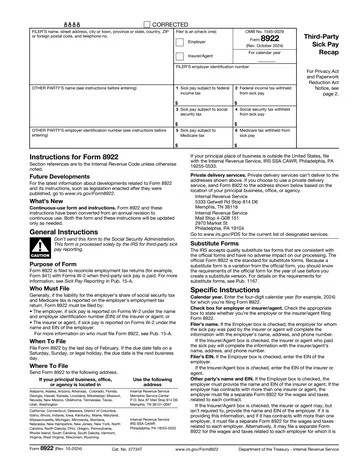
Plan for three things before January 2028: which employees had state medical leave benefits in 2027, whether the state shifted the employer share to you (it then sends a sick pay statement), and whether you or the state files the Form 8922 recap (see our Form 8922: Third-Party Sick Pay Recap page). The steps are on our third-party sick pay page.
Forms, line by line
Tools for this topic
Questions employers ask
What is CASDI on my W-2?
California State Disability Insurance withheld from pay during the year, shown in box 14 (box 14a on 2026 forms). EDD tells employers to use the abbreviation CASDI or SDI withheld, and to show CASDI 0 when wages were not subject to SDI.
Is SDI the same as OASDI?
No. OASDI is Social Security, 6.2% for the employee and 6.2% for the employer in 2027. SDI is a state disability insurance deduction, such as California's 1.3% in 2026 and 1.4% in 2027.
Does SDI reduce taxable wages in box 1?
No. Under Rev. Rul. 2025-4 the employee's state disability or paid leave contribution is the employee's own state tax, so it stays in boxes 1, 3 and 5. Box 14a only reports it.
Which box do we use on the 2026 W-2, 14a or 14b?
Box 14a. The 2026 form split box 14; box 14a is the old Other box, and box 14b is only for Treasury Tipped Occupation Codes.
Is a box 14 entry required?
Box 14a is optional for federal purposes. Some states ask for it: California (CASDI, VPDI), Massachusetts (MAPFML) and New York; Connecticut says employers may use CTPL. Check each state where you withhold.
We pay the PFML deduction for our employees. What goes on the W-2?
The amount you paid is extra wages in boxes 1, 3 and 5. California also asks that the SDI you paid be shown in box 14 as if it were withheld, grossed up by its formula.
Sources
- IRS: 2026 Instructions for Forms W-2 and W-3 (What's New, box 12 code J, box 13, box 14a, Form W-3 box 14); Rev. Rul. 2025-4; Notice 2026-6; Pub. 15-A (2026), section 6
- Social Security Administration: Contribution and benefit base
- California EDD: California Employer's Guide (DE 44) and Rates and withholding; Massachusetts DFML: Wage contributions reporting; Connecticut Paid Leave Authority: Consolidated policies; New York: Paid Family Leave cost, Workers' Compensation Law 209, DFS 2026 and 2027 rate decisions
- New Jersey Department of Labor: Employer hub, Rate information, employer handbook (taxes and wages, TDI and FLI); Rhode Island DLT: Employer tax unit; Hawaii DLIR: 2026 maximum weekly wage base notice; Puerto Rico DTRH: SINOT