- Who gives it
- Every covered New York employer
- When
- Within 5 days of learning of the disability
- Filed with
- Not filed: given to the employee
- Form revision
- DB-271S (12/23)
- Pages
- 1
At a glance
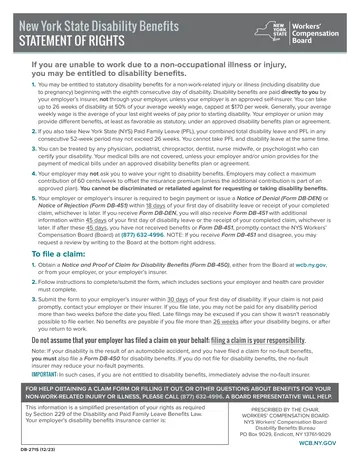
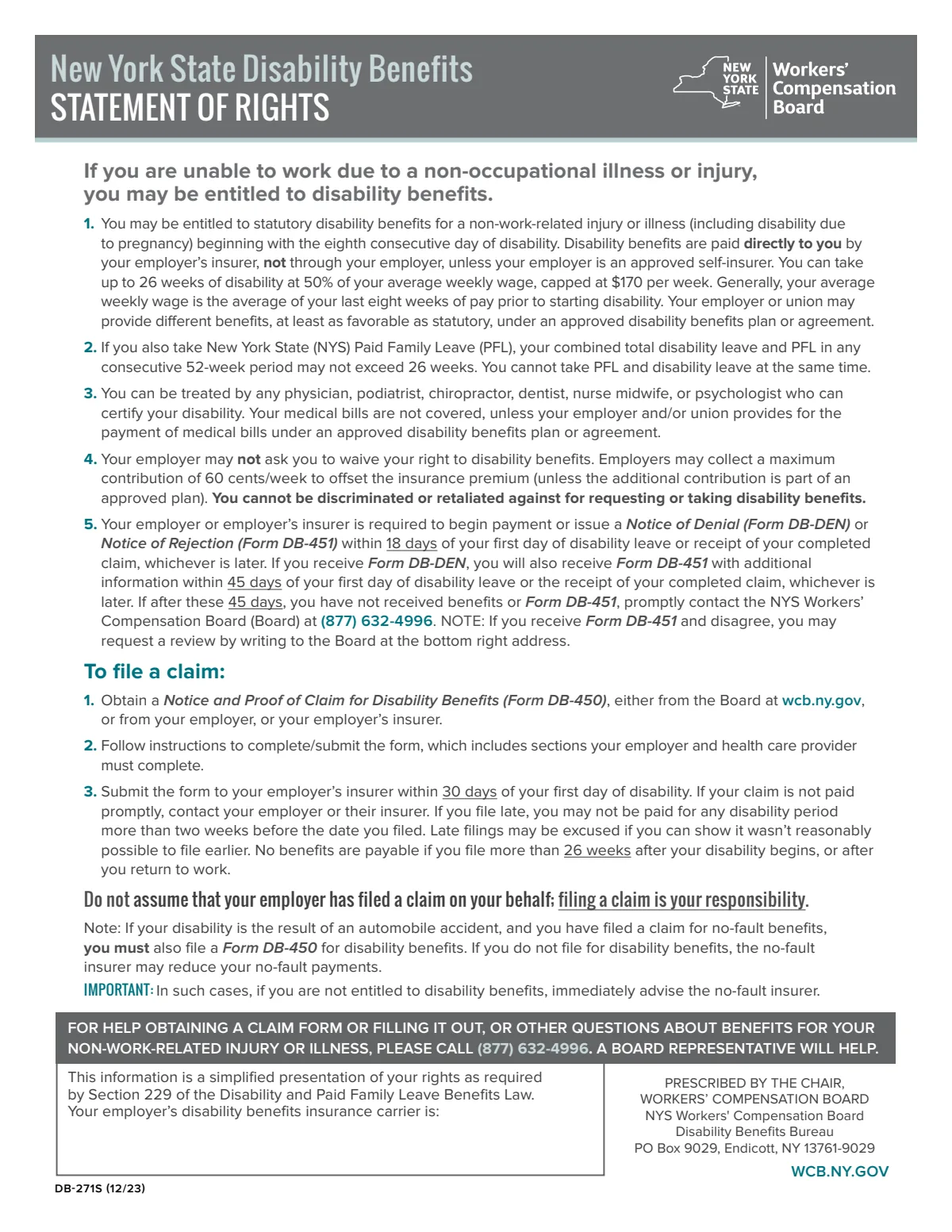
Form DB-271S is the New York State Disability Benefits “STATEMENT OF RIGHTS”, revision DB-271S (12/23). It is a one-page notice the employer hands to an employee who is out with an off-the-job illness or injury. It tells the employee what the Disability Benefits Law pays, how to file a claim and who the employer's carrier is. The footer says it is “a simplified presentation of your rights as required by Section 229 of the Disability and Paid Family Leave Benefits Law”.
- Who gives it. Every covered employer, whether insured or self-insured. WCB lists the duty among employer responsibilities: “Supply a worker who has been disabled more than seven days with a Statement of Rights under the Disability Benefits Law”.
- When. Within five days of learning of the disability (the two wordings WCB uses are below).
- How. Hand or send it to the employee. Nothing is filed with the Board.
- Form. DB-271S (PDF), one page, with one blank: the carrier's name. WCB posts translations on its disability and Paid Family Leave forms page.
- Not the PFL notice. Paid Family Leave has its own statement, the PFL-271S. The DB-271S covers disability benefits only.
DB-271S (12/23); WCB, Employers' Rights and Responsibilities; WCB disability and PFL forms list.
Tap a box once for its note, again to jump to the line. Zoom in to read the small print.
When the employer must give it
WCB states the deadline two ways. The employer responsibilities page and the eligibility page say “within five days of learning that the employee is disabled (WCL §229[2])”. The forms list gives a fuller rule: “When covered employee is absent from work due to disability for more than 7 consecutive days, form must be issued within 5 business days thereafter; or within 5 days after employer knows or should know that absence is due to disability, whichever is greater.” Both rest on WCL section 229(2). The safe practice is to send the notice as soon as an absence passes seven days and you know or should know it is a disability, and never later than five business days after that.
The employer does not decide whether the claim is good. The notice goes out first; the carrier (or a self-insured employer acting as its own carrier) decides the claim within the 18 days in paragraph 5.
Paragraphs 1 to 5: the rights
The five numbered paragraphs summarize the benefit, its interaction with Paid Family Leave, the providers who may certify a disability, the employee contribution and the carrier's deadlines. Read them before you answer an employee's questions: the notice is what the employee will quote back to you.
| Part | Paragraph | What it says and what it means for payroll |
|---|---|---|
| Intro | If you are unable to work due to a non-occupational illness or injury, you may be entitled to disability benefits. | The heading frames the notice for the employee. Disability benefits under the Disability Benefits Law (DBL) cover off-the-job conditions; work injuries are workers' compensation. |
| R1 | 1. Statutory benefits | The core numbers: “You can take up to 26 weeks of disability at 50% of your average weekly wage, capped at $170 per week.” Benefits start beginning with the eighth consecutive day of disability, and are paid by the insurer unless the employer is an approved self-insurer. WCB's own page gives the same cap: “currently $170 per week (WCL §204)”. |
| R2 | 2. Disability and Paid Family Leave together | “your combined total disability leave and PFL in any consecutive 52-week period may not exceed 26 weeks.” You cannot take PFL and disability leave at the same time. |
| R3 | 3. Who can certify the disability | A physician, podiatrist, chiropractor, dentist, nurse midwife or psychologist may certify it. Medical bills are not covered unless an approved plan or agreement pays them. |
| R4 | 4. No waiver; employee contribution | The employer “may not ask you to waive your right to disability benefits.” The contribution cap printed here matches WCB's employer page: “An employee's contribution is computed at the rate of one-half of one percent of their wages, but no more than sixty cents a week.” The paragraph ends with the anti-retaliation rule. |
| R5 | 5. When the employer or insurer must act | Payment, a Notice of Denial (DB-DEN) or a Notice of Rejection (DB-451) is due “within 18 days of your first day of disability leave or receipt of your completed claim, whichever is later.” After a DB-DEN, the DB-451 follows within 45 days. A self-insured employer carries this duty itself. |
Filing a claim
The second half of the notice tells the employee how to claim. WCB's forms list says where the DB-450 goes: “If you became sick or disabled while employed or you became sick or disabled within four (4) weeks after termination of employment, file with your employer or its insurer.”
| Part | Step | What it says and what it means for payroll |
|---|---|---|
| C1 | To file a claim: 1. Obtain Form DB-450 | The Notice and Proof of Claim for Disability Benefits. Keep blank copies or the DB-450 (PDF) link handy, because the notice tells the employee the employer is one place to get it. |
| C2 | 2. Complete and submit the form | The DB-450 includes sections your employer and health care provider must complete. Fill in the employer part promptly so the claim is not held up. |
| C3 | 3. Submit within 30 days | “Submit the form to your employer’s insurer within 30 days of your first day of disability.” A late claim may lose pay for any period more than two weeks before filing, and “No benefits are payable if you file more than 26 weeks after your disability begins, or after you return to work.” |
| Note | Do not assume that your employer has filed a claim on your behalf | “filing a claim is your responsibility.” An employee hurt in a car accident who claims no-fault benefits must also file a DB-450, because the no-fault insurer may otherwise reduce its payments. |
The carrier blank and the footer
The bottom of the page holds the only entry the employer makes and the Board's contact details.
| Part | As printed | What goes there |
|---|---|---|
| Help | For help obtaining a claim form or filling it out | The Board's help line for disability claims, (877) 632-4996, printed in capitals on the notice. |
| Carrier | Your employer’s disability benefits insurance carrier is: | The one blank on the notice. Enter the carrier's name before you hand it over; a self-insured employer enters its own name as self-insurer. The employee files the DB-450 with this carrier. |
| Board | NYS Workers' Compensation Board, Disability Benefits Bureau | The address the employee writes to for a review of a DB-451 rejection: PO Box 9029, Endicott, NY 13761-9029. |
Rules that trip employers up
- Waiting for the employee to ask. The duty is the employer's. The notice reminds the employee that filing the claim is theirs, but giving the notice is not optional.
- Leaving the carrier blank. The employee needs the carrier's name to file the DB-450. Fill it in before you send the notice.
- Using the PFL statement instead. Leave for the employee's own illness is disability; leave to care for a family member or bond with a child is Paid Family Leave, with its own PFL-271S.
- Asking the employee to waive benefits. The notice itself says the employer may not ask, and WCB adds that “any agreement by an employee to waive their right to disability benefits shall be void.”
- Over-deducting. The employee share is half of one percent of wages, at most 60 cents a week; an employee with two jobs may ask each employer to prorate so the total stays at 60 cents (WCB, Employers' Rights and Responsibilities).
- Retaliation. Employers may “Not discriminate against an employee because they have requested or taken disability or Paid Family Leave benefits” (WCL 120, 203-a and 203-b).
The saved WCB sources set no separate fine for a late DB-271S. The penalties WCB publishes are for having no disability and Paid Family Leave coverage at all; see the NY DBL penalties section.
How it connects
- The program behind the notice: coverage, the 60 cent contribution, carriers and self-insurance: New York DBL for employers.
- The leave that runs alongside it, with its own statement of rights: New York Paid Family Leave.
- Self-insuring the benefit instead of buying a policy: DB-150, Application for Self-Insurance. Notices and posters in every state: paid leave posters and notices.
Questions employers ask
When do I have to give an employee the DB-271S?
Within five days of learning that the employee is disabled, once the disability has lasted more than seven days. WCB's forms list words it as within 5 business days after the seventh consecutive day of absence, or within 5 days after the employer knows or should know the absence is a disability, whichever is greater.
Do I file the DB-271S with the Workers' Compensation Board?
No. It is a notice to the employee. The employee then files the claim form, DB-450, with the employer's carrier within 30 days.
Is the DB-271S the same as the Paid Family Leave statement of rights?
No. The DB-271S covers disability benefits for the employee's own off-the-job illness or injury. Paid Family Leave has a separate statement, the PFL-271S.
What benefit does the DB-271S promise?
Statutory benefits from the eighth consecutive day of disability, at 50 percent of the average weekly wage up to $170 a week, for up to 26 weeks. An approved plan may pay more.
What do I write in the carrier box?
The name of the employer's disability benefits insurance carrier. A Board-approved self-insured employer enters its own name as self-insurer.
Is the DB-271S available in other languages?
Yes. WCB's forms page posts it in Spanish, Russian, Polish, Chinese, Italian, Haitian Creole, Korean, Bengali, Yiddish, Arabic, French and Urdu.