- At a glance
- The form, with hotspots
- The header
- Lines 1 to 4: withholding and statewide transit tax
- Lines 5 to 12: TriMet, Lane Transit and monthly counts
- Lines 13 to 24: UI and Paid Leave Oregon
- Line 21b: the booklet and ORS 657B.920
- Lines 25 to 32 and signature
- Rules that trip employers up
- How it connects
- Questions employers ask
- Sources
- Who files
- Every registered Oregon employer
- Due
- Last day of the month after the quarter
- Filed with
- Frances Online or DOR by mail
- Form revision
- 150-206-521 (Rev. 08-18-22)
- Pages
- 2
At a glance
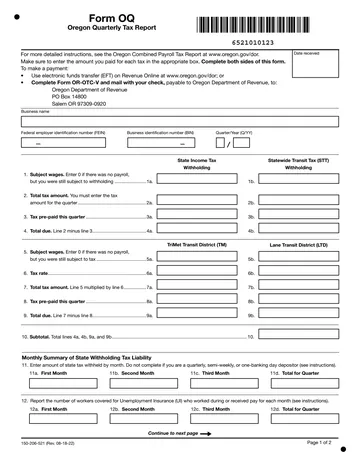
Form OQ is the “Oregon Quarterly Tax Report”, revision 150-206-521 (Rev. 08-18-22): one return for Oregon income tax withholding, the statewide transit tax, the TriMet and Lane transit taxes, unemployment insurance, Paid Leave Oregon contributions and the Workers' Benefit Fund assessment. The booklet calls the set the Oregon Combined Payroll Tax Report, and uses Form OQ to document how the employer calculates each of those amounts for the quarter.
- Who files. Every registered employer, “even if you had no payroll during the quarter.” Employers with an approved Equivalent Plan for Paid Leave file too.
- With it. Form 132, the employee detail report, and Schedule B for semi-weekly or one-banking-day depositors.
- When. By the last day of the month after the quarter, moved to the next business day on a weekend or holiday.
- How. Electronically in Frances Online (free), or on paper to Oregon Department of Revenue, PO Box 14800, Salem OR 97309-0920. Pay by EFT in Revenue Online or with Form OR-OTC-V.
- Form. Form OQ (PDF), two pages, and the 2026 Combined Payroll Tax Report instruction booklet (PDF), whose line instructions every note below follows.
2026 Oregon Combined Payroll Tax Report booklet, Filing Due Dates for Quarterly Reports. Payments are due on the same dates.
Tap a box once for its note, again to jump to the line. Zoom in to read the small print.
The header
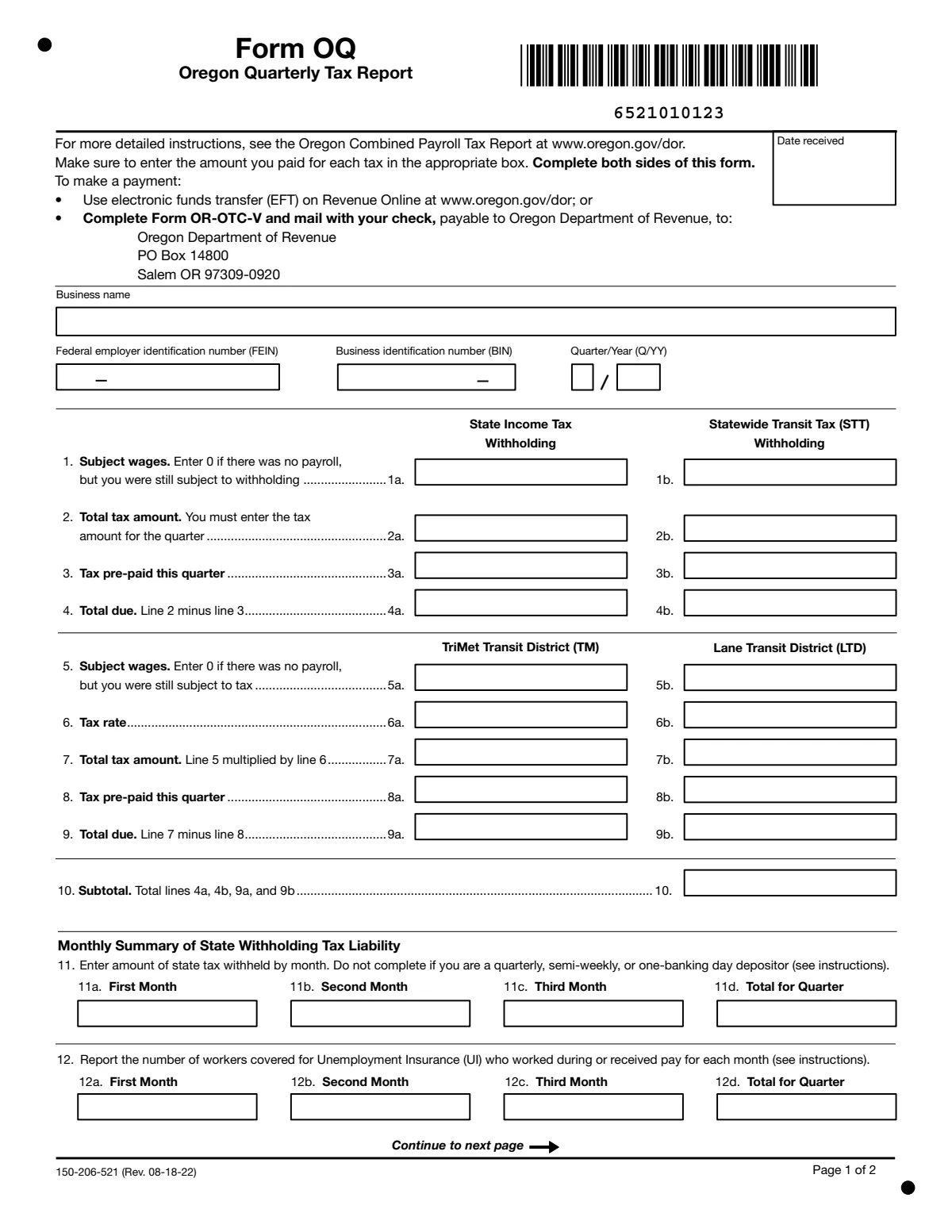
The booklet's tip list starts here: “Put the BIN and quarter/year on each report form in the appropriate box.” A paper OQ is read by machine, so use black or blue ink and capital letters.
| Box | Label as printed | What goes there |
|---|---|---|
| Name | Business name | As registered. If the name, BIN or FEIN changed, update it in Frances Online or on the Business Change in Status form, not by a note on the OQ. |
| FEIN | Federal employer identification number (FEIN) | The FEIN. |
| BIN | Business identification number (BIN) | The booklet: “The correct format for a BIN is NNNNNNNN-N”. The BIN is not the Revenue Identification Number (RIN) or the Secretary of State registry number. |
| QY | Quarter/Year (Q/YY) | The quarter (1 to 4) and the last two digits of the year. |
Lines 1 to 4: withholding and statewide transit tax
Column a is Oregon income tax withholding; column b is the statewide transit tax (STT) of 0.1 percent, withheld from employees. Fill a column only for programs you are subject to, and enter 0 rather than leaving it blank: “Only columns on Form OQ that are filled in with numerical information are considered a filed return”.
| Box | Label as printed | What goes there |
|---|---|---|
| 1a | 1. Subject wages (State Income Tax Withholding) | Total wages subject to Oregon income tax withholding. Enter 0 if there was no payroll but you were still subject to withholding. |
| 1b | 1. Subject wages (Statewide Transit Tax Withholding) | Total wages subject to the statewide transit tax. The booklet: “A 0.001 STT is imposed on the wages of every Oregon resident and nonresident” for services performed in Oregon. |
| 2a | 2. Total tax amount (withholding) | The Oregon income tax withheld this quarter; 0 if you had subject payroll but no withholding. Monthly depositors also complete line 11: “Note: Box 4a and 11d must be the same amount.” |
| 2b | 2. Total tax amount (STT) | The STT withheld this quarter; 0 if subject but none to pay. |
| 3a | 3. Tax pre-paid this quarter (withholding) | Withholding paid during the quarter, with any withholding credits used. |
| 3b | 3. Tax pre-paid this quarter (STT) | STT paid during the quarter, with any credits used. |
| 4a | 4. Total due. Line 2 minus line 3 (withholding) | 2a minus 3a. If zero or less, enter 0. Semi-weekly and one-banking-day depositors put the Schedule B total here. |
| 4b | 4. Total due (STT) | 2b minus 3b. If zero or less, enter 0. |
Lines 5 to 12: TriMet, Lane Transit and monthly counts
The two district transit taxes are employer-paid taxes on wages for work done inside each district; see TriMet and Lane transit taxes for the district maps and rules.
| Box | Label as printed | What goes there |
|---|---|---|
| 5a | 5. Subject wages (TriMet Transit District) | Wages paid for work done in the TriMet district; 0 if none this quarter. |
| 5b | 5. Subject wages (Lane Transit District) | Wages paid for work done in the Lane Transit District; 0 if none this quarter. |
| 6a | 6. Tax rate (TriMet) | 0.008237 for 2026 and beyond, as the booklet prints it. |
| 6b | 6. Tax rate (LTD) | 0.0080 for 2026 and beyond. |
| 7a | 7. Total tax amount. Line 5 multiplied by line 6 (TriMet) | Multiply 5a by 6a and round down to the nearest cent; 0 if subject but no tax. |
| 7b | 7. Total tax amount (LTD) | Multiply 5b by 6b and round down to the nearest cent. |
| 8a | 8. Tax pre-paid this quarter (TriMet) | TriMet tax prepaid, with credits used. |
| 8b | 8. Tax pre-paid this quarter (LTD) | LTD tax prepaid, with credits used. |
| 9a | 9. Total due (TriMet) | 7a minus 8a; 0 if zero or less. |
| 9b | 9. Total due (LTD) | 7b minus 8b; 0 if zero or less. |
| 10 | 10. Subtotal. Total lines 4a, 4b, 9a, and 9b | The withholding, STT, TriMet and LTD amounts due, added. It carries to line 32. |
| 11 | 11. Enter amount of state tax withheld by month | Do not complete if you are a quarterly, semi-weekly, or one-banking day depositor. |
| 11a | 11a. First Month | Oregon income tax withheld in the first month of the quarter. |
| 11b | 11b. Second Month | Withholding in the second month. |
| 11c | 11c. Third Month | Withholding in the third month. |
| 11d | 11d. Total for Quarter | 11a, 11b and 11c added. It must equal box 4a. |
| 12 | 12. Report the number of workers covered for Unemployment Insurance (UI) | Count the full- and part-time workers who worked or were paid for UI-covered work in the payroll period that includes the 12th of the month. |
| 12a | 12a. First Month | The count for the first month. If there were no covered workers, enter 0: “Don’t leave these boxes blank.” |
| 12b | 12b. Second Month | The count for the second month. |
| 12c | 12c. Third Month | The count for the third month. |
| 12d | 12d. Total for Quarter | 12a, 12b and 12c added. |
Lines 13 to 24: UI and Paid Leave Oregon
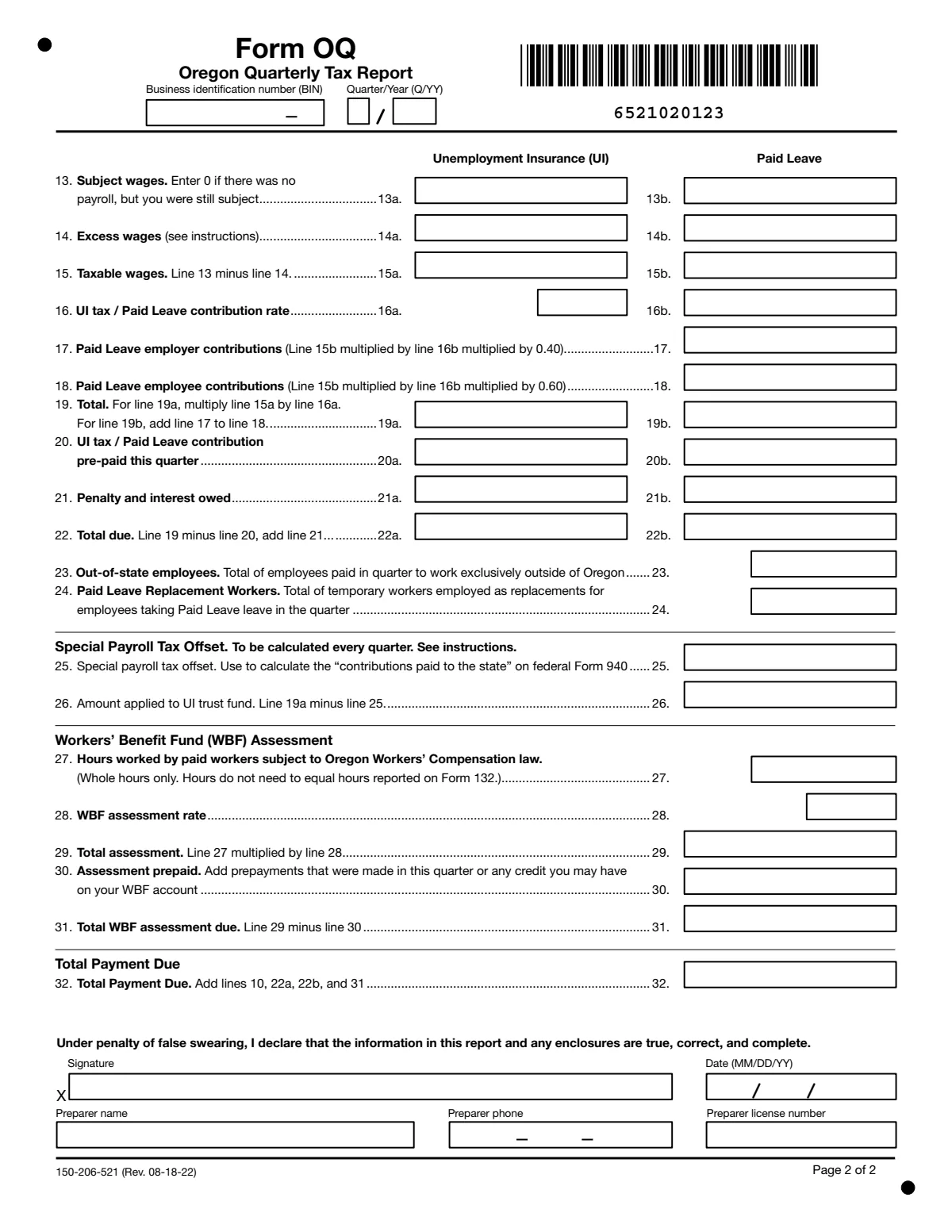
Page 2 carries the two programs the Employment Department runs. Column a is unemployment insurance; column b is Paid Leave Oregon, 1 percent of wages up to the yearly base, split 60 percent employee and 40 percent employer (the employer share only for large employers).
| Box | Label as printed | What goes there |
|---|---|---|
| BIN-2 | Business identification number (BIN); Quarter/Year (Q/YY) | The same BIN and quarter as page 1; the pages are processed separately. |
| 13a | 13. Subject wages (Unemployment Insurance) | “This amount must be the same as box G (Total UI Subject wages) on Form 132.” Include excess wages; 0 if none. |
| 13b | 13. Subject wages (Paid Leave) | Total wages subject to Paid Leave Oregon, including excess. “This amount must be the same as box H (Total Paid Leave subject wages) on Form 132.” |
| 14a | 14. Excess wages (UI) | Wages above the UI taxable wage base for the year, per employee: $56,700 for 2026. Reimbursing employers leave it blank. |
| 14b | 14. Excess wages (Paid Leave) | Wages above the Paid Leave base, per employee: $184,500 for 2026. For 2027 OED states: “1% of subject wages up to $192,300 (2027 Social Security taxable maximum wage) per employee.” |
| 15a | 15. Taxable wages. Line 13 minus line 14 (UI) | 13a minus 14a. Reimbursing employers leave it blank. |
| 15b | 15. Taxable wages (Paid Leave) | 13b minus 14b; 0 if zero or less. |
| 16a | 16. UI tax rate | Your assigned UI rate for the year. OED mails it and posts it to Frances Online: “2027 individual employer UI Tax rate and Paid Leave Contribution rate information was mailed to employers by Nov. 13, 2026” |
| 16b | 16. Paid Leave contribution rate | “Enter the current contribution rate of 1 percent (0.01).” |
| 17 | 17. Paid Leave employer contributions (Line 15b multiplied by line 16b multiplied by 0.40) | Large employers, on the state plan or an equivalent plan, and small employers that received an assistance grant multiply 15b x 0.01 x 0.40 and round to the cent. “If you are a small employer who has not received an assistance grant, leave this box blank.” Paid Leave Oregon: “You are a small employer if you have fewer than 25 employees on average.” |
| 18 | 18. Paid Leave employee contributions (Line 15b multiplied by line 16b multiplied by 0.60) | Every employer: 15b x 0.01 x 0.60, rounded to the cent. “Note: Employee contributions must be held in trust until paid to DOR quarterly on Form OR-OTC-V.” “An employer may choose to pay all or part of the employee's contribution.” |
| 19a | 19. Total (UI): line 15a multiplied by line 16a | 15a times 16a, rounded to the nearest cent; 0 if no UI tax. |
| 19b | 19. Total (Paid Leave): line 17 plus line 18 | Line 17 plus line 18. |
| 20a | 20. UI tax pre-paid this quarter | UI tax prepaid or credits used, including old overpayments not refunded. |
| 20b | 20. Paid Leave contribution pre-paid this quarter | Contributions prepaid, with credits from earlier overpayments not refunded. |
| 21a | 21. Penalty and interest owed (UI) | Only if the OQ is filed more than 10 days late: the penalty is $11 per employee, minimum $100, maximum $2,800, plus interest at 0.015 a month on unpaid tax. |
| 21b | 21. Penalty and interest owed (Paid Leave) | Only if filed more than 10 calendar days late. Interest is 1.5% a month, a full month if a day late. On the penalty the booklet and the statute differ; see the note below this table. |
| 22a | 22. Total due (UI): line 19 minus line 20, add line 21 | 19a minus 20a plus 21a; 0 if less than zero. |
| 22b | 22. Total due (Paid Leave) | 19b minus 20b plus 21b; 0 if zero or less. |
| 23 | 23. Out-of-state employees. Total of employees paid in quarter to work exclusively outside of Oregon | A count of employees who worked only outside Oregon during the quarter. |
| 24 | 24. Paid Leave Replacement Workers | The number of temporary employees hired to replace employees off on Paid Leave benefits during the quarter. |
Line 21b: the booklet and ORS 657B.920
The 2026 booklet says “The Paid Leave late-filing penalty is 2 percent of the employer's employee wages rounded to the nearest $100.” The statute says the penalty “shall be 0.02 percent of the wages of the employer’s employees rounded to the nearest $100.” (ORS 657B.920(3)). The statute governs: the booklet appears to drop the decimal. Both agree that the penalty applies only after a written warning, to a report filed late within three years, and that an employer with no subject wages pays a flat amount starting at $10. Late payment is separate: interest of 1.5 percent a month on unpaid contributions, and a 10 percent penalty if an assessment is not paid within 10 days of a written demand.
Lines 25 to 32 and signature
The special payroll tax offset is a reporting figure for federal Form 940, not a tax. The Workers' Benefit Fund assessment is an hourly assessment for workers' compensation programs, run by the Department of Consumer and Business Services.
| Box | Label as printed | What goes there |
|---|---|---|
| 25 | 25. Special payroll tax offset | 15a times the quarter's rate: 0.00135 in every quarter of 2026. It is not added to or subtracted from line 19a or 32; it is used for the "contributions paid to the state" on federal Form 940. Reimbursing employers and employers not subject to FUTA skip it. |
| 26 | 26. Amount applied to UI trust fund. Line 19a minus line 25 | 19a minus 25. |
| 27 | 27. Hours worked by paid workers subject to Oregon Workers' Compensation law | Whole hours, rounded down, of everyone subject to Oregon workers' compensation, including salaried workers, reported in the quarter paid. They need not match the hours on Form 132. |
| 28 | 28. WBF assessment rate | The Workers' Benefit Fund rate: 0.018 for 2026. Employers pay half of the hourly assessment and deduct half from workers' wages. |
| 29 | 29. Total assessment. Line 27 multiplied by line 28 | 27 times 28, rounded down to the cent; 0 if none. |
| 30 | 30. Assessment prepaid | WBF prepaid this quarter or WBF credits. |
| 31 | 31. Total WBF assessment due. Line 29 minus line 30 | 29 minus 30; 0 if zero or less. It should match the WBF box on Form OR-OTC-V. |
| 32 | 32. Total Payment Due. Add lines 10, 22a, 22b, and 31 | The whole quarter's payment. Pay by EFT in Revenue Online or mail Form OR-OTC-V with a check to the Oregon Department of Revenue. |
| Sign | Signature; Date; Preparer name, phone and license number | Sign and date: Under penalty of false swearing, I declare that the information in this report and any enclosures are true, correct, and complete. A paid preparer adds name, phone and license number. |
Rules that trip employers up
- Leaving boxes blank. A blank is not a filed return for that program. Enter 0.
- Forgetting to withhold Paid Leave. The booklet: “the employer is considered to have elected to pay the employee contributions they failed to withhold for that quarter.”
- Line 17 for small employers. A small employer without an assistance grant leaves line 17 blank but still withholds and reports the 60 percent employee share on line 18.
- Mismatched totals. 13a must equal Form 132 box G, 13b must equal box H, and 4a must equal 11d.
- Hours. Line 27 counts hours in the quarter paid; Form 132 counts UI hours in the quarter worked. They will not always match.
- Old rates. Use the current year's bases: for 2027, “The UI taxable wage base for 2027 is $58,600 per employee.” and the Paid Leave base is $192,300.
- Notes on the form. The booklet warns that “our systems won’t pick up special instructions or notations you write on Form OQ”. Amend with the Form OQ/OA Amended.
How it connects
- Paid Leave Oregon for employers: coverage, the 60/40 split, small employers and equivalent plans: Paid Leave Oregon.
- The employee detail report filed with every OQ: Form 132.
- The transit taxes on lines 1b and 5 to 9: Oregon statewide transit tax and TriMet and Lane transit taxes. Due dates in every state: PFML reports and due dates.
Questions employers ask
When is Oregon Form OQ due?
By the last day of the month after the quarter, or the next business day. For 2026: April 30, July 31, November 2 (October 31 was a Saturday) and February 1, 2027.
What Paid Leave Oregon rate goes on line 16b?
1 percent (0.01). Employees pay 60 percent of it on line 18 and large employers 40 percent on line 17, on wages up to $184,500 for 2026 and $192,300 for 2027.
Does a small employer complete line 17?
No, unless it received a Paid Leave assistance grant. A small employer has fewer than 25 employees on average. It still withholds and reports the employee share on line 18.
Do I file Form OQ if I had no payroll?
Yes, every registered employer files each quarter. Enter 0 in the boxes for the programs you are subject to. An employer with no payroll or hours in any program may file a no-payroll report by phone.
Can I file Form OQ online?
Yes. Form OQ, Schedule B and Form 132 can be filed free in Frances Online, and payments made by EFT in Revenue Online.
What is the late-filing penalty for Paid Leave Oregon?
ORS 657B.920 sets 0.02 percent of the employer's employees' wages, rounded to the nearest $100, after a written warning. The 2026 booklet prints 2 percent; the statute governs.