- Who files
- Anyone with payroll or owner services in the city
- Due
- May 31, Aug. 31, Nov. 30, Feb. 28
- Filed with
- City of Pittsburgh Treasurer, 414 Grant St.
- Form revision
- ET-1 2026, Rev 12/25
- Pages
- 1 form page (2 of instructions)
At a glance
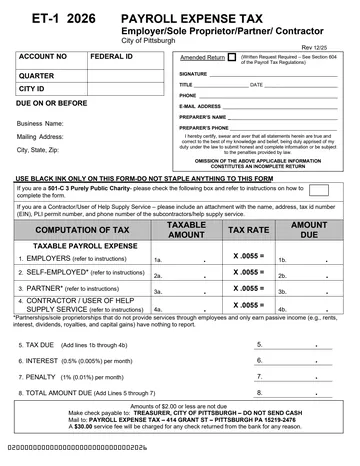
Form ET-1 is the City of Pittsburgh's “ET-1 2026 PAYROLL EXPENSE TAX” return for employers, sole proprietors, partners and contractors, revision “Rev 12/25”. It reports the quarter's payroll expense for work done in the city and pays the 0.55% tax on it. The employer pays this tax itself; it is separate from the earned income tax and Local Services Tax withheld from employees.
- Who files. “Every employer conducting business in the City of Pittsburgh is required to file a Payroll Tax on their payroll expense” and on owners' own distributions. The city's FAQ: “If you conduct any business within the City limits, you are required to file and pay payroll expense tax.” Being located outside the city does not matter. Only governmental entities are excluded from filing.
- Rate. “The Payroll Tax is fifty-five hundredths of a percent (.55% or .0055) of payroll expense generated as a result of an employer conducting business within the City of Pittsburgh, collected quarterly.”
- When. The last day of the second month after the quarter: May 31, August 31, November 30 and February 28. A mailed return “must be postmarked by the United States Post Office by the due date.”
- How. On the paper form, by mail or at the Treasurer's windows at 414 Grant Street. Zero quarters still need a return: an active business with no payroll or draws “you must file the quarterly return indicating ‘zero’ for reportable” compensation and tax due, the FAQ says.
- Form. 2026 ET-1 Tax Form (PDF): page 1 is the return, pages 2 and 3 the instructions. Earlier years have their own ET-1 on the city's tax forms page.
City of Pittsburgh ET-1 2026 instructions and Payroll Tax Regulations, sec. 301(e).
Tap a box once for its note, again to jump to the line. Zoom in to read the small print.
Header: account and quarter
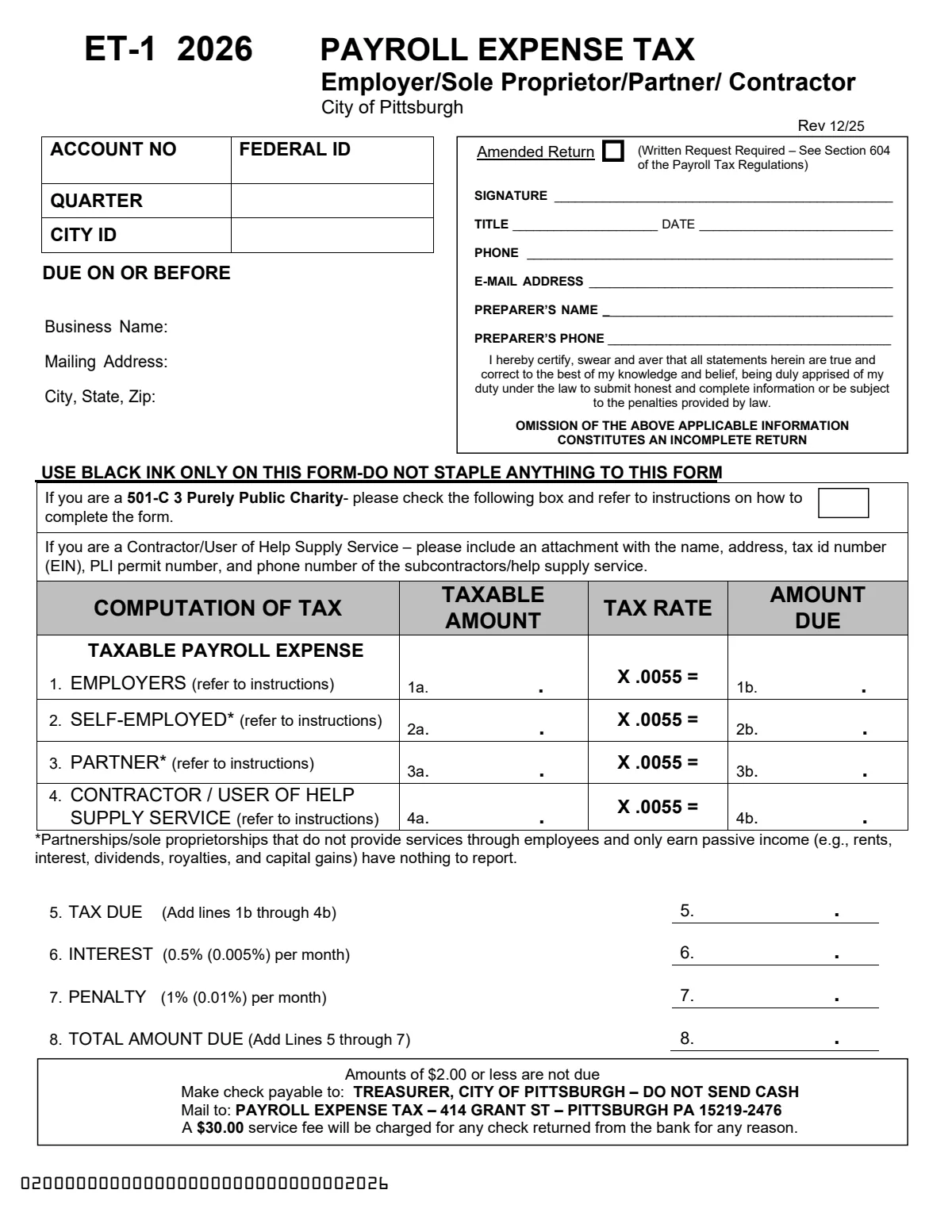
The left block identifies the account, the quarter and the business. The form says “USE BLACK INK ONLY ON THIS FORM-DO NOT STAPLE ANYTHING TO THIS FORM”.
| Line | Label | What goes there |
|---|---|---|
| Account | ACCOUNT NO | Your City of Pittsburgh Payroll Expense Tax account number. |
| FEIN | FEDERAL ID | Your federal EIN. |
| Quarter | QUARTER | The calendar quarter and year. The ET-1 instructions: “THE PAYROLL EXPENSE TAX WILL REVERT TO A CALENDAR REPORTING QUARTER AS FOLLOWS:” January to March, April to June, July to September and October to December. |
| CityID | CITY ID | The City ID number from your city registration. “Every Employer not registered with the City of Pittsburgh shall, within fifteen (15) days, register with the Treasurer the Employer’s name, address and such other information as the Treasurer may require.” Register on the city's New Business Registration form. |
| Due | DUE ON OR BEFORE | The due date for the quarter. “Thus, 1st Quarter taxes and reports are due May 31st, 2nd Quarter; taxes and reports are due August 31st, 3rd Quarter taxes and reports are due November 30th, and 4th Quarter taxes and reports are due February 28th of the following year.” |
| BizName | Business Name: | The business name on the account. |
| Mailing | Mailing Address: | Where the city should send notices. To change it, file the Change in Business Status Form. |
| CSZ | City, State, Zip: | Of the mailing address. |
Signature block and special filers
The right block holds the signature, contacts and the amended return box; the two boxed lines under it flag charities and contractors, who follow special rules.
| Line | Label | What goes there |
|---|---|---|
| Amended | Amended Return (Written Request Required: See Section 604 of the Payroll Tax Regulations) | Check this box only on an amended return. Under the regulations a taxpayer that overpaid, or believes it is not liable, “may file a written request on an amended tax return (ET-1) with the Department of Finance for a refund or a credit of the tax.” The request is due within three years of the return's due date or one year after payment, whichever is later. |
| Sign | SIGNATURE | The person filing signs. |
| TitleDate | TITLE; DATE | The signer's title and the date signed. |
| Phone | PHONE | A daytime number for the Department of Finance. |
| E-MAIL ADDRESS | An address the city can use for questions. | |
| PrepName | PREPARER'S NAME | The name of the person or firm that prepared the return, if not the signer. |
| PrepPhone | PREPARER'S PHONE | The preparer's number. |
| Certify | I hereby certify, swear and aver that all statements herein are true and correct ... OMISSION OF THE ABOVE APPLICABLE INFORMATION CONSTITUTES AN INCOMPLETE RETURN | The signer certifies the return under penalty of law. Leave out the signature, contact or preparer details and the city treats the return as incomplete. |
| Charity | If you are a 501-C 3 Purely Public Charity: please check the following box and refer to instructions on how to complete the form. | A purely public charity files the full return but pays only on activity subject to unrelated business income tax: it “shall only pay the tax on that portion of its payroll expense attributable to business activity for which a tax may be imposed pursuant to Section 511 of the Internal Revenue Code.” It enters on line 1a the payroll that would be taxable if it were not a charity, and must “Attach a worksheet showing what is taxable and what is not taxable.” |
| Contractor | If you are a Contractor/User of Help Supply Service: please include an attachment ... | When subcontractors or a help supply service did work in the city, “the contractor must show the name, address, tax id number (EIN), PLI permit number, and phone number of the subcontractors/help supply service on an attachment.” General contractors also file the General Contractor Detail Report. |
Lines 1 to 8: computation of tax
Each line 1 to 4 is a taxable amount (column a) times .0055 (column b). Most employers use only line 1; owners of partnerships and sole proprietorships add their own distributions on lines 2 and 3.
| Line | Label | What goes there |
|---|---|---|
| 1 | 1. EMPLOYERS (refer to instructions): 1a. taxable amount; X .0055 = 1b. amount due | Line 1a is the compensation earned by employees for work in the city during the quarter, whenever paid. “The Payroll Tax is on gross payroll of the Employer.” “The Employers’ portions of federal and state payroll taxes, health insurance premiums, retirement plan contributions, etc., are not part of taxable gross payroll.” Employees who work partly outside the city are counted by hours: the city says to “use the percentage of total number of working hours employed within the City of Pittsburgh compared to the total number of hours employed (within and outside) the City for each individual employee.” Line 1b is 1a times .0055. “The Payroll Tax is a tax that is levied on Employers. Under no circumstance may the Payroll Tax be deducted from the Employees’ wages.” |
| 2 | 2. SELF-EMPLOYED* (refer to instructions): 2a; X .0055 = 2b | A sole proprietor's own taxable distributions for services in the city. “A partner or a self-employed individual is taxed only on the draws and distributions received by him or her during the year from his or her business.” “Any draws and distributions that exceed the net income of the partnership or sole proprietorship for the calendar year are not subject to tax.” The city's FAQ gives the rule as the lesser of draws or net income. |
| 3 | 3. PARTNER* (refer to instructions): 3a; X .0055 = 3b | Distributions to partners for services in the city, on the same draws-or-net-income rule as line 2. In computing net income, partners may not deduct their IRA, pension or 401(k) contributions, Section 125 benefits or health insurance premiums. |
| 4 | 4. CONTRACTOR / USER OF HELP SUPPLY SERVICE (refer to instructions): 4a; X .0055 = 4b | Employee compensation of a contractor or help supply user, measured as Pennsylvania personal income tax compensation, without deductions for deferred compensation, IRA, SEP, 401(k) or Section 125 plans. “income excluded from Pennsylvania personal income tax under a state reciprocity agreement (see PA Form-419 EX) is not exempt if it is earned in Pittsburgh.” Attach the subcontractor list. |
| Passive | *Partnerships/sole proprietorships that do not provide services through employees and only earn passive income ... have nothing to report. | “Partnerships/sole proprietorships that do not provide services through employees and only earn passive income” (rents, interest, dividends, royalties and capital gains) leave lines 2 and 3 empty. |
| 5 | 5. TAX DUE (Add lines 1b through 4b) | Lines 1b, 2b, 3b and 4b added. A charity enters only the tax on its unrelated business activity. |
| 6 | 6. INTEREST (0.5% (0.005%) per month) | Only on a late return. The regulations: “interest at the rate of six (6%) percent per annum on the amount of tax and a penalty of one (1%) percent per month for each month or fraction of a whole month during the period in which the tax remains unpaid shall be added to the tax.” Six percent a year is 0.5% a month. The form's "(0.005%)" is the decimal .005 written with a stray percent sign. |
| 7 | 7. PENALTY (1% (0.01%) per month) | Only on a late return: 1% of the unpaid tax for each month or part of a month (Payroll Tax Regulations, sec. 504). As on line 6, the "(0.01%)" means the decimal .01. “Good faith shall not be a defense to the imposition of penalty and interest.” |
| 8 | 8. TOTAL AMOUNT DUE (Add Lines 5 through 7) | Lines 5, 6 and 7 added. The instructions for charities refer to a "Line 9" to “enter the amount of tax owed and paid”; the 2026 form has no line 9, so the total goes on line 8. |
| Pay | Amounts of $2.00 or less are not due; Make check payable to: TREASURER, CITY OF PITTSBURGH; Mail to: PAYROLL EXPENSE TAX, 414 GRANT ST, PITTSBURGH PA 15219-2476 | Pay by check to the Treasurer, City of Pittsburgh, and mail it with the return to Payroll Expense Tax, 414 Grant St., Pittsburgh, PA 15219-2476, or pay at the Treasurer's windows. “A $30.00 service fee will be charged for any check returned from the bank for any reason.” |
Rules that trip employers up
- Deducting it from pay. The payroll expense tax is the employer's. It may never be withheld from employees.
- Gross payroll. Line 1a is gross payroll for city work. Only the employer's own share of payroll taxes and its benefit costs stay out.
- Work from home. The city's remote work policy, which it says “This policy is still in effect and has not changed for determining residency”, keeps the tax on employees who have an office in the city even if they choose to work from home: “If the employer offers the employee space at an office location in the City of Pittsburgh, that location should be where the employer will withhold the Local Services Tax and pay the employer Payroll Tax, even if the employee elects to work from home outside the City.” Required home work outside the city needs a letter and an updated Residency Certification Form.
- New and closing businesses. The first return covers only the part of the quarter the business operated; the FAQ's example: “The first return is due August 31 based on the current quarter’s payroll from May 15 thru June 30.” A business that stops operating must, under the regulations, file “within 10 days after discontinuing Business or ceasing operation” and file a Change in Business Status Form.
- Professional employer organizations. A PEO that files for its clients completes the city's Payroll Expense Tax (ET) Allocation Schedule.
- No discounts, no grace. “No discounts are available for the Payroll Tax.” Not knowing about the tax is no excuse for late fees: “It is ultimately the responsibility of the taxpayer (or their legal representative) to be informed of all municipal tax laws including the due dates of the required tax returns.”
How it connects
- Pittsburgh's three employer taxes (the payroll expense tax, the earned income tax and the $52 Local Services Tax) and how they fit together: Pittsburgh payroll taxes for employers.
- The earned income tax withheld from Pittsburgh employees goes on the Act 32 return, not the ET-1: CLGS-32-5 Employer Quarterly Return, with each employee's CLGS-32-6. The statewide rules: Pennsylvania local EIT and Local Services Tax.
- Other employer-paid city payroll taxes: St. Louis P-10 and Seattle payroll expense tax.
Questions employers ask
When is the Pittsburgh payroll expense tax due?
The last day of the second month after each calendar quarter: May 31, August 31, November 30 and February 28 of the following year.
What is the Pittsburgh payroll expense tax rate?
0.55% (.0055) of payroll expense for work performed in the city, paid by the employer, as of November 2026.
Can the payroll expense tax be withheld from employees?
No. The regulations say it is levied on employers and may never be deducted from employees' wages.
Do I file the ET-1 if my business is outside Pittsburgh?
Yes, if your employees do any work in the city. Out-of-city employers report the payroll for work done in Pittsburgh, by hours for employees who work both in and outside the city.
How do I amend an ET-1?
File an amended ET-1 with the amended return box checked, as a written request for a refund or credit under section 604 of the Payroll Tax Regulations, within three years of the due date or one year after payment, whichever is later.
Do I file a return for a quarter with no payroll?
Yes. An active business with no payroll or owner distributions files the quarterly return showing zero compensation and zero tax.
Sources
- City of Pittsburgh, ET-1 2026 Payroll Expense Tax form and instructions (Rev 12/25), PDF
- City of Pittsburgh, Payroll Expense Tax Regulations, PDF
- City of Pittsburgh, Payroll Expense Tax FAQs, PDF
- City of Pittsburgh, Tax descriptions (Payroll Expense Tax)
- City of Pittsburgh, Tax Forms
- City of Pittsburgh, remote work, tele-work and work from home policy (Rev. 11/2026)