- Who files
- Employers with a Pennsylvania worksite
- Due
- Within 30 days after each quarter
- Filed with
- The worksite's local EIT collector
- Form revision
- CLGS-32-5 (06-13)
- Pages
- 2 (return and continuation page)
At a glance
Form CLGS-32-5 is the Employer Quarterly Return, Local Earned Income Tax Withholding: the standard return Pennsylvania's Department of Community and Economic Development (DCED) prescribes for the local earned income tax (EIT) an employer withholds under Act 32. The current DCED edition is dated “CLGS-32-5 (06-13)”. Page 1 carries the worksite, the totals and the first four employees; page 2 is a continuation page for sixteen more.
- Who files. Every employer with a Pennsylvania worksite, for the employees who work there. Act 32 says “all employers who have a worksite address within the Commonwealth of Pennsylvania, are required to implement and follow the local tax withholding and remittance requirements as stated in Act 32.”
- When. “within 30 days following the end of each calendar quarter, every employer shall file a quarterly return and pay the amount of income taxes deducted during the preceding calendar quarter to the tax officer for the place of employment of each employee.” DCED's FAQ says the same in plain words: “Quarterly filings and remittances are due within 30 days of the end of each calendar quarter.”
- Where. With the EIT collector (the tax officer) for the tax collection district where the worksite is, never with the PA Department of Revenue. “Employers with worksites in one Tax Collection District are not to file quarterly returns and make tax remittances to multiple tax officers.” DCED's Address Search Application gives each address's PSD code, rates and collector.
- How. On this form or the collector's electronic system. Act 32 does not require e-filing, but “Each employer and payroll company should check with its tax collector to determine whether or not the Tax Collection Committee requires electronic filing.”
- Form. CLGS-32-5 (06-13), DCED PDF.
Act 32 (Local Tax Enabling Act, sec. 512); DCED Act 32 procedure manual and Local Withholding Tax FAQs.
Tap a box once for its note, again to jump to the line. Zoom in to read the small print.
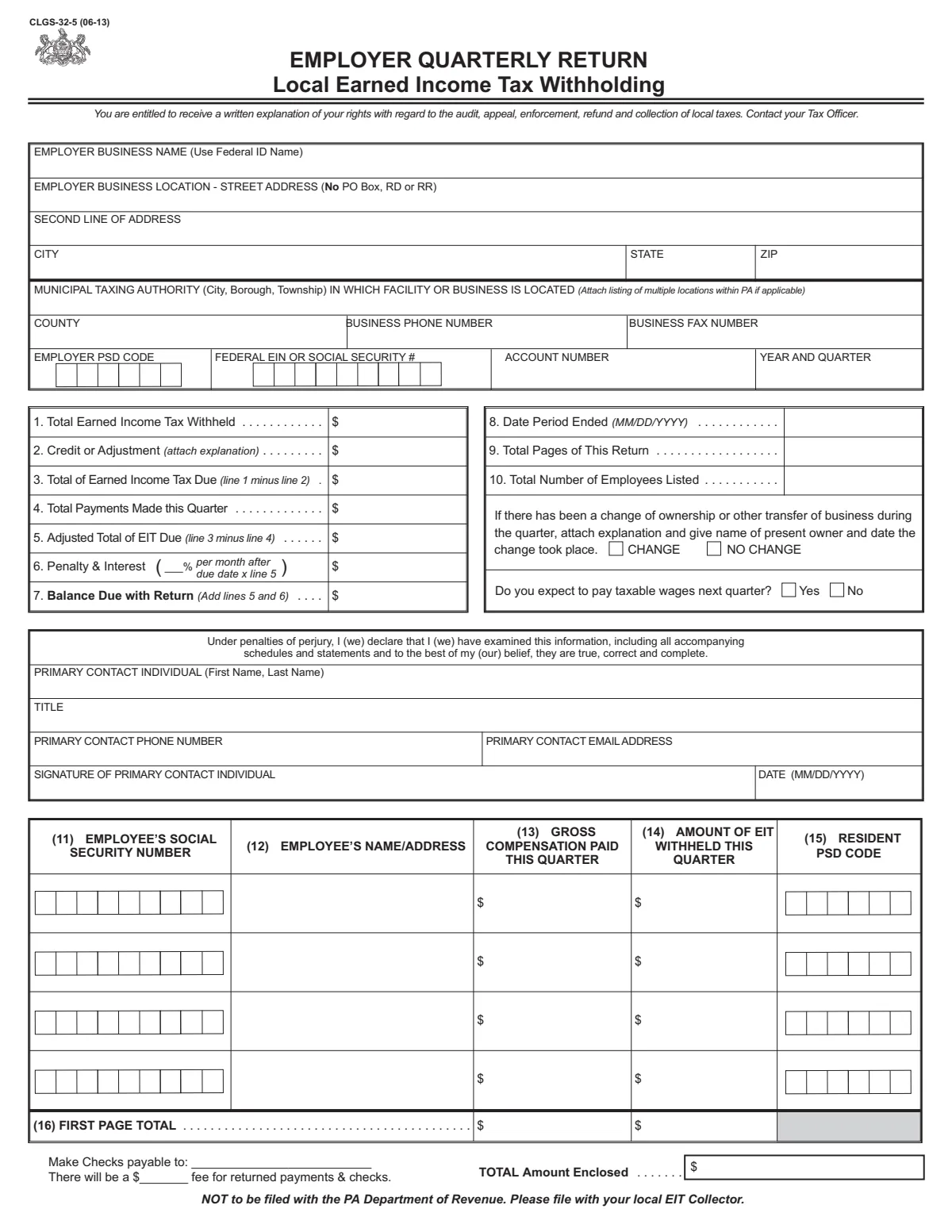
Header: the worksite
The header identifies one Pennsylvania worksite (or one tax collection district's worth of worksites) and the quarter. Everything in it describes where people work, because the return goes to the collector for the place of employment. The employees' homes come later, in column 15.
| Line | Label | What goes there |
|---|---|---|
| Name | EMPLOYER BUSINESS NAME (Use Federal ID Name) | Your legal business name exactly as the IRS has it for your EIN. |
| Location | EMPLOYER BUSINESS LOCATION: STREET ADDRESS (No PO Box, RD or RR); SECOND LINE OF ADDRESS | The street address of the Pennsylvania worksite this return covers, not a mailing or headquarters address. Act 32 ties the return to the place of employment: “within 30 days following the end of each calendar quarter, every employer shall file a quarterly return and pay the amount of income taxes deducted during the preceding calendar quarter to the tax officer for the place of employment of each employee.” A worksite includes a home office: DCED lists “Examples of business sites include but are not limited to factories, warehouses, offices and residences of home-based employees.” |
| City | CITY, STATE, ZIP | City, state and ZIP code of the worksite address above. |
| Muni | MUNICIPAL TAXING AUTHORITY (City, Borough, Township) IN WHICH FACILITY OR BUSINESS IS LOCATED (Attach listing of multiple locations within PA if applicable) | The municipality, not the post office name. A ZIP code often spans several municipalities, so look up the address in DCED's Address Search Application rather than guessing from the mailing city. If you have more Pennsylvania worksites in the same tax collection district, attach a list. |
| County | COUNTY | The county of the worksite. |
| Phone | BUSINESS PHONE NUMBER | The business's main number. |
| Fax | BUSINESS FAX NUMBER | Leave blank if you have no fax. |
| PSD | EMPLOYER PSD CODE | “PSD (political subdivision) codes are six-digit numbers that uniquely identify each municipality in Pennsylvania.” Enter the code for the worksite municipality. Its first two digits identify the tax collection district, which is how the collector knows the return is theirs. |
| EIN | FEDERAL EIN OR SOCIAL SECURITY # | Your nine-digit federal EIN. A sole proprietor with no EIN uses a Social Security number, as the label allows. |
| Account | ACCOUNT NUMBER | The local account number the collector issued when you registered the worksite. Registration comes first: “The employer has 15 days to register after becoming an employer.” DCED's uniform employer registration form is the form for it. |
| Quarter | YEAR AND QUARTER | The calendar year and quarter, for example 2027 and 1 for January to March 2027. |
Lines 1 to 7: the tax
Lines 1 to 7 run from the tax withheld to the balance due. On a timely return with no adjustments and no in-quarter payments, lines 1, 3, 5 and 7 are the same number.
| Line | Label | What goes there |
|---|---|---|
| 1 | 1. Total Earned Income Tax Withheld | All local earned income tax withheld during the quarter from employees at this worksite. It should equal the sum of the line 16 totals in column 14 on every page of the return. You withhold one combined amount per employee, at the higher rate: “The applicable EIT rate owed and to be withheld is always the higher of the two rates.” You do not split it between the municipality and the school district on the return; “Employers are not required, and are encouraged by the Department not to report the resident municipal and school district tax rates or the nonresident tax rates and the corresponding tax withholdings separately on the employer returns”. |
| 2 | 2. Credit or Adjustment (attach explanation) | A credit or correction, such as an overpayment on an earlier return that the collector has agreed to apply. The form asks you to attach an explanation; without one, expect the collector to disallow the credit. |
| 3 | 3. Total of Earned Income Tax Due (line 1 minus line 2) | Line 1 minus line 2. |
| 4 | 4. Total Payments Made this Quarter | Payments already made to the collector for this quarter. This line matters for an employer that pays monthly. A tax officer can require monthly filing: an employer that missed the proper deduction or payment in two of the last four quarters “may be required by the tax officer to file returns and pay the income tax monthly”. Quarterly payers who paid nothing during the quarter enter zero. |
| 5 | 5. Adjusted Total of EIT Due (line 3 minus line 4) | Line 3 minus line 4. |
| 6 | 6. Penalty & Interest (___% per month after due date x line 5) | Only on a late return. The form leaves the percentage blank for the collector to set. The Local Tax Enabling Act sets the outside limits: “interest at the rate the taxpayer is required to pay to the Commonwealth under section 806 of the act of April 9, 1929 (P.L.343, No.176), known as The Fiscal Code”, plus “an additional penalty of 1% of the amount of the unpaid income tax for each month or fraction of a month during which the income tax remains unpaid shall be added and collected but the amount shall not exceed 15% in the aggregate.” (Local Tax Enabling Act, sec. 509(i)). |
| 7 | 7. Balance Due with Return (Add lines 5 and 6) | Lines 5 and 6 added. This is the payment that goes with the return. |
Lines 8 to 10 and the status boxes
| Line | Label | What goes there |
|---|---|---|
| 8 | 8. Date Period Ended (MM/DD/YYYY) | The last day of the quarter: 03/31, 06/30, 09/30 or 12/31 of the year. |
| 9 | 9. Total Pages of This Return | Page 1 plus every continuation page. Page 1 holds four employees; each continuation page holds sixteen more. |
| 10 | 10. Total Number of Employees Listed | The count of employee rows across all pages. It should match the number of people paid at this worksite during the quarter. |
| Change | If there has been a change of ownership or other transfer of business during the quarter ... CHANGE / NO CHANGE | Check one box. On a sale or transfer, attach an explanation with the present owner's name and the date of the change. A business that closes files a final return: “Any employer who discontinues business before the end of the tax year is required, within 30 days of the discontinuance of business, to do the following:” file a final quarterly return, pay any tax withheld and not yet paid, and file the W2-R. |
| Next | Do you expect to pay taxable wages next quarter? Yes / No | Answer No only if the worksite will have no payroll. Otherwise the collector expects a return every quarter. |
Declaration and contact
| Line | Label | What goes there |
|---|---|---|
| Contact | Declaration; PRIMARY CONTACT INDIVIDUAL (First Name, Last Name) | The person signing declares, under penalties of perjury, that the return is true, correct and complete. Name the person the collector should call with questions. |
| Title | TITLE | The contact's title, for example payroll manager or controller. |
| CPhone | PRIMARY CONTACT PHONE NUMBER | A direct number for the contact. |
| PRIMARY CONTACT EMAIL ADDRESS | Where the collector can write about the return. | |
| Sign | SIGNATURE OF PRIMARY CONTACT INDIVIDUAL | The contact signs the return. |
| Date | DATE (MM/DD/YYYY) | The date signed. |
Columns 11 to 16: the employee list
The employee list is what makes the Act 32 system work: the collector for the worksite receives the tax and then distributes each employee's share to the employee's home municipality and school district using the resident PSD code. Act 32 lists what the return must show for each employee, including the “Employee’s Actual Street Address (PO Boxes are not acceptable)” and the “Employee’s Resident Political Subdivision (PSD) Code”.
| Line | Label | What goes there |
|---|---|---|
| 11 | (11) EMPLOYEE'S SOCIAL SECURITY NUMBER | One row per employee who received earned income at this worksite in the quarter. Act 32 lists the employee's SSN first among the items the return must carry. |
| 12 | (12) EMPLOYEE'S NAME/ADDRESS | The employee's name and home street address. “Employee’s Actual Street Address (PO Boxes are not acceptable)”. The address comes from the employee's Residency Certification Form (CLGS-32-6). |
| 13 | (13) GROSS COMPENSATION PAID THIS QUARTER | The employee's compensation for the quarter. Act 32 asks for “Employee’s Compensation during the preceding calendar quarter”. |
| 14 | (14) AMOUNT OF EIT WITHHELD THIS QUARTER | The local EIT withheld from the employee in the quarter, at the higher of the resident and nonresident rates. One amount, not split by municipality and school district. |
| 15 | (15) RESIDENT PSD CODE | The six-digit PSD code of the municipality where the employee lives. This is how the collector sends the tax to the employee's home municipality and school district. “For an employee who lives out-of-state, the ‘Resident PSD Code’ will be 880000, and the ‘Total Resident EIT Rate’ will be 0%.” A Philadelphia resident working at a Pennsylvania worksite outside Philadelphia is the exception: DCED says “Act 32 does not apply.” for that employee, and the Philadelphia resident rate is remitted to Philadelphia's Department of Revenue instead. |
| 16 | (16) FIRST PAGE TOTAL | Column 13 and column 14 totals for the four rows on page 1. The shaded PSD cell takes no total. |
| Payee | Make Checks payable to: ____; There will be a $____ fee for returned payments & checks. | DCED prints these blank because every tax collection district has its own collector. Your collector's copy, or its instructions, gives the payee name and its returned-payment fee. |
| Enclosed | TOTAL Amount Enclosed | The amount of the check or payment sent with the return. It is normally line 7. |
| Where | NOT to be filed with the PA Department of Revenue. Please file with your local EIT Collector. | Local EIT goes to the EIT collector for the worksite's tax collection district. The PA Department of Revenue handles state income tax withholding only. |
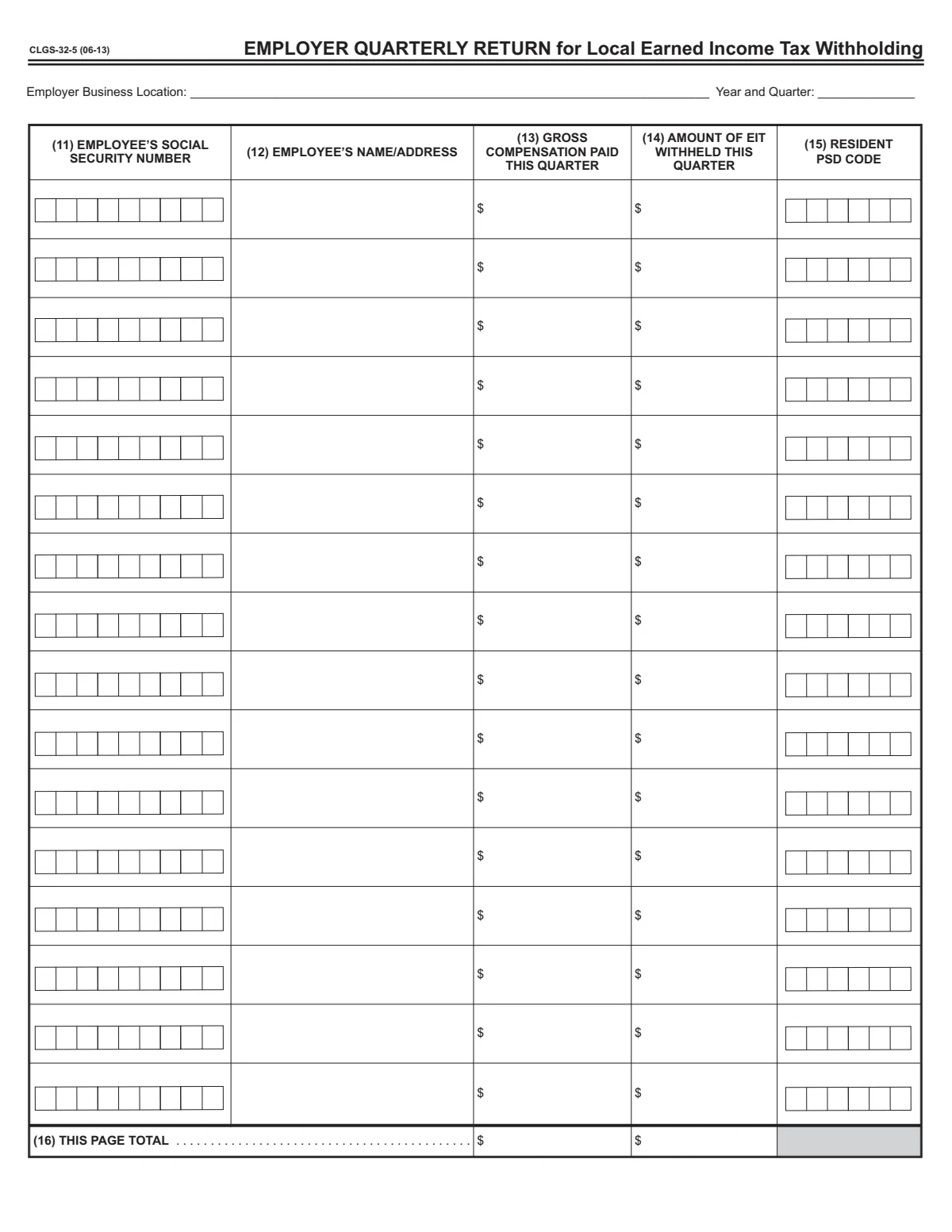
The continuation page
Page 2 repeats the employee columns with sixteen rows. Attach as many copies as you need, put the worksite and quarter at the top of each, and carry every page's line 16 totals into line 1.
| Line | Label | What goes there |
|---|---|---|
| P2-Loc | Employer Business Location: ____ Year and Quarter: ____ | The worksite and the year and quarter, the same as page 1, so a loose page can be matched. |
| P2-11 | (11) EMPLOYEE'S SOCIAL SECURITY NUMBER | Sixteen more employees per continuation page. Use as many pages as you need and count them on line 9. |
| P2-12 | (12) EMPLOYEE'S NAME/ADDRESS | Name and actual street address, no PO Box. |
| P2-13 | (13) GROSS COMPENSATION PAID THIS QUARTER | Compensation for the quarter. |
| P2-14 | (14) AMOUNT OF EIT WITHHELD THIS QUARTER | EIT withheld in the quarter. |
| P2-15 | (15) RESIDENT PSD CODE | The employee's home PSD code. |
| P2-16 | (16) THIS PAGE TOTAL | Column 13 and column 14 totals for this page. Add every page's totals to reach line 1. |
Rules that trip employers up
- Withholding the wrong rate. Compare the employee's total resident rate with the worksite's nonresident rate and withhold the higher. An out-of-state resident still owes the worksite's nonresident rate. For an employee who works in several municipalities, “the employer shall establish the employee’s nonresident rate based on the PSD assigned to the employee’s liability for the Local Services Tax or from which the employee claims exemption from the Local Services Tax.”
- Temporary job sites. “Employees working for less than 90 consecutive days at a job location, the greater of the employee’s resident tax or the employee’s nonresident tax based on the location of the permanent home office of the employer.” At 90 consecutive days or more, use the job location.
- PO boxes. Column 12 needs a street address. A PO box on the residency form counts as incorrect information from the employee, and the employer is protected only if the employee supplied it.
- One district, one collector. All worksites in the same tax collection district go on one return to one collector. Worksites in several districts file a return with each district's collector, unless you elect combined filing.
- Combined filing is monthly. An employer with worksites in more than one district may file everything with one collector, but “Employers who make combined filings and remittances are required to file and remit electronically and on a monthly basis, rather than quarterly.” It starts with a Notice of Intention to File Combined Returns and Make Combined Payments sent to every collector at least one month ahead, and “Under no circumstances can an employer file combined returns and make combined payments on a quarterly basis.” The monthly combined return also carries each employee's work location PSD code.
- The LST is separate. This return is for the EIT only. “The option to make combined filings and remittances does not apply to the Local Services Tax (LST).” The Local Services Tax has its own collectors and returns.
- Failing to withhold. “an employer who willfully or negligently fails or omits to make the deductions required by this subsection shall be liable for payment of income taxes which the employer was required to withhold to the extent that the income taxes have not been recovered from the employee.”
How it connects
- The rules behind the return (who withholds, rates, PSD codes, the residency certificate and the official register): Pennsylvania local earned income tax for employers.
- The employee's form that feeds columns 12 and 15: CLGS-32-6 Residency Certification Form. The year-end form that ties the quarters to the W-2s: W2-R Annual Reconciliation.
- Pittsburgh worksites also owe the city's employer-paid payroll expense tax on a separate city return: Pittsburgh ET-1. Philadelphia is outside Act 32: Philadelphia wage tax.
- Setting up a new Pennsylvania worksite: the new work location local payroll tax checklist and the local payroll tax lookup.
Questions employers ask
When is the Pennsylvania Employer Quarterly Return due?
Within 30 days after the end of each calendar quarter, under Act 32 section 512. DCED's own worked example (for 2012) puts the first quarter's deadline at April 30. Employers who elect combined filing for several districts file monthly instead, within 30 days after each month.
Where do I send CLGS-32-5?
To the EIT collector (tax officer) for the tax collection district where the worksite is, not to the PA Department of Revenue. DCED's Address Search Application shows the collector for any address.
Do I report the municipal and school district rates separately?
No. You withhold one combined amount per employee and report it in column 14. DCED encourages employers not to break out the resident municipal and school district rates or the nonresident rates on the return.
What PSD code do I use for an employee who lives in another state?
880000, with a total resident rate of 0%. The employee still owes the worksite's nonresident rate, which you withhold.
Is there a separate return for each school district?
No. The collector distributes the tax to each employee's home municipality and school district using the resident PSD code in column 15.
Do I file if I had no payroll at the worksite this quarter?
The return asks whether you expect taxable wages next quarter, and a closing business files a final return and the W2-R within 30 days. For a quarter with no payroll at a worksite you keep open, ask your collector whether it wants a zero return.
Sources
- DCED Form CLGS-32-5 (06-13), Employer Quarterly Return, Local Earned Income Tax Withholding, PDF
- DCED, Local Withholding Tax FAQs
- DCED, Act 32 procedure manual (section 512, withholding and remittance)
- Local Tax Enabling Act (Act 511 of 1965, as amended by Act 32 of 2008), Pennsylvania General Assembly