- Who completes
- Each employee, at hire and after a move
- When
- New hire, name or address change; yearly refresh suggested
- Filed with
- Kept by the employer
- Form revision
- CLGS-32-6 (05/17)
- Pages
- 1
At a glance
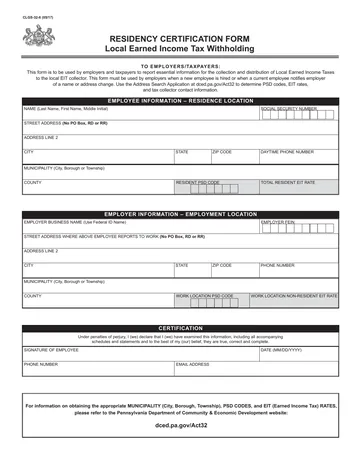
Form CLGS-32-6 is the Residency Certification Form, Local Earned Income Tax Withholding, published by Pennsylvania's Department of Community and Economic Development (DCED). The current edition is “CLGS-32-6 (05/17)”. It records where an employee lives and where the employee works, with each place's PSD code and EIT rate, so the employer can withhold the right local earned income tax and the collector can send it to the right municipality and school district.
- Who completes it. The employee, at hire and after a move. Act 32 says “An employer shall require each new employee to complete a certificate of residency form, which shall be an addendum to the Federal Employee's Withholding Allowance Certificate (Form W-4).” and “An employer shall also require any employee who changes their address or domicile to complete a certificate of residency form.” DCED's FAQ puts it on the employer: “As an employer, you must complete the Residency Certification Form for each employee”. Read together: the employer gives each employee the form and keeps the signed copy; the employee completes, dates and signs it.
- When. “This form must be used by employers when a new employee is hired or when a current employee notifies employer of a name or address change.” DCED adds a yearly refresh: “The Department strongly suggests that employers issue a Residency Certification Form to every employee at the beginning of each tax year”.
- Where it goes. It stays with the employer. “The Department strongly recommends that employers should also consider retaining the Residency Certification Form with employee personnel records as a safeguard against charges of failing to withhold at the proper tax rate.” The employer copies the address and resident PSD code to the Employer Quarterly Return (CLGS-32-5).
- Form. CLGS-32-6 (05/17), DCED PDF, one page. The form points to “Use the Address Search Application at dced.pa.gov/Act32 to determine PSD codes, EIT rates,” and collector contact details.
Tap a box once for its note, again to jump to the line. Zoom in to read the small print.
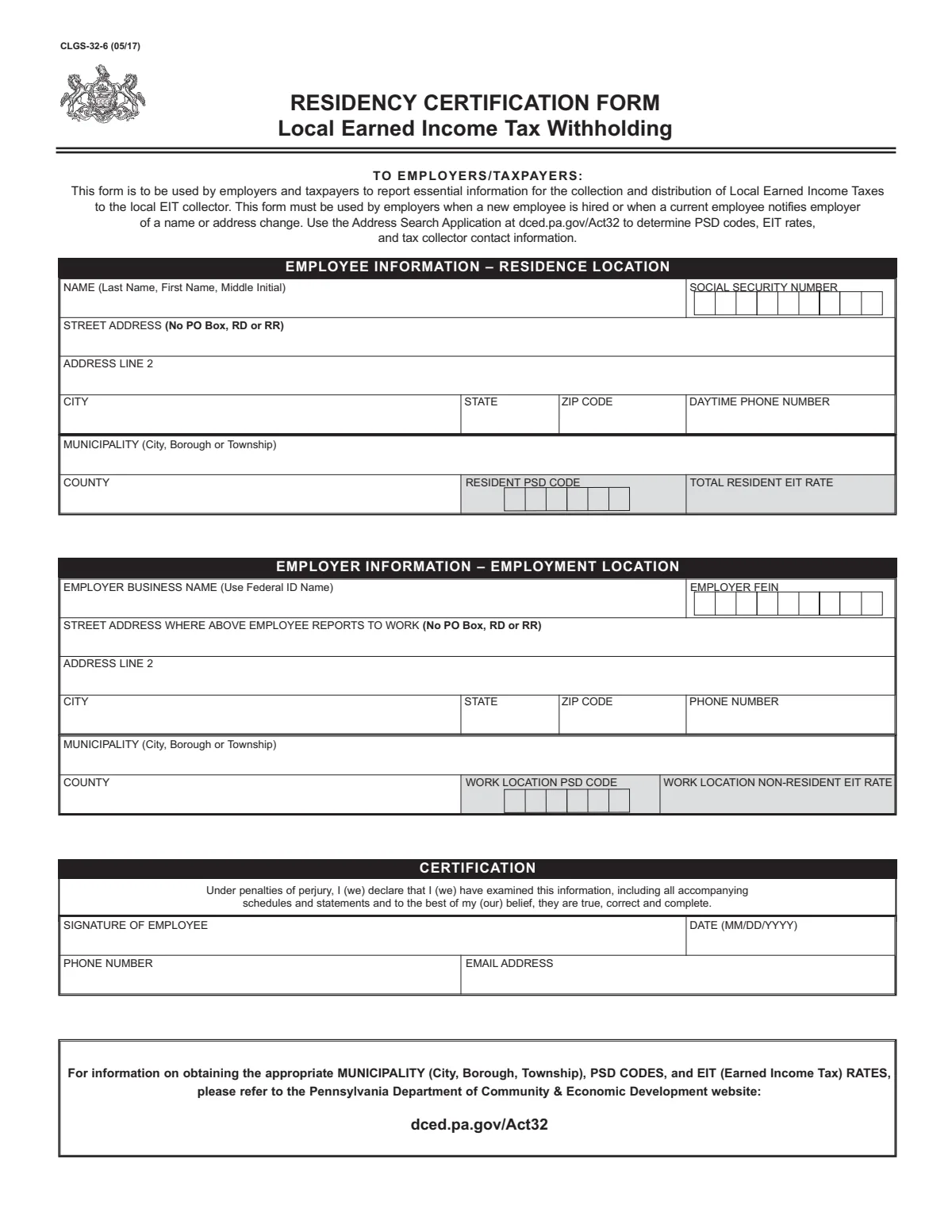
Employee information: residence location
The top half is the employee's home. Its PSD code and total resident rate drive two things: which rate wins the comparison, and where the collector sends the money. The gray cells (PSD code and rate) are the ones payroll should check against DCED's lookup before the first payroll.
| Line | Label | What goes there |
|---|---|---|
| E-Name | NAME (Last Name, First Name, Middle Initial) | The employee's legal name, last name first. Use the same name as the W-4 and payroll record so the collector can match the quarterly return. |
| E-SSN | SOCIAL SECURITY NUMBER | The full nine-digit number. The employer copies it to column 11 of the Employer Quarterly Return. |
| E-Street | STREET ADDRESS (No PO Box, RD or RR) | The street address of the employee's home, the place that sets the resident rate. A PO box will not do: “the employee’s submission of a post office box instead of a street address on the Residency Certification Form shall be considered as incorrect information.” |
| E-Addr2 | ADDRESS LINE 2 | Apartment, unit or building. |
| E-City | CITY, STATE, ZIP CODE | The home's city, state and ZIP code. |
| E-Phone | DAYTIME PHONE NUMBER | So payroll can ask about an address that does not match a municipality. |
| E-Muni | MUNICIPALITY (City, Borough or Township) | The city, borough or township of the home, which is often not the post office name in the mailing address. Look the address up in DCED's Address Search Application. |
| E-County | COUNTY | The county of the home. |
| E-PSD | RESIDENT PSD CODE | The six-digit political subdivision code of the home municipality. “For an employee who lives out-of-state, the ‘Resident PSD Code’ will be 880000, and the ‘Total Resident EIT Rate’ will be 0%.” Use the Address Search for the code, not a list of city names: the code follows the municipality, not the mailing address. |
| E-Rate | TOTAL RESIDENT EIT RATE | The resident rate of the home municipality and school district combined, as DCED lists it. It is compared with the worksite's nonresident rate below. |
Employer information: employment location
The bottom half is the place the employee reports to work. Its nonresident rate is the floor: an employee who lives in a low-rate municipality, or outside Pennsylvania, still pays at least the worksite's nonresident rate.
| Line | Label | What goes there |
|---|---|---|
| W-Name | EMPLOYER BUSINESS NAME (Use Federal ID Name) | The employer's legal name on its EIN. |
| W-FEIN | EMPLOYER FEIN | The employer's federal EIN. |
| W-Street | STREET ADDRESS WHERE ABOVE EMPLOYEE REPORTS TO WORK (No PO Box, RD or RR) | The worksite the employee reports to, not the headquarters or payroll office. For a remote employee this is a judgment the employer must be able to support; see the Pittsburgh note below. |
| W-Addr2 | ADDRESS LINE 2 | Suite, floor or building. |
| W-City | CITY, STATE, ZIP CODE | The worksite's city, state and ZIP code. |
| W-Phone | PHONE NUMBER | The employer's payroll or worksite number. |
| W-Muni | MUNICIPALITY (City, Borough or Township) | The municipality where the worksite sits. |
| W-County | COUNTY | The worksite's county. |
| W-PSD | WORK LOCATION PSD CODE | The worksite municipality's six-digit PSD code. Its first two digits name the tax collection district whose collector gets the quarterly return. |
| W-Rate | WORK LOCATION NON-RESIDENT EIT RATE | The rate the worksite municipality charges people who live elsewhere. “In many cases, the nonresident tax rate will be one percent (1%).” “School Districts are not allowed to levy a nonresident earned income tax.” |
Certification
| Line | Label | What goes there |
|---|---|---|
| Cert | CERTIFICATION: Under penalties of perjury, I (we) declare ... | The employee certifies that the information is true, correct and complete. |
| E-Sign | SIGNATURE OF EMPLOYEE | “It is to be completed, dated and signed by the new employee and returned to the employer.” The employer keeps the signed form. |
| E-Date | DATE (MM/DD/YYYY) | The date signed. A new form with a later date replaces the old one after a move. |
| C-Phone | PHONE NUMBER | The employee's contact number. |
| C-Email | EMAIL ADDRESS | The employee's email. |
Using the form in payroll
Once the form is complete, compare the two rates. DCED's rule: “The applicable EIT rate owed and to be withheld is always the higher of the two rates.” Withhold that one rate from every paycheck and report the employee on the quarterly return with the resident PSD code.
DCED Local Withholding Tax FAQs; Act 32 procedure manual, section 512.
- It protects the employer. “No employer shall be held liable for failure to withhold an income tax from an employee if the failure to withhold the income tax arises from incorrect information submitted by the employee as to the employee's place of residence.” That protection depends on having the employee's signed form on file, which is why DCED recommends keeping it with personnel records.
- Moves. A move to a new municipality changes the resident rate and the PSD code. Get a new form and change the withholding from the next payroll.
- Out-of-state employers. “As an out-of-state employer, you are NOT required to complete the Residency Certification Form or withhold the local Earned Income Tax (EIT) for a PA resident employee.” The employer may withhold the resident rate as a courtesy; if it does not, DCED asks it to tell the employee to make quarterly estimated payments.
- Temporary job sites. Under 90 consecutive days at a job location, the work location is the employer's permanent home office; at 90 days or more, the job location (Act 32 section 512, as DCED's FAQ restates it).
- Philadelphia. Philadelphia residents and Philadelphia worksites are under the city's wage tax, not Act 32 (see Philadelphia wage tax).
Remote and home-based employees
DCED counts a home office as a worksite: “Examples of business sites include but are not limited to factories, warehouses, offices and residences of home-based employees.” So the "street address where above employee reports to work" can be the employee's home, which also means registering that home's tax collection district.
The City of Pittsburgh ties its own taxes to this form. Its remote work policy, which it says “This policy is still in effect and has not changed for determining residency”, provides: “If the employer offers the employee space at an office location in the City of Pittsburgh, that location should be where the employer will withhold the Local Services Tax and pay the employer Payroll Tax, even if the employee elects to work from home outside the City.” If the employer requires home work outside the city, it gives the employee a signed letter on company letterhead and obtains an updated residency form showing the home as the employment location. (The policy prints the form number as “Form GLGS-32-6”; DCED's form is CLGS-32-6.) The Pittsburgh payroll taxes page covers the rest.
How it connects
- The full Act 32 withholding rules, PSD codes and the official register: Pennsylvania local earned income tax for employers.
- Where the form's data goes: the Employer Quarterly Return (CLGS-32-5) every quarter and the W2-R Annual Reconciliation at year end.
- The worksite also sets the Local Services Tax. For a new office, use the new work location checklist.
Questions employers ask
Is the Residency Certification Form required in Pennsylvania?
Yes, for employers with a Pennsylvania worksite. Act 32 requires each new employee to complete a certificate of residency as an addendum to the federal Form W-4, and any employee who changes address or domicile to complete a new one.
Do I send the Residency Certification Form to the tax collector?
No routine filing is required. The employer keeps it with the employee's personnel records and uses it to fill in the quarterly return; DCED recommends keeping it as a safeguard against charges of withholding at the wrong rate.
What if the employee gives a PO box?
A PO box is treated as incorrect information. Ask for the street address of the home; the resident PSD code depends on it.
What PSD code goes on the form for someone who lives in New Jersey or Ohio?
880000, with a total resident EIT rate of 0%. The employer withholds the worksite's nonresident rate.
Should employees fill out a new form every year?
DCED strongly suggests issuing the form to every employee at the start of each tax year, and the law requires a new one after any change of address or domicile.