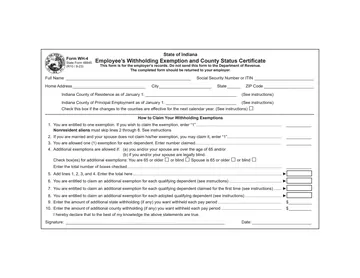
- Who completes it
- Each employee subject to Indiana tax
- Kept by
- The employer; not sent to DOR
- County status
- Fixed as of January 1
- Form revision
- State Form 48845 (R10 / 8-23)
- Pages
- 1 (plus instructions)
At a glance
Form WH-4 is Indiana's “Employee’s Withholding Exemption and County Status Certificate”, State Form 48845, revision “(R10 / 8-23)”. It does two jobs. It sets the exemptions for Indiana state and county income tax withholding, and it fixes each employee's county status as of January 1, which decides the county tax rate for the whole year. For a payroll department, the two county lines are the local tax part of the form.
- Who completes it. The employee, resident or nonresident, whose pay is subject to Indiana state or county income tax.
- Who keeps it. The employer. “This form is for the employer’s records. Do not send this form to the Department of Revenue.”
- When to update. Anytime exemptions increase; within 10 days when they decrease; each year the line 7 first-time exemption is claimed; and when the employee's county status changes for the next year.
- Form. WH-4 (State Form 48845), Department of Revenue PDF. The Department lists it as the “Employee's Withholding Exemption & County Status Certificate”.
Indiana Department of Revenue, Departmental Notice #1 (effective Oct. 1, 2026).
Tap a box once for its note, again to jump to the line. Zoom in to read the small print.
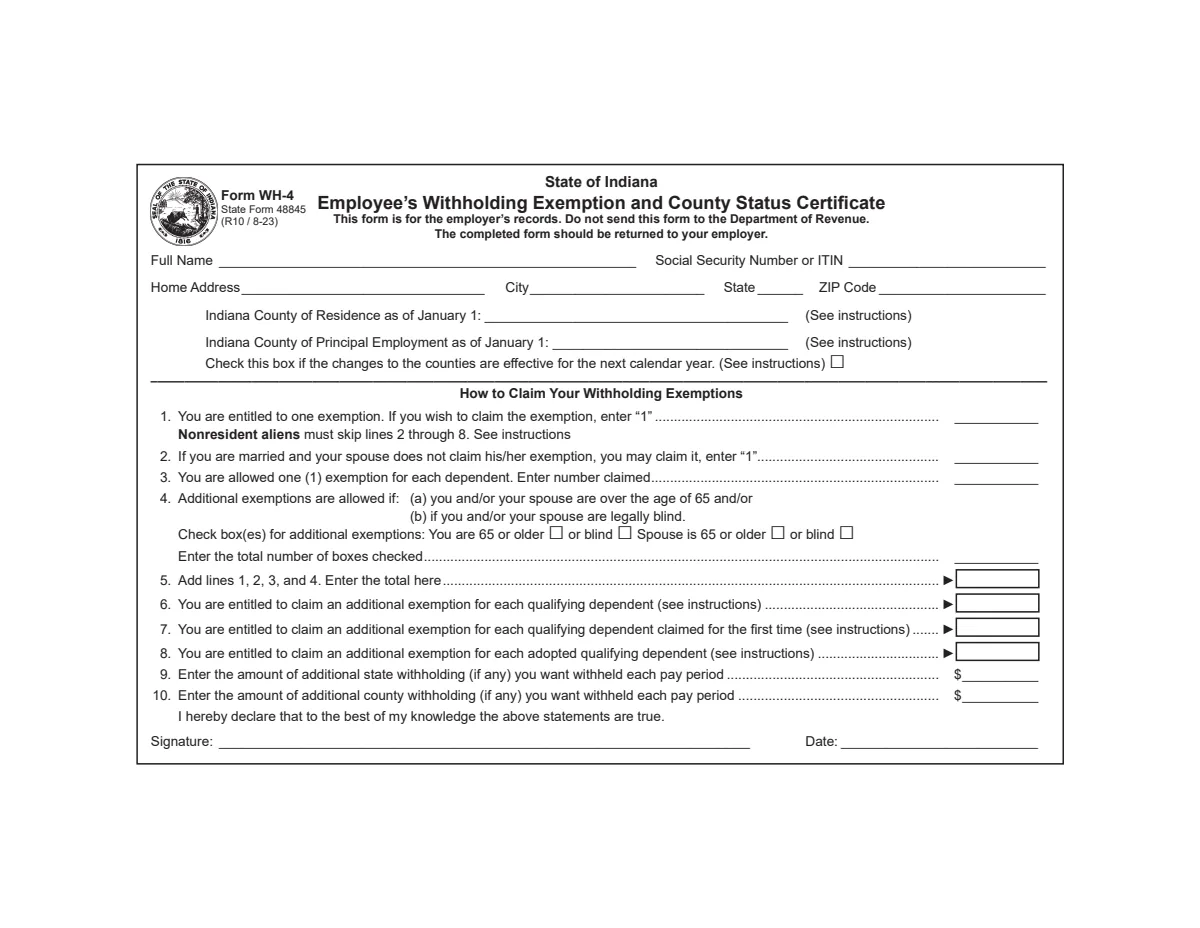
Name, address and the two counties
The county lines are the reason Indiana's form is a county status certificate. Indiana fixes county status once a year, on January 1, so an employee who moves in March keeps the January county for the rest of the year.
| Line | Label | What goes there |
|---|---|---|
| Head | Form WH-4, State Form 48845 (R10 / 8-23): This form is for the employer’s records. Do not send this form to the Department of Revenue. The completed form should be returned to your employer. | “This form is for the employer’s records. Do not send this form to the Department of Revenue.” “This form should be completed by all resident and nonresident employees having income subject to Indiana state and/or county income tax.” That includes nonresidents: an Indiana county can tax a nonresident whose principal work is in Indiana. |
| Name | Full Name | “Print or type your full name, Social Security number or ITIN and home address.” |
| SSN | Social Security Number or ITIN | The employee's SSN, or an ITIN for an employee without one. |
| Address | Home Address; City; State; ZIP Code | The home address. It should agree with the county of residence below. |
| CountyRes | Indiana County of Residence as of January 1: (See instructions) | “Enter your Indiana county of residence and county of principal employment as of January 1 of the current year.” “If you neither lived nor worked in Indiana on January 1 of the current year, enter ‘not applicable’ on the line(s).” The county of residence on January 1 decides the county tax for the whole year: “Withholding agents should withhold county tax based on the employee’s Indiana county of residence as of Jan. 1 of the tax year.” |
| CountyEmp | Indiana County of Principal Employment as of January 1: (See instructions) | The county where the employee principally worked on January 1. It matters only for an employee who lived outside Indiana that day: “If the employee resides out-of-state on Jan. 1 but has his or her principal place of work or business in an Indiana county as of Jan. 1, then the withholding agent should withhold for the Indiana county of the principal place of work or business.” |
| Next | Check this box if the changes to the counties are effective for the next calendar year. (See instructions) | “If you move to (or work in) another county after January 1, your county status will not change until the next calendar year.” “Please check the box if you are requesting a change to a county of residence or work for the next calendar year.” Keep withholding for the old county for the rest of this year and switch on January 1. |
Lines 1 to 10: exemptions and extra withholding
Lines 1 to 5 are personal exemptions; lines 6 to 8 are the larger dependent exemptions; lines 9 and 10 are optional extra withholding. The same exemptions reduce the base for both the state and the county tax.
| Line | Label | What goes there |
|---|---|---|
| 1 | 1. You are entitled to one exemption. If you wish to claim the exemption, enter “1”. Nonresident aliens must skip lines 2 through 8. See instructions | Enter 1 to claim the employee's own exemption. “If a parent or legal guardian claims you on their federal tax return, you may still claim an exemption for yourself for Indiana purposes.” “If you are a nonresident alien, enter ‘1’ on line 1, then skip to line 9.” |
| 2 | 2. If you are married and your spouse does not claim his/her exemption, you may claim it, enter “1” | “Lines 1 & 2 - You are allowed to claim one exemption for yourself and one for your spouse (if he/she does not claim the exemption for him/herself).” Employees may claim fewer than they are entitled to, to have more withheld, but not more. |
| 3 | 3. You are allowed one (1) exemption for each dependent. Enter number claimed | One for each dependent under the state's rules. A dependent must receive more than half of their support from the employee and “must have less than $4,400 gross income during the tax year”, unless the person is the employee's child under 19, or under 24 and a full-time student for at least 5 months. |
| 4 | 4. Additional exemptions are allowed if: (a) you and/or your spouse are over the age of 65 and/or (b) if you and/or your spouse are legally blind. Check box(es) ... Enter the total number of boxes checked | “Line 4 - Additional Exemptions. You are also allowed one exemption each for you and/or your spouse if either is 65 or older and/or blind.” Up to four boxes. |
| 5 | 5. Add lines 1, 2, 3, and 4. Enter the total here | The personal exemption total. “Each employee is entitled to deduct $1,000 per year per exemption claimed on line 5 of his/her Form WH-4.” |
| 6 | 6. You are entitled to claim an additional exemption for each qualifying dependent (see instructions) | Dependent children already counted on line 3 who are a son, stepson, daughter, stepdaughter, foster child or child under legal guardianship, under 19 or under 24 and a full-time student. “Most employees are entitled to deduct $1,500 per year per qualifying dependent exemption claimed on line 6 of his/her Form WH-4.” |
| 7 | 7. You are entitled to claim an additional exemption for each qualifying dependent claimed for the first time (see instructions) | “This exemption is good only for the calendar year in which the WH-4 claiming the exemption is submitted.” “If you claim this in multiple tax years, you MUST submit a new WH-4 each year for which this exemption is claimed.” “Most employees are entitled to deduct $1,500 per year per qualifying first-time dependent exemption claimed on line 7 of his/her Form WH-4.” |
| 8 | 8. You are entitled to claim an additional exemption for each adopted qualifying dependent (see instructions) | Children on lines 3 and 6 adopted by the employee or spouse (son, stepson, daughter or stepdaughter), under 19 or under 24 and a full-time student. “Most employees are entitled to deduct $3,000 per year per qualifying adopted child claimed on line 8 of his/her Form WH-4.” |
| 9 | 9. Enter the amount of additional state withholding (if any) you want withheld each pay period | A flat extra amount of state tax each pay period. “An entry on this line does not obligate your employer to withhold the amount.” “If the employer does withhold the additional amount, it should be submitted along with the regular state and county tax withholding.” |
| 10 | 10. Enter the amount of additional county withholding (if any) you want withheld each pay period | The same for county tax. It goes on the same WH-1 as the regular county withholding. |
| Sign | I hereby declare that to the best of my knowledge the above statements are true. Signature: Date: | The employee signs and dates the certificate. “Penalties are imposed for willingly supplying false information or information which would reduce the withholding exemption.” |
What payroll does with it
Departmental Notice #1 turns the WH-4 into a deduction each pay period: the line 5 exemptions at $1,000 a year, lines 6 and 7 at $1,500 and line 8 at $3,000, each divided by the number of pay periods. The result comes off gross pay, and the state rate (2.95% for 2026) and the county rate for the employee's January 1 county apply to what is left. Bonuses and other irregular payments are different: for one-time or non-periodic payments, withholding “should be computed without exemptions”. “For purposes of withholding, Indiana does not follow the allowance for no withholding permitted for federal purposes under IRC § 3402(n).”
The state and county tax withheld are reported together on the WH-1 for each period and reconciled on the annual WH-3, both filed in INTIME. The Department's withholding page describes the WH-3 as the return that will “Match yearly WH-1 totals to wage statements”.
Rules that trip employers up
- Moving the county mid-year. Do not. County status is fixed on January 1. A move during the year is entered with the next-year box checked and applied from the next January 1.
- Out-of-state employees. An employee who lived outside Indiana on January 1 but principally worked in an Indiana county that day owes that county's tax. One who neither lived nor worked in Indiana on January 1 writes not applicable and owes no county tax for the year.
- Short stays. Since 2024, an employee expected to work in Indiana 30 days or less in the year may need no state or county withholding, and a properly completed WH-4AFF relieves the employer until the employee passes 30 days. The rule does not apply to anyone who is or becomes an Indiana resident during the year.
- Line 7 expires. The first-time dependent exemption lasts one calendar year. Without a new WH-4 the next year, drop it from the calculation.
- Fewer exemptions within 10 days. “You must file a new Form WH-4 within 10 days if the number of exemptions previously claimed by you decreases”: a divorce or separation, a dependent supported by someone else, or a child who no longer qualifies.
- Extra withholding is optional for the employer. Lines 9 and 10 are requests; the employer may decline them.
How it connects
- The county tax the WH-4 feeds (rates effective October 1, 2026, the January 1 rule, nonresidents and WH-1 and WH-3): Indiana county income tax: which county.
- Neighboring states' employee certificates for local tax on this site: Ohio IT 4 (school district) and Pennsylvania CLGS-32-6 (local earned income tax).
- Looking up a local tax for an address: the local payroll tax lookup.
Questions employers ask
Does the employer send the WH-4 to the Indiana Department of Revenue?
No. The form says it is for the employer's records and must not be sent to the Department.
Which county tax do I withhold for a new hire who moved to Indiana in June?
None for that year if the employee neither lived nor worked in Indiana on January 1. The employee writes not applicable on the county lines. From the next January 1, the new county applies.
An employee moved from Marion County to Hamilton County in April. When does the rate change?
On the next January 1. County status is fixed as of January 1; the employee checks the next-year box on a new WH-4 and you keep withholding for the old county until then.
What if the employee never gives me a WH-4?
The sources we read state no default. Departmental Notice #1 computes the deductions from the exemptions claimed on the WH-4, so ask for a completed form, and note that the county lines are what tell you the employee's January 1 county.
Is the line 7 exemption permanent?
No. It is good only for the calendar year of the WH-4 that claims it. The employee must submit a new WH-4 each year it is claimed, and only for a child never eligible for the additional dependent exemption before.
Do I have to honor the extra withholding on lines 9 and 10?
No. The instructions say an entry there does not obligate the employer to withhold it. If you do, remit it with the regular state and county withholding.