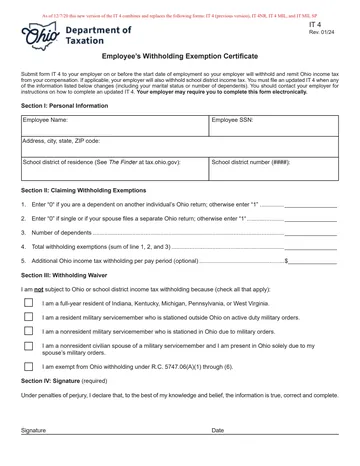
- Who completes it
- Each employee, by the start date
- Kept by
- The employer, at least 4 years
- Filed with
- Not filed with the state
- Form revision
- IT 4 (Rev. 01/24)
- Pages
- 1 (plus 3 instruction pages)
At a glance
Ohio IT 4 is the “Employee’s Withholding Exemption Certificate”: the form every Ohio employee gives the employer so the employer can withhold Ohio income tax and, where the employee lives in a taxing school district, school district income tax. It is one page, “Rev. 01/24”, with three pages of instructions. For local payroll tax the key field is the school district number: it is the only way the employer learns which school district tax to withhold.
- Who completes it. The employee. “Submit form IT 4 to your employer on or before the start date of employment so your employer will withhold and remit Ohio income tax from your compensation.” “Your employer may require you to complete this form electronically.”
- Who keeps it. The employer. “The IT 4 does not need to be filed with the Department of Taxation. Your employer must maintain a copy as part of its records.” The 2026 filing guidelines add: “The employer must keep the IT 4 in their records for at least four (4) years”.
- Without it. “Each employee must complete an Ohio IT 4, Employee’s Withholding Exemption Certificate, or the employer must withhold tax based on the employee claiming zero exemptions.” And the employer, the instructions say, “Will not withhold school district income tax, even if the employee lives in a taxing school district.”
- When to update. “You must file an updated IT 4 when any of the information listed below changes (including your marital status or number of dependents).” “If you move during the tax year, complete an updated IT 4 immediately reflecting your new address and/ or school district of residence.”
- Form. Ohio IT 4 (Rev. 01/24), Department of Taxation PDF. It combines and replaces the old IT 4, IT 4NR, IT 4 MIL and IT MIL SP.
Ohio IT 4 (Rev. 01/24) instructions; Ohio Department of Taxation, 2026 Employer and School District Withholding Tax Filing Guidelines.
Tap a box once for its note, again to jump to the line. Zoom in to read the small print.
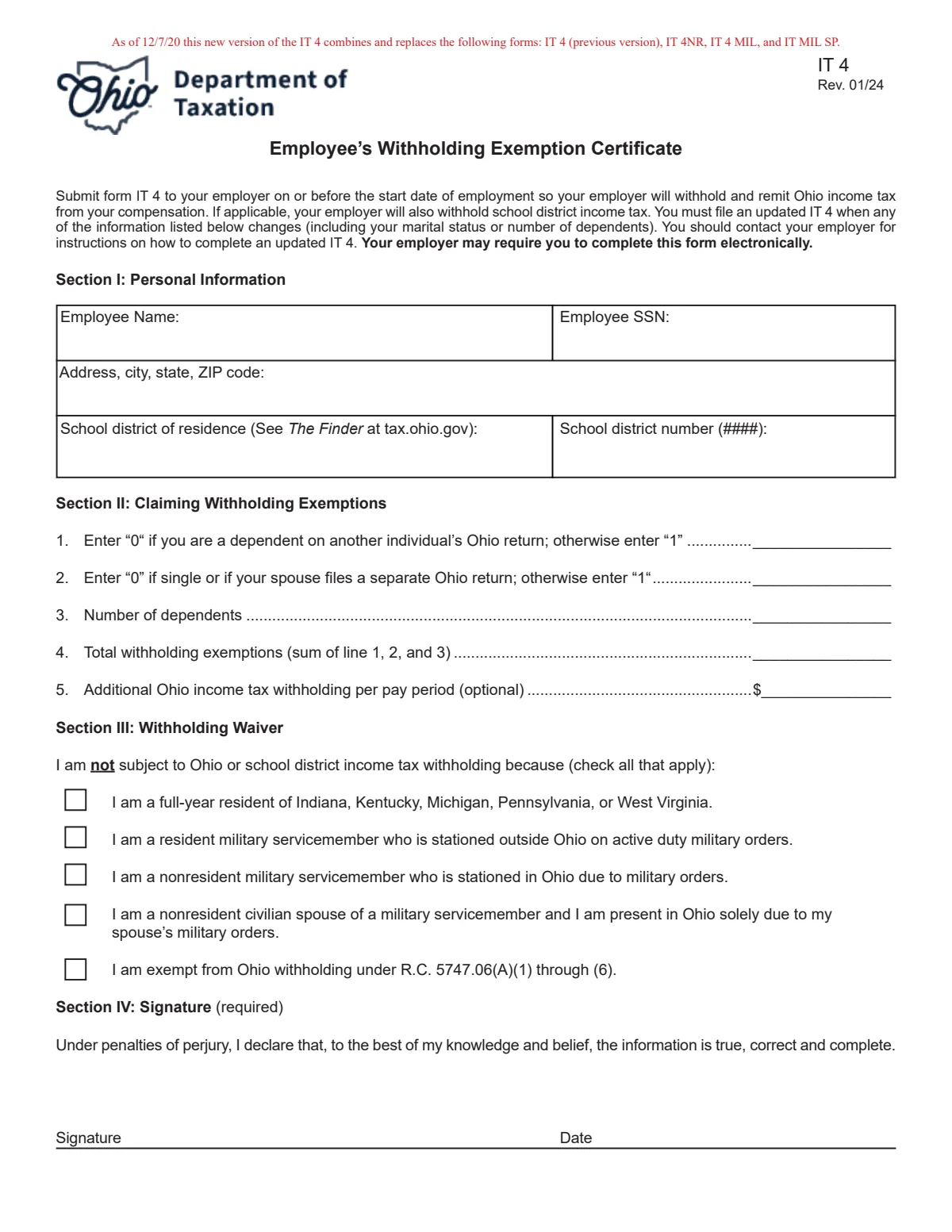
Section I: personal information
Section I is where the school district comes from. The employee enters the home address and the school district that address sits in, with its four-digit number. Ohio school district income tax is a residence tax, so the work location does not matter here.
| Line | Label | What goes there |
|---|---|---|
| Name | Employee Name: | The employee's full legal name, matching payroll records and the W-2. |
| SSN | Employee SSN: | The employee's Social Security number. |
| Address | Address, city, state, ZIP code: | The employee's home address, not the work address. School district tax follows where the employee lives: “This requirement is based on an employee's address of residence and applies even if the employer conducts no business or operations in the school district.” |
| District | School district of residence (See The Finder at tax.ohio.gov): | The name of the school district for the home address. “If you do not know your school district of residence or its school district number, use The Finder at tax.ohio.gov.” “You can also verify your school district by contacting your county auditor or county board of elections.” |
| Number | School district number (####): | “Enter the four-digit school district number of your primary address.” This is the field payroll keys: it is how you know to withhold, and at which district's rate and base. “Employers are required to withhold school district income tax from compensation for any employee who resides in a taxing school district.” |
Section II: exemptions
Employees who owe Ohio tax complete Sections I, II and IV. Section II counts the withholding exemptions used in the Ohio withholding tables.
| Line | Label | What goes there |
|---|---|---|
| 1 | 1. Enter “0“ if you are a dependent on another individual's Ohio return; otherwise enter “1” | “Line 1: If you can be claimed on someone else’s Ohio income tax return as a dependent, then you are to enter ‘0’ on this line. Everyone else may enter ‘1’.” |
| 2 | 2. Enter “0” if single or if your spouse files a separate Ohio return; otherwise enter “1“ | “Line 2: If you are single, enter ‘0’ on this line.” A married employee whose spouse files a separate Ohio return also enters 0; a married couple filing jointly enters 1. |
| 3 | 3. Number of dependents | “Line 3: You are allowed one exemption for each dependent.” “Your dependents for Ohio income tax purposes are the same as your dependents for federal income tax purposes.” |
| 4 | 4. Total withholding exemptions (sum of line 1, 2, and 3) | Lines 1 to 3 added. This is the number payroll uses in the Ohio withholding tables. It also drives school district withholding in a traditional base district: “Withhold using the same wage base & number of exemptions used for employer withholding and the school district rate tables”. In an earned income base district it does not matter: “Withhold at a flat rate using the school district withholding rate tables located at tax.ohio.gov/employer with no reduction or adjustment for personal exemptions.” |
| 5 | 5. Additional Ohio income tax withholding per pay period (optional) | “Line 5: If you expect to owe more Ohio income tax than the amount withheld from your compensation, you can request that your employer withhold an additional amount of Ohio income tax.” “This amount should be reported in whole dollars.” The line asks for extra Ohio income tax; it is not a request for extra school district or city tax. |
Section III: withholding waiver
Employees whose pay is not subject to Ohio tax complete Sections I, III and IV instead. “Checking the box will cause your employer to not withhold Ohio income tax and/or school district income tax.”
| Line | Label | What goes there |
|---|---|---|
| III-1 | I am a full-year resident of Indiana, Kentucky, Michigan, Pennsylvania, or West Virginia. | “Reciprocity Exemption: If you are a resident of Indiana, Kentucky, Pennsylvania, Michigan or West Virginia and you work in Ohio, you do not owe Ohio income tax on your compensation.” The employee's home state tax is withheld instead, under that state's rules. The reciprocity is for the state income tax: Ohio city income tax on work in an Ohio city is a separate tax under ORC chapter 718. |
| III-2 | I am a resident military servicemember who is stationed outside Ohio on active duty military orders. | Ohio residents in the armed forces, reserves or National Guard owe no Ohio or school district tax on active duty pay while stationed outside Ohio. “This exemption does not apply to compensation for nonactive duty status or received while you are stationed in Ohio.” |
| III-3 | I am a nonresident military servicemember who is stationed in Ohio due to military orders. | A nonresident of Ohio in the uniformed services owes no Ohio or school district tax on military pay and allowances. |
| III-4 | I am a nonresident civilian spouse of a military servicemember and I am present in Ohio solely due to my spouse's military orders. | Both conditions must hold: the spouse is stationed in Ohio on military orders, and the employee is in Ohio solely to be with the spouse. “You must provide a copy of the employee’s spousal military identification card issued to the employee by the Department of Defense when completing the IT 4.” |
| III-5 | I am exempt from Ohio withholding under R.C. 5747.06(A)(1) through (6). | The statutory exemptions: agricultural labor, domestic service in a private home, an employee regularly employed who earns less than $300 in a calendar quarter, newspaper delivery by someone under 18, service for a foreign government or international organization, and noncash pay outside the trade or business. “*These exemptions are not common.” The income is still taxable; only withholding is excused. |
Section IV: signature
| Line | Label | What goes there |
|---|---|---|
| Sign | Section IV: Signature (required); Signature; Date | “Under penalties of perjury, I declare that, to the best of my knowledge and belief, the information is true, correct and complete.” The employee signs and dates the form. The signature is required, so an unsigned IT 4 is not a completed certificate. |
What payroll does with it
Key the school district number from Section I into payroll and look up the district's rate and tax base in the Department of Taxation's school district rate table. A traditional base district uses the same wage base and exemptions as Ohio withholding, so line 4 matters; an earned income base district is a flat rate with no exemptions. The district tax is then reported on the SD 101 for each period and reconciled on the SD 141, both filed electronically through OH|TAX eServices. The 2026 guidelines describe the SD 101 as the return “To report and pay Ohio school district income tax withheld for the period.”
The employer's own location does not limit this. An employer with no office in a taxing district still withholds that district's tax for an employee who lives there. “Failure to withhold will result in penalties and interest for any unpaid tax even if the taxes were not withheld.”
Rules that trip employers up
- Blank district number. An IT 4 with no district number gives you nothing to withhold on, but it does not end the liability if the employee does live in a taxing district. Check the address in The Finder.
- Moves. An employee who moves mid-year gives you a new IT 4 at once; the new district applies from then on.
- Reciprocity is state tax only. A Section III reciprocity box turns off Ohio income tax and school district tax. It does not turn off the city income tax of an Ohio city where the employee works, which RITA, CCA or the city itself collects.
- Military spouses. Keep the copy of the spousal military identification card with the IT 4.
- Version on file. The current form is Rev. 01/24, while the 2026 filing guidelines still describe the current IT 4 as “revised 12/2020”, the date it replaced the four older forms. Either version is the combined form; older single-purpose forms (IT 4NR, IT 4 MIL, IT MIL SP) are replaced.
- Records. Keep each IT 4 at least four years. The employer's withholding records must also show each employee's “school district of residence, principal county of employment”.
How it connects
- The school district tax the IT 4 feeds (rates, the two tax bases, SD 101 and SD 141): Ohio school district income tax: the IT 4 and finding the district.
- City income tax, which the IT 4 does not cover: Ohio municipal income tax, RITA and its Form 11 and Form 17.
- Looking up an address: the local payroll tax lookup, which links Ohio's Finder.
Questions employers ask
Does the employer file the IT 4 with Ohio?
No. The employee gives it to the employer, and the employer keeps it for at least four years and shows it to the Department of Taxation on request.
What if a new hire never returns an IT 4?
Withhold Ohio income tax as if the employee claimed zero exemptions. You will not withhold school district tax, but if the employee lives in a taxing district the unpaid district tax can still bring penalties and interest.
Where does the employee find the school district number?
In The Finder on tax.ohio.gov, or from the county auditor or county board of elections. The number is four digits.
Does the IT 4 cover city income tax?
No. It covers Ohio income tax and school district income tax. Municipal income tax follows where the employee works (and, for residence credit, where the employee lives) under Ohio Revised Code chapter 718.
Can the employee claim the reciprocity exemption and still have school district tax withheld?
No. A reciprocity state resident does not live in an Ohio school district, and checking any Section III box tells the employer not to withhold Ohio income tax or school district income tax.
Can we make employees complete the IT 4 online?
Yes. The form itself says the employer may require the employee to complete it electronically.