- Who files
- Employers with work in Louisville Metro
- Due
- Apr. 30, July 31, Oct. 31, Jan. 31
- Filed with
- Louisville Metro Revenue Commission
- Form revision
- Form W-1, Tax Year 2026
- Pages
- 1 form page
At a glance
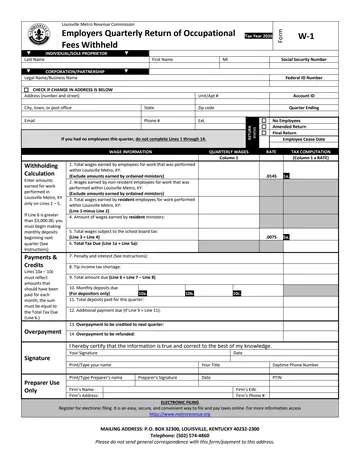
Form W-1 is the Louisville Metro Revenue Commission's “Employers Quarterly Return of Occupational Fees Withheld”, printed for “Tax Year 2026”. An employer reports on it the wages paid for work in Louisville Metro (Jefferson County, Kentucky) and the occupational license tax withheld from them: 1.45% on all those wages, plus the 0.75% school boards tax on the wages of employees who live in the county.
- Who files. Every employer with employees working in Louisville Metro. LMRC: “Employers are required to withhold Occupational License Fees/Taxes from the gross salaries, wages, commissions, and other forms of compensation earned by employees for work performed within Louisville/Jefferson County.” A sole proprietor with employees files it too.
- When. By the last day of the month after each calendar quarter, postmarked or hand-delivered. Employers that withheld more than $3,000 in a quarter also make monthly W-1D deposits.
- How. In EMINTS, LMRC's online tax portal, as a single return or a bulk file, or on paper. Filers of more than 25 returns, forms or reports a year must file electronically.
- Where. EMINTS, or P.O. Box 32300, Louisville, Kentucky 40232-2300 for paper.
- Form and guides. LMRC's 2026 Form W-1 (PDF), its W-1 instructions and the W-1 Filing Specification Guide (version 2025.1, Dec. 17, 2025), which also explains each line for bulk filers.
LMRC tax calendar: due by the last day of the month after the quarter, postmarked or hand-delivered; a Saturday, Sunday or Louisville Metro holiday moves to the next business day.
Tap a box once for its note, again to jump to the line. Zoom in to read the small print.
Employer and return status
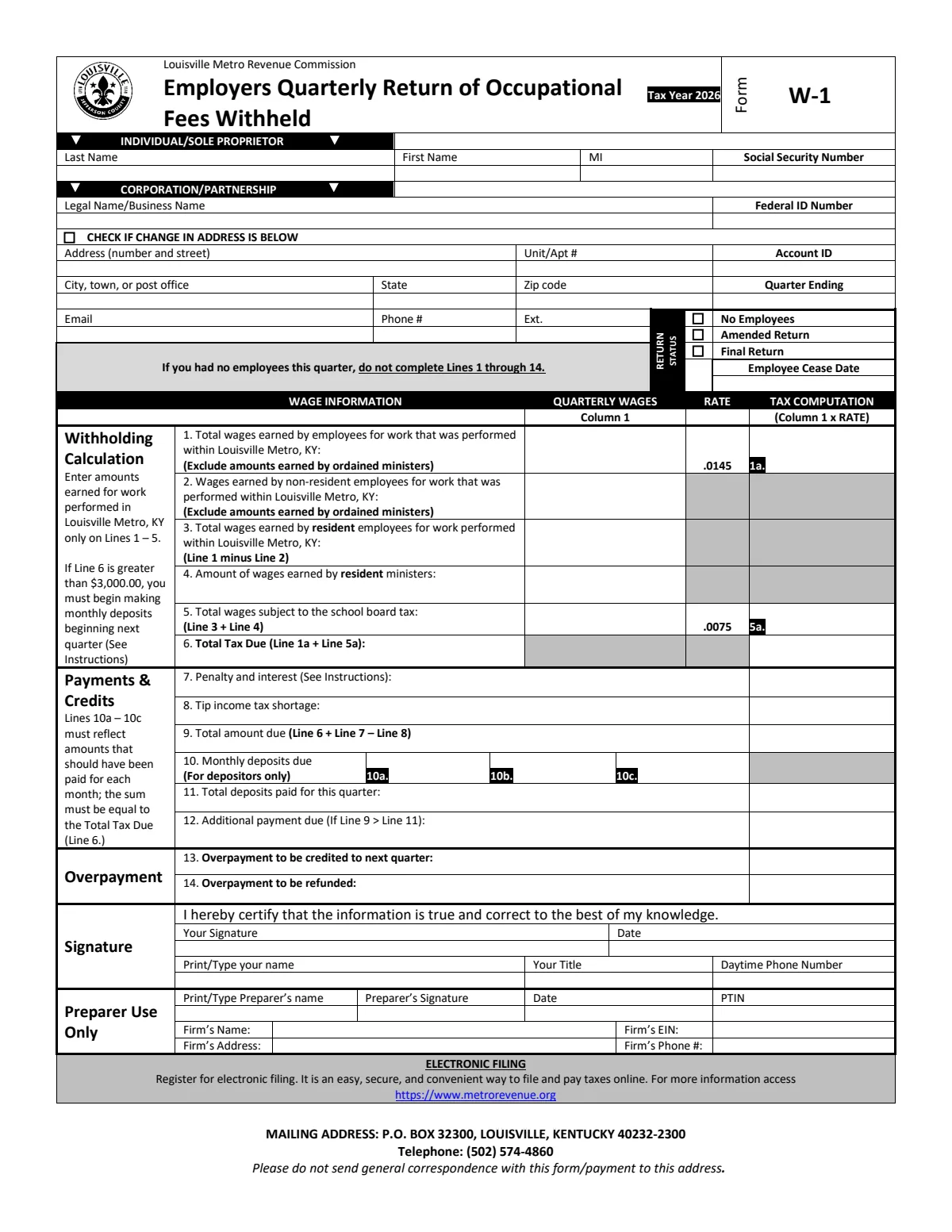
The top of the form identifies the employer. Fill in either the individual row or the corporation and partnership row, then the address, account and quarter. The return status boxes on the right flag a quarter with no employees, an amended return or a final return.
| Line | Label | What goes there |
|---|---|---|
| Form | Louisville Metro Revenue Commission; Employers Quarterly Return of Occupational Fees Withheld; Tax Year 2026; Form W-1 | The quarterly return for the occupational license tax an employer withholds from pay for work done in Louisville Metro, which is Jefferson County: “Louisville Metro includes the area within the boundaries of Jefferson County, Kentucky.” The return is due by the last day of the month after the quarter; it “must be hand-delivered to the Louisville Metro Revenue Commission (LMRC) or postmarked by the last day of the month following the close of the calendar quarter in which the compensation was earned”. LMRC posts the 2026 Form W-1 on its forms and publications page. |
| LastName | INDIVIDUAL/SOLE PROPRIETOR: Last Name | Fill in one section only. “Enter full legal name under applicable section. (i.e., Individual/Sole Proprietor or Corporation/Partnership)” A sole proprietor with employees uses the top row. |
| FirstName | First Name | The sole proprietor's first name. |
| MI | MI | Middle initial, or blank. |
| SSN | Social Security Number | “If you are filing as an Individual/Sole Proprietor, you must provide your Social Security number.” |
| LegalName | CORPORATION/PARTNERSHIP: Legal Name/Business Name | The entity's legal name. LMRC's filing guide: “If you are entering business entity name or dba name, use the business name on file with the LMRC.” |
| FEIN | Federal ID Number | “If you are filing as a Corporation/Partnership, you must provide your Federal ID number.” |
| AddrChange | CHECK IF CHANGE IN ADDRESS IS BELOW | “Enter your current address. If your address has changed, check the change in address box.” |
| Address | Address (number and street) | The employer's current mailing address. |
| Unit | Unit/Apt # | Suite, unit or apartment, if any. |
| AccountID | Account ID | The employer's LMRC W-1 account ID, ten digits. “All returns must include Account number and Quarter Ending (MM/DD/YYYY).” A new employer gets the number by registering in EMINTS, LMRC's online tax portal (new tax accounts); LMRC says “In most cases, a new LMRC customer can get an account number immediately via EMINTS.” |
| CityTown | City, town, or post office | City of the address. |
| State | State | Two-letter state code. |
| Zip | Zip code | ZIP code; LMRC's file format also accepts foreign postal codes with letters. |
| Quarter | Quarter Ending | The last day of the calendar quarter, MM/DD/YYYY: 03/31, 06/30, 09/30 or 12/31 of the year. LMRC's bulk file rejects any other date. |
| “Include email address of the individual to contact for questions regarding the return.” | ||
| Phone | Phone # | The contact's phone number. |
| Ext | Ext. | Extension, if any. |
| Line | Label | What goes there |
|---|---|---|
| NoEmp | RETURN STATUS: No Employees | Check it for a quarter in which you paid no employees. The return is still due: “W-1 must be filed even if employer did not have employees during the quarter.” |
| NoLines | If you had no employees this quarter, do not complete Lines 1 through 14. | With No Employees checked, the rest of the return stays blank except the signature. |
| Amended | Amended Return | “Amended Return - Check this box if you are amending the return.” Bulk filers send a new file with only the corrected returns, marked as amended. |
| Final | Final Return | “Final Return - Check this box if you permanently ceased having employees in Louisville Metro; you must provide a cease date.” The account is closed; the year's W-3 reconciliation and W-2 information are still due. |
| Cease | Employee Cease Date | The date you stopped having employees in Louisville Metro. Leave it blank unless Final Return is checked. |
Lines 1 to 6: withholding calculation
Three taxes share one return. Line 1a is the Louisville Metro tax (1.25%) and the transit authority tax (0.2%) on all wages for work in the county; line 5a is the school boards tax (0.75%) on residents' wages only. Lines 1 to 5 count only wages “earned for work performed in Louisville Metro, KY only”.
| Line | Label | What goes there |
|---|---|---|
| 1 | 1. Total wages earned by employees for work that was performed within Louisville Metro, KY: (Exclude amounts earned by ordained ministers) | “Line 1: Enter the gross wages paid to all employees for work that was performed within Louisville Metro, Kentucky.” Residents and nonresidents alike, but only for work done in the county: a Louisville resident working elsewhere is not on line 1. Gross follows Kentucky's definition of compensation, which adds back 401(k), 403(b), 457 and Section 125 deferrals; the Louisville page explains it. |
| 1a | Rate .0145; 1a. (Column 1 x RATE) | Line 1 times .0145. The instructions: “Multiply Line 1 by .0145 (Louisville Metro Tax 1.25% (.0125) and Transit Authority Tax .2% (.0020))”. Every employee's Louisville Metro wages bear this 1.45%. |
| 2 | 2. Wages earned by non-resident employees for work that was performed within Louisville Metro, KY: (Exclude amounts earned by ordained ministers) | “Determine what portion of the total Louisville Metro, Kentucky wages (entry on Line 1) were paid to employees who did not live in Louisville Metro, Kentucky, during the quarter.” Residence is where the employee lived during the quarter; LMRC suggests checking addresses with usps.com. |
| 3 | 3. Total wages earned by resident employees for work performed within Louisville Metro, KY: (Line 1 minus Line 2) | Line 1 minus line 2. The instructions: this “represents the total wages paid to employees who lived in Louisville Metro, Kentucky, for work that they performed in Louisville Metro, Kentucky.” |
| 4 | 4. Amount of wages earned by resident ministers: | “Line 4: Enter the gross wages paid to ministers who live and work in Louisville Metro, Kentucky.” Ministers are left out of line 1, so their wages bear only the school boards tax. A nonresident minister's wages go on no line. |
| 5 | 5. Total wages subject to the school board tax: (Line 3 + Line 4) | Line 3 plus line 4. “This is the total payroll subject to the School Boards Tax.” |
| 5a | Rate .0075; 5a. | “Line 5 (a): Multiply wages subject to the school boards tax (Line 5) by .0075.” With line 1a, a resident's wages bear 2.2% in all: “Resident Tax Rate = 2.2%, Non-resident Tax Rate = 1.45%”. |
| 6 | 6. Total Tax Due (Line 1a + Line 5a): | Line 1a plus line 5a. The form's margin warns: “If Line 6 is greater than $3,000.00, you must begin making monthly deposits beginning next quarter”. The deposit rule covers “any employer who is responsible for withholding Occupational License Fees/Taxes greater than $3,000.00 during any quarter”, and then “The employer must submit monthly deposits of the occupational license fees/taxes withheld to the LMRC for the next four consecutive quarters”. |
Lines 7 to 12: payments and credits
These lines turn the tax into a payment: add any penalty and interest, take off the tip shortage, then subtract monthly deposits already made.
| Line | Label | What goes there |
|---|---|---|
| 7 | 7. Penalty and interest (See Instructions): | Only on a late return or payment. “Employers are subject to a penalty of five percent (5%) per month, or a fraction of a month, to a maximum of twenty-five percent (25%) of the total license tax liability, plus interest at a rate of twelve percent (12%) per annum from the due date until paid.” “Also, there is a minimum $25.00 penalty for failure to file and/or pay any return or report by the due date.” The same figures are in state law (KRS 67.790(2) and (3)), where “A fraction of a month is counted as an entire month.” |
| 8 | 8. Tip income tax shortage: | “Complete this line only for employees with tip income.” For each tipped employee, figure the tax on all wages at the resident or nonresident rate, subtract what you withheld, and add up the shortfalls (worked example below). The line lowers your total: “This tax should be paid by the employee with tip income. They are required to file and pay a Form OL-3 Occupational License Tax Return for the tax shortage owed.” |
| 9 | 9. Total amount due (Line 6 + Line 7 - Line 8) | “Line 9: Add Line 6 (total tax due) and Line 7 (penalty and interest) and subtract Line 8 (tip income tax shortage).” |
| 10 | 10. Monthly deposits due (For depositors only) | Only for employers on monthly W-1D deposits. The form's margin says lines 10a to 10c show the amounts that should have been paid each month, adding up to line 6, and LMRC's filing guide asks for the required deposit, not the payment made (see Rules below). “Failure to enter monthly deposits may result in penalties and interest.” |
| 10a | 10a. | Depositors: “If a depositor, enter the amount of the required deposit for the first month of the quarter being reported.” |
| 10b | 10b. | Depositors: the required deposit for the second month of the quarter. |
| 10c | 10c. | Depositors: the required deposit for the third month of the quarter. |
| 11 | 11. Total deposits paid for this quarter: | “Line 11: Add Lines 10a, 10b, and 10c.” “This figure should be equal to Line 6 (Total Tax Due).” It counts monthly deposits only: “Do not enter amount of a single payment being sent in conjunction with your W-1 filing.” A quarterly payer enters zero here and pays the whole line 9 as line 12. |
| 12 | 12. Additional payment due (If Line 9 > Line 11): | “Line 12: If Line 9 (total amount due) is greater than Line 11 (total deposits), the additional amount is due with the return.” |
Line 8 worked example
LMRC's filing guide shows the tip shortage for four tipped employees. Each employee's tax is wages times the resident (2.2%) or nonresident (1.45%) rate; the shortage is that tax minus what the employer withheld. The total, “795.00”, goes on line 8.
| Employee | Wages | Rate | Tax due | Withheld | Shortage |
|---|---|---|---|---|---|
| A | $15,000.00 | 2.20% | $330.00 | $200.00 | $130.00 |
| B | $10,000.00 | 1.45% | $145.00 | $145.00 | $0.00 |
| C | $25,000.00 | 2.20% | $550.00 | $20.00 | $530.00 |
| D | $30,000.00 | 1.45% | $435.00 | $300.00 | $135.00 |
| Total | $795.00 |
Lines 13 and 14: overpayment
When deposits on line 11 exceed the total due on line 9, choose a credit or a refund for the difference.
| Line | Label | What goes there |
|---|---|---|
| 13 | 13. Overpayment to be credited to next quarter: | When line 11 is more than line 9, put the difference here to apply it to the next quarter. LMRC first uses it against old balances: “If prior unpaid balances exist, the overpayment will offset any debt before being credited to next quarter.” |
| 14 | 14. Overpayment to be refunded: | When line 11 is more than line 9, put the difference here for a refund instead of a credit. Prior unpaid balances are offset first here too. |
Signature, preparer and filing
Who signs depends on the employer's form of business. A payroll company or CPA that prepares the return completes the preparer section as well.
| Line | Label | What goes there |
|---|---|---|
| Certify | I hereby certify that the information is true and correct to the best of my knowledge. | The person who signs below makes this certification for the employer. It covers the whole return, including the preparer's figures. |
| Sign | Your Signature | “If the form is filed by a sole proprietor, it must be signed and dated by that individual.” “If the form is filed by a corporation, it must be signed and dated by a corporate officer.” “If the form is filed by a partnership, it must be signed and dated by a general partner.” |
| SignDate | Date | The date signed. |
| PrintName | Print/Type your name | The signer's printed name. |
| YourTitle | Your Title | Owner, officer or general partner, matching who must sign. |
| DayPhone | Daytime Phone Number | A number where LMRC can reach the signer. |
| PrepName | Preparer Use Only: Print/Type Preparer’s name | “Preparer: If the form is filed by a third party (CPA/Payroll Company), ‘Preparer Use Only’ section on the bottom of the form must be completed.” The filing guide warns: “Failure to provide preparer information could result in LMRC applying penalty as the records were not submitted in our prescribed manner.” |
| PrepSign | Preparer’s Signature | The preparer signs. |
| PrepDate | Date | The date the preparer signed. |
| PTIN | PTIN | The preparer's IRS preparer tax identification number. “Leave blank if no preparer used or preparer does not have PTIN.” |
| FirmName | Firm’s Name: | The preparing firm's name. |
| FirmEIN | Firm’s EIN: | The firm's nine-digit EIN, no dashes. |
| FirmAddr | Firm’s Address: | The firm's address. |
| FirmPhone | Firm’s Phone #: | The firm's phone number. |
| EFile | ELECTRONIC FILING: Register for electronic filing. It is an easy, secure, and convenient way to file and pay taxes online. | For many employers e-filing is required, not optional: “Any employer, employee, business entity, and third-party payroll reporting agent, natural person, or other taxpayer who files more than 25 returns, forms, or reports per year must file the following forms electronically.” The list starts with “Withholding Forms - W-1, W-2, W-3”. Tax preparers must e-file at “10 or more returns, forms, or reports per year”. “Any person who fails to comply with the electronic filing requirements will incur a minimum penalty of $500.00 or $5.00 for each return, report or document not filed electronically, whichever is greater.” |
| MAILING ADDRESS: P.O. BOX 32300, LOUISVILLE, KENTUCKY 40232-2300; Telephone: (502) 574-4860 | Paper returns and payments go here, postmarked or hand-delivered by the due date. “Please do not send general correspondence with this form/payment to this address.” |
Rules that trip employers up
- Lines 10a to 10c: required or paid? The W-1 instructions say “Line 10: Enter the amount of tax remitted during each month of the quarter on the appropriate lines.” The form's margin and LMRC's filing guide describe the amount that should have been paid each month, and the guide asks for “the amount of the required deposit” for each month. Line 11 is where the deposits actually made go. Enter each month's required deposit on 10a to 10c and the deposits made on line 11; when every deposit was made on time, the two match.
- Once on deposits, four quarters. Crossing $3,000 in a quarter puts you on monthly W-1D deposits for the next four quarters, even if later quarters stay under $3,000. Each deposit is due “by the 15th day after the end of the month the compensation was earned”.
- Zero quarters. “W-1 must be filed even if employer did not have employees during the quarter.” Check No Employees and sign. Leaving out a quarter brings the minimum $25 penalty.
- E-filing. More than 25 returns, forms or reports a year with LMRC means electronic filing through EMINTS, and filing on paper anyway costs at least $500. “CD submission does not meet the electronic filing requirement and will not be accepted.”
- Bulk files and account IDs. A preparer filing for clients needs each client's account ID: “Do not send paper forms or reports without an account ID listed.”
- Kentucky Jobs Credit employers. An employer in a Kentucky business incentive program files the W-1KJC instead, in EMINTS or on paper; there is no bulk upload for it.
- The W-3 still follows. The quarterly W-1s are reconciled on Form W-3, with W-2 information for every employee who worked in Louisville Metro, due Feb. 28 each year (KRS 67.783(4) sets the same date).
How it connects
- The Louisville rules behind each line (who withholds, the 2026 rates, residents and nonresidents, W-1D deposits, the W-3, EMINTS and penalties): Louisville occupational license tax for employers, with its returns section.
- Kentucky's statewide framework, including the 2026 law on standard occupational tax forms: Kentucky occupational license tax. Lexington and the other Kentucky collectors: Northern Kentucky, Bowling Green and Boone County taxes.
- Other city withholding returns line by line: Detroit Form 5323, RITA Form 11 and St. Louis W-10. The local payroll tax lookup finds the taxes for a work address.
Questions employers ask
When is the Louisville W-1 due?
By the last day of the month after each calendar quarter: April 30, July 31, October 31 and January 31, postmarked or hand-delivered. A due date on a Saturday, Sunday or Louisville Metro holiday moves to the next business day.
Do I file a W-1 for a quarter with no employees?
Yes. LMRC says the W-1 must be filed even if the employer did not have employees during the quarter. Check No Employees and leave lines 1 to 14 blank.
What rates go on the 2026 W-1?
Line 1a is .0145 (the 1.25% Louisville Metro tax and the 0.2% transit tax) on all wages for work in Louisville Metro; line 5a is .0075 (the school boards tax) on residents' wages and resident ministers' wages. A resident's total is 2.2% and a nonresident's 1.45%.
Who has to make monthly deposits?
An employer that withheld more than $3,000 in any quarter. It deposits monthly on Form W-1D for the next four quarters, by the 15th day after each month, and reports the deposits on lines 10a to 11 of the W-1.
Must the W-1 be filed online?
Yes, if you file more than 25 returns, forms or reports a year with LMRC (10 or more for a tax preparer). Otherwise paper is allowed, mailed to P.O. Box 32300, Louisville, KY 40232-2300.
What is the penalty for a late W-1?
5% of the tax per month or part of a month, up to 25%, plus 12% a year interest, with a $25 minimum penalty.
Sources
- Louisville Metro Revenue Commission, Form W-1, Employers Quarterly Return of Occupational Fees Withheld, Tax Year 2026, PDF
- Louisville Metro Revenue Commission, W-1 Filing Specification Guide v 2025.1 (Dec. 17, 2025), PDF
- Louisville Metro Revenue Commission, W-1 tax form instructions (with the forms and publications page)
- Louisville Metro Revenue Commission, Tax calendar
- Louisville Metro Revenue Commission, Electronic filing requirements
- Louisville Metro Revenue Commission, Frequently asked questions
- KRS 67.783 and 67.790