- Who files
- Annual withholding filers (agricultural, Form WA)
- Due
- January 31 after the year
- Filed with
- Oregon DOR (Revenue Online or mail)
- Form revision
- 150-206-001 (Rev. 09-21-20 ver. 02)
- Pages
- 1
At a glance
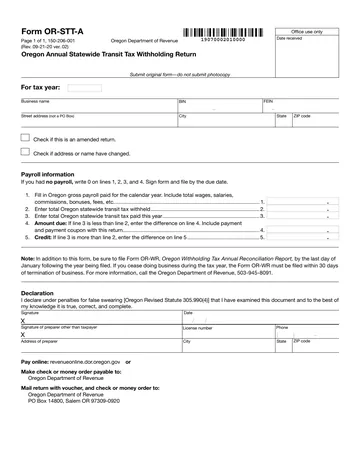
Form OR-STT-A is the Oregon Department of Revenue's “Oregon Annual Statewide Transit Tax Withholding Return”, form 150-206-001, “(Rev. 09-21-20 ver. 02)”. It is the annual return for the 0.1% statewide transit tax that employers withhold from wages, used by the employers who report Oregon withholding once a year. Most employers never file it: quarterly filers report the statewide transit tax on Form OQ.
- Who files. Employers who file an Oregon Agricultural Annual Withholding Tax Return (Form WA) “to report withholding of income taxes of employees must do the same for statewide transit taxes.” The Department's page: “Agricultural employers can report and remit the Statewide Transit Tax on either a quarterly or annual basis.”
- When. “If you are an annual filer, you must remit and report the tax by the last day of the month following the end of the calendar year, or January 31.” A due date on a weekend or holiday moves to the next business day.
- How. “Annual Statewide Transit Tax filers can continue to file through Revenue Online for all years or by paper.” On paper, mail the return with Form OR-STT-2 and the OR-STT-V voucher.
- Rate. 0.1% of wages (ORS 320.550), unchanged for 2026: “Measure 120 did not pass in the May 19, 2026 primary election.”
- Form. OR-STT-A, DOR PDF and its instructions; the employee detail report is Form OR-STT-2.
Oregon DOR Form OR-STT-A instructions (Rev. 6-25-20); Statewide Transit Tax page; 2026 Combined Payroll Tax Report booklet.
Tap a box once for its note, again to jump to the line. Zoom in to read the small print.
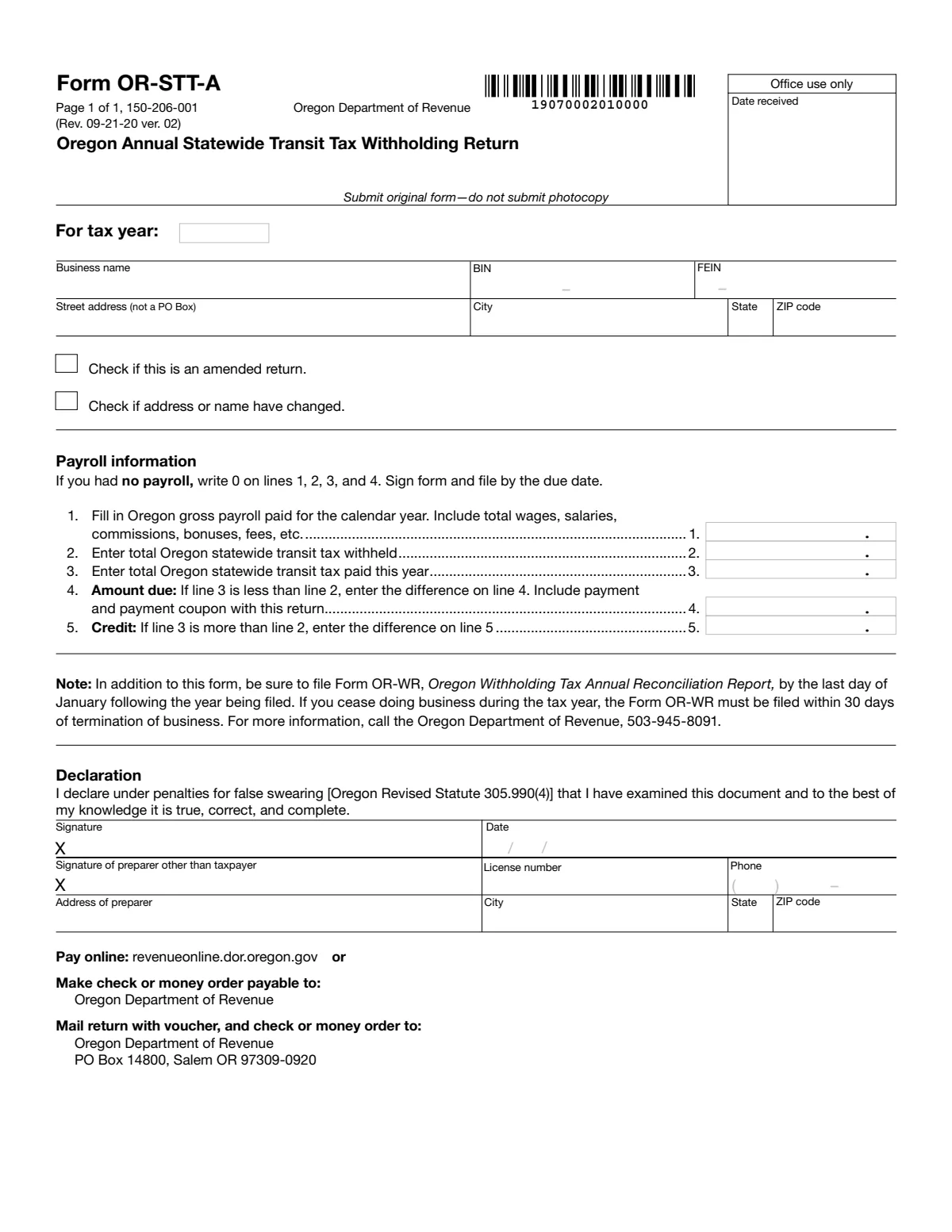
Header: year and business
| Line | Label | What goes there |
|---|---|---|
| Year | For tax year: | The calendar year the return covers. “Write the tax year, your business name, Oregon business identification number (BIN)”, federal employer identification number (FEIN), and mailing address in the appropriate boxes. |
| Name | Business name | The employer's name as registered for Oregon payroll taxes. |
| BIN | BIN | Your Oregon business identification number, the combined payroll tax account number from registration. |
| FEIN | FEIN | Your federal employer identification number. |
| Street | Street address (not a PO Box) | A street address. The form does not accept a PO box here. |
| CityZip | City; State; ZIP code | City, state and ZIP code of that address. |
| Amended | Check if this is an amended return. | “To amend Form OR-STT-A, make your changes and check the ‘amended’ box at the top of the return.” “Send your amended return to the address listed.” |
| Changed | Check if address or name have changed. | Check when the business name or address differs from the last return. Ownership and other changes go on the Business Change in Status Form. |
Lines 1 to 5: payroll information
Five lines settle the year: the wages, the tax withheld from them, what you already paid, and the balance either way.
| Line | Label | What goes there |
|---|---|---|
| NoPay | Payroll information: If you had no payroll, write 0 on lines 1, 2, 3, and 4. Sign form and file by the due date. | “Don’t use Form WA to report statewide transit taxes. You must file Form OR-STT-A even if there was no payroll” during the reporting period. “A signature is required even if you file a 0 return.” |
| 1 | 1. Fill in Oregon gross payroll paid for the calendar year. Include total wages, salaries, commissions, bonuses, fees, etc. | The year's wages subject to the statewide transit tax. The instructions call this line subject wages: the total wages subject to the statewide transit tax “(wages, salaries, commissions, bonuses, fees, etc.) for this year.” Subject wages are Oregon residents' wages wherever earned and nonresidents' wages for work in Oregon, using the income tax definition of wages in ORS 316.162. |
| 2 | 2. Enter total Oregon statewide transit tax withheld | “Statewide transit tax. Enter total Oregon statewide transit tax withheld.” It should be 0.1% of line 1: the tax is “imposed at the rate of one-tenth of one percent of the wages of an employee who is” a resident, wherever the work is done, or a nonresident working in Oregon (ORS 320.550). “Only numerical information provided on this return will be considered a filed return for statewide transit tax purposes.” |
| 3 | 3. Enter total Oregon statewide transit tax paid this year | The statewide transit tax already paid to the Department of Revenue during the year, for example with an OR-STT-V voucher or on Revenue Online. |
| 4 | 4. Amount due: If line 3 is less than line 2, enter the difference on line 4. Include payment and payment coupon with this return. | Line 2 minus line 3 when you paid less than you withheld. Pay it with the return and the OR-STT-V voucher, or online. “The filing of this return and payment of tax are due on the last day of the month following the end of the calendar year (January 31).” |
| 5 | 5. Credit: If line 3 is more than line 2, enter the difference on line 5 | Line 3 minus line 2 when you paid more than you withheld. |
| Note | Note: In addition to this form, be sure to file Form OR-WR, Oregon Withholding Tax Annual Reconciliation Report, by the last day of January following the year being filed. | “If you cease doing business during the tax year, the Form OR-WR must be filed within 30 days of termination of business.” The combined payroll booklet says the OR-WR includes state withholding and the STT and is filed electronically. |
Declaration, signature and payment
| Line | Label | What goes there |
|---|---|---|
| Declare | Declaration: I declare under penalties for false swearing [Oregon Revised Statute 305.990(4)] that I have examined this document and to the best of my knowledge it is true, correct, and complete. | The signer's declaration. |
| Sign | Signature; Date | The employer, or the preparer, signs and dates. “A signature is required even if you file a 0 return.” |
| Preparer | Signature of preparer other than taxpayer; License number; Phone; Address of preparer; City; State; ZIP code | The instructions ask the tax preparer to sign on the signature line “and include a phone number and the date they filled out the return.” |
| Pay | Pay online: revenueonline.dor.oregon.gov or Make check or money order payable to: Oregon Department of Revenue. Mail return with voucher, and check or money order to: Oregon Department of Revenue PO Box 14800, Salem OR 97309-0920 | Pay on Revenue Online or by check to the Oregon Department of Revenue. “Mail the completed return, the Statewide Transit Tax Employee Detail Report (Form OR-STT-2), and Oregon Annual Statewide Transit Tax Voucher (Form OR-STT-V) with payment on or before the appropriate due date to:” Oregon Department of Revenue, PO Box 14800, Salem OR 97309-0920. |
Who files OR-STT-A instead of Form OQ
The statewide transit tax normally rides on the combined quarterly payroll report. “Starting with first quarter 2023 and forward, the Statewide Transit Tax must be filed on the Form OQ if you are a quarterly filer.” OR-STT-A is the exception for annual filers, and the Department's sources describe that exception in two ways. The OR-STT-A instructions tie it to the agricultural annual withholding return: employers who file Form WA for income tax withholding file OR-STT-A for the transit tax. The Statewide Transit Tax page says agricultural employers may report the tax quarterly or annually. But the 2026 Combined Payroll Tax Report booklet, in its paragraph on Form OR-WA, says: “Agricultural employers subject to UI tax, WBF assessment, TriMet Transit District tax, Lane Transit District tax, STT must file Form OQ in addition to Form OR-WA.”
Read together: an agricultural employer that reports Oregon withholding annually may file OR-STT-A for the statewide transit tax, while the booklet points it to Form OQ for its other quarterly items. The booklet and the STT page are the newer texts (the instructions date from 2020). An agricultural employer unsure which return the Department expects should ask the Department of Revenue's payroll unit before January 31, and never report the transit tax on Form WA.
Whichever return you use, Form OR-STT-2 lists the employees. “Enclose with Form OR-STT-1, Oregon Quarterly Statewide Transit Tax Return, or Form OR-STT-A, Oregon Annual Statewide Transit Tax Withholding Return.” “Failure to report all employees with correct SSNs may result in penalties.”
Rules that trip employers up
- Zero returns. File and sign OR-STT-A even with no payroll for the year, with zeros on lines 1 to 4.
- Residents working elsewhere. The tax follows Oregon residents wherever they work, and nonresidents only for work in Oregon. An out-of-state employer cannot be required to withhold for an Oregon resident but may do so as a courtesy.
- Everyone is subject. “Employees who are not subject to regular income tax withholding due to high exemptions, wages below the threshold for income tax withholding, or other factors are subject to Statewide Transit Tax withholding.”
- Not the TriMet or Lane tax. The statewide transit tax is withheld from the employee; the TriMet and Lane transit taxes are employer payroll taxes reported separately.
- Penalties. “We can assess penalties for knowingly failing to deduct and withhold the tax of $250 per employee, up to $25,000 for each tax period, in addition to other penalties and interest authorized by state law.” ORS 320.550(9) also makes an employer that fails to withhold responsible for the tax itself.
- The OR-WR is separate. The annual withholding reconciliation, Form OR-WR, is still due by January 31, filed electronically.
How it connects
- The statewide transit tax itself (rate, who withholds, residents and nonresidents, returns and due dates): Oregon statewide transit tax: returns, payments and due dates.
- The quarterly return most employers use instead: Oregon Form OQ, with Form 132 for employee detail.
- The employer transit taxes in the Portland and Eugene areas: TriMet and Lane transit payroll taxes. Oregon's paid leave program on the same combined report: Paid Leave Oregon.
Questions employers ask
Who files Oregon Form OR-STT-A?
Employers who report Oregon income tax withholding annually, in practice agricultural employers that file the annual Form WA. Quarterly filers report the statewide transit tax on Form OQ instead.
When is OR-STT-A due?
January 31 after the tax year, together with payment of any balance. A due date on a weekend or holiday moves to the next business day.
Do I file OR-STT-A if I had no payroll?
Yes. Write 0 on lines 1 to 4, sign the return and file it by the due date. A signature is required even on a zero return.
What is the statewide transit tax rate for 2026?
One-tenth of 1% (0.001) of wages under ORS 320.550. Measure 120, which would have changed parts of HB 3991, did not pass on May 19, 2026, and the Department says to keep withholding at 0.1%.
What goes with the paper return?
Form OR-STT-2, the Statewide Transit Tax Employee Detail Report, and the OR-STT-V voucher with payment, mailed to PO Box 14800, Salem OR 97309-0920. You can also file and pay on Revenue Online.
Can I report the statewide transit tax on Form WA?
No. The OR-STT-A instructions say not to use Form WA for statewide transit taxes.
Sources
- Oregon Department of Revenue, Form OR-STT-A (150-206-001, Rev. 09-21-20 ver. 02), PDF
- Oregon Department of Revenue, Form OR-STT-A instructions (150-206-001-1, Rev. 6-25-20), PDF
- Oregon Department of Revenue, Form OR-STT-2, Statewide Transit Tax Employee Detail Report, PDF
- Oregon Department of Revenue, Statewide Transit Tax
- Oregon Department of Revenue, 2026 Oregon Combined Payroll Tax Report booklet, PDF
- ORS 320.550, Oregon Legislature