- Who files
- Every Rhode Island employer, every quarter
- Due
- Last day of the month after the quarter
- Filed with
- DLT Employer Tax Division, online or by mail
- Form revision
- TX-17 (Rev. 1/26)
- Pages
- 1, plus instructions
At a glance
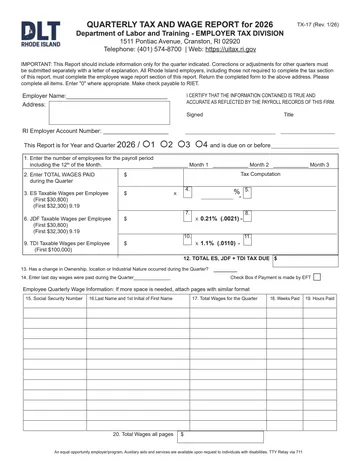
Form TX-17 is the Rhode Island Department of Labor and Training's “QUARTERLY TAX AND WAGE REPORT for 2026”, revision TX-17 (Rev. 1/26). One report carries three taxes and the wage detail: “The Employer Tax Unit processes all Quarterly Tax and Wage Reports (Form TX-17) and accompanying tax payments, submitted by Rhode Island employers.” Two of the taxes are the employer's own (Employment Security, the state unemployment tax, and the Job Development Fund). The third, Temporary Disability Insurance (TDI), is the employees' 1.1% payroll deduction that funds TDI and Temporary Caregiver Insurance (TCI); the employer withholds it and sends it in on this form.
- Who files. Every Rhode Island employer, each quarter. A report is due even with no payroll: “even if you had no employees and paid no wages during the quarter, a report indicating that must be filed by the due date”.
- When. By the last day of the month after the quarter: April 30, July 31, October 31 and January 31.
- How. Online through DLT's online TX-17 filing, or on paper mailed to the Employer Tax Division, 1511 Pontiac Avenue, Cranston, RI 02920. Wage detail must go electronically at 25 employees or more.
- Payment. One payment for all three taxes, by ACH or by check payable to RIET.
- Form. TX-17 for 2026 (PDF), from DLT's Tax Forms page, which also keeps the TX-17 for each year back to 2021. Page 1 is the report; page 2 holds the instructions quoted below. DLT mails a preprinted TX-17, with the employer's rate, every quarter.
DLT Employer Tax FAQ: due on the last day of the month after the quarter. The saved DLT pages do not say whether a weekend date moves, and the online window for the third quarter of 2026 closed Oct. 31; file before the weekend.
Tap a box once for its note, again to jump to the line. Zoom in to read the small print.
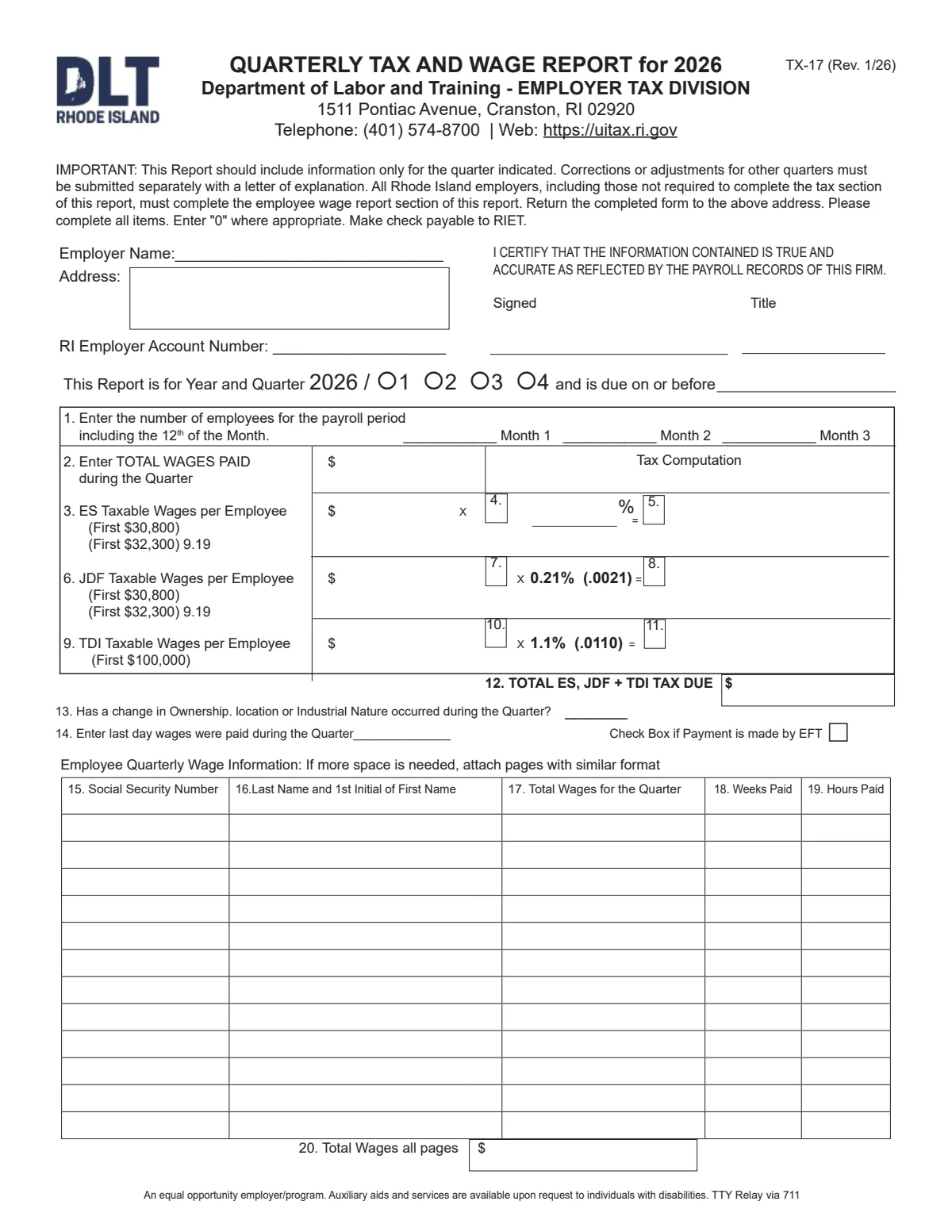
The header and certification
The top third of the form identifies the employer, the quarter and the person who signs. Use the name and account number exactly as DLT has them, so the payment and the wage records post to the right account.
| Box | Label as printed | What goes there |
|---|---|---|
| Important | IMPORTANT | The box sets three rules. “This Report should include information only for the quarter indicated.” Every employer files the wage part: “All Rhode Island employers, including those not required to complete the tax section of this report, must complete the employee wage report section of this report.” And the payee: Make check payable to RIET. Enter 0 rather than leaving a line blank. |
| Name | Employer Name: | The legal name on the DLT account. A business that changed hands this quarter also answers item 13. |
| Address | Address: | The mailing address. DLT mails the preprinted TX-17 and rate notices here, so keep it current with the employer account update form. |
| Account | RI Employer Account Number: | The DLT employer account number. The online system asks for it as “(10 digits, include leading zeroes)”. On a paper check, write it with the year and quarter. |
| Cert | I CERTIFY THAT THE INFORMATION CONTAINED IS TRUE AND ACCURATE AS REFLECTED BY THE PAYROLL RECORDS OF THIS FIRM. | Sign and give a title. The instructions repeat it: “Please be sure the form is SIGNED in the space at the top of the form by a responsible party of your firm.” |
| Quarter | This Report is for Year and Quarter | Mark 1, 2, 3 or 4 for 2026. The due date line is blank on the downloaded form; DLT's FAQ gives the dates: “Quarterly taxes are due on the last day of the month following end of the quarter; January 31, April 30, July 31, and October 31.” |
Items 1 to 12: the tax computation
The tax section runs three parallel calculations, each wages times a rate: Employment Security (items 3 to 5), the Job Development Fund (items 6 to 8) and TDI (items 9 to 11). The first two use the unemployment wage base of $30,800 per worker for 2026; TDI uses its own $100,000 base. Wages are counted per employee per calendar year, so an employee who passed the base earlier in the year drops out of items 3, 6 or 9 while still appearing in full in items 2 and 17.
| Item | Label as printed | What goes there |
|---|---|---|
| 1 | 1. Enter the number of employees for the payroll period including the 12th of the Month. | For each month of the quarter, “the number of full-time and part-time covered workers (subject to the RI Employment Security Act) who performed services during or received pay for the payroll which includes the 12th of the month”. If no employment in the payroll period, enter zero. |
| 2 | 2. Enter TOTAL WAGES PAID during the Quarter | “Enter all wages paid in this calendar quarter whether in money or in kind, such as meals and lodging.” This total must agree with the amount in Item 20. Leave out exempt services; the instructions' example is that an individual owner should not report wages paid to a spouse or children under 18. |
| 3 | 3. ES Taxable Wages per Employee (First $30,800) (First $32,300) 9.19 | Employment Security (unemployment) wages: the item 2 wages, but “exclude wages paid by you in excess of the E.S. wage base ($30,800 for 2026)” per worker for the year, or $32,300 when your ES rate is 9.19 or higher. DLT's page gives the same figures: “Taxable Wage Base: $30,800 per employee ($32,300 for those employers that have an experience rate of 9.19 or higher)”. |
| 4 | 4. (ES rate) % | This is your Employment Security contribution rate. It is employer specific. DLT tells employers to check it: “Your tax rate is located on the TX-17 Quarterly Tax Report mailed to taxpayers every quarter as well as your Notice of Tax Rate received in January.” A new employer's 2026 rate is 1.00%, not counting the 0.21% Job Development Fund. |
| 5 | 5. (ES tax) | Compute and enter the dollar amount of Employment Security taxes due by multiplying the dollar amount in Item 3 by the percentage figure in Item 4. This is an employer tax: nothing is withheld from employees for it. |
| 6 | 6. JDF Taxable Wages per Employee (First $30,800) (First $32,300) 9.19 | Job Development Fund wages use the ES wage base: $30,800 per worker for 2026, or $32,300 if the ES rate is 9.19 or higher. In most quarters item 6 equals item 3. |
| 7 | 7. x 0.21% (.0021) | This is your Job Development Fund rate. DLT: “Job Development Fund: Taxable Wage Base: $30,800 per employee ($32,300 for those employers that have an experience rate of 9.19 or higher). Tax Rate: 0.21%” |
| 8 | 8. (JDF tax) | Item 6 times 0.21%. Also an employer tax. |
| 9 | 9. TDI Taxable Wages per Employee (First $100,000) | Temporary Disability Insurance wages: the item 2 wages, but “exclude wages paid by you in excess of the TDI wage base ($100,000.00 for 2026” to any worker during the calendar year. The base is the same on DLT's page: “Temporary Disability Insurance: Taxable Wage Base: $100,000 per employee. Tax Rate: 1.1%” |
| 10 | 10. x 1.1% (.0110) | This is your Temporary Disability Insurance rate. Unlike items 4 and 7, it is the employees' money: the quick reference lists the deduction as “1.1% of first $100,000 earned” and the employer share as none. |
| 11 | 11. (TDI tax) | Compute and enter the dollar amount of Temporary Disability taxes due by multiplying the dollar amount in Item 9 by the percentage figure in Item 10, “or enter the amount withheld, whichever is greater.” Over-withheld TDI is still sent in; it is not kept by the employer. |
| 12 | 12. TOTAL ES, JDF + TDI TAX DUE | Enter the sum of Items 5, 8, and 11. DLT takes one payment: “We accept only ONE payment for all 3 taxes”. |
TX-17 (Rev. 1/26) instructions, items 9 to 12; DLT Employer Tax Unit, 2026 rates.
The TDI rate and base on this form are the 2026 figures. Both are reset each year: the rate by formula on or before November 15 (“The employee contribution rate for the following calendar year shall be determined by computing the fund cost rate on or before November 15 of each year”, R.I. Gen. Laws 28-40-1), and the base as the greater of $100,000 or a figure tied to the maximum weekly benefit. As of Nov. 22, 2026, DLT had not posted the 2027 rate or a 2027 TX-17: Not listed. The Rhode Island TDI page tracks the 2027 figures.
A worked example
A new employer (ES rate 1.00% for 2026) pays two employees in the fourth quarter of 2026. Employee A had $85,000 in wages before the quarter and is paid $30,000 in it; employee B had $20,000 and is paid $9,000. Our arithmetic, line by line:
| Item | Employee A | Employee B | Report |
|---|---|---|---|
| 2. Total wages | $30,000 | $9,000 | $39,000 |
| 3 and 6. ES and JDF wages (base $30,800) | $0 (already past the base) | $9,000 | $9,000 |
| 5. ES tax at 1.00% | $90.00 | ||
| 8. JDF tax at 0.21% | $18.90 | ||
| 9. TDI wages (base $100,000) | $15,000 (to reach $100,000) | $9,000 | $24,000 |
| 11. TDI tax at 1.1% | $264.00 | ||
| 12. Total due | $372.90 | ||
| 17 and 20. Wages reported | $30,000 | $9,000 | $39,000 (equals item 2) |
Two checks catch most errors. Item 20 must equal item 2, because item 17 lists full wages, never capped. And item 11 can never be less than what payroll actually withheld: if payroll had kept deducting 1.1% from all of employee A's $30,000, it would have withheld $330.00 for A alone, and the form's rule (the greater amount) would put at least that on item 11. Stop TDI deductions when an employee reaches the base, and an employee who overpaid through two employers claims the refund from DLT; the employer does not adjust it.
Items 13 and 14
Two short questions and the payment check box sit below the tax computation.
| Item | Label as printed | What goes there |
|---|---|---|
| 13 | 13. Has a change in Ownership, location or Industrial Nature occurred during the Quarter? | Answer yes or no. If answer is yes to this question, please attach an explanation. The form asks only for the yes or no and that explanation. |
| 14 | 14. Enter last day wages were paid during the Quarter | Enter the last date wages were paid within the quarter covered by report. If no wages were paid, write None. |
| EFT | Check Box if Payment is made by EFT | Check it when the item 12 amount goes electronically, by ACH credit or by ACH debit in the online system, instead of by check. |
Items 15 to 20: the wage report
The lower half is the quarterly wage record for each employee, the detail behind item 2. The instructions stress who fills it in: “This section must be completed and filed by all RI employers including those not required to complete items 1 through 12.” List only employees paid subject wages in this quarter. When the twelve rows run out, use DLT's Additional Wage Filing Form (PDF), which repeats the columns and asks you to “Complete this page and attach to your TX-17 Quarterly Tax and Wage form if necessary.”
| Item | Column as printed | What goes there |
|---|---|---|
| 15 | Social Security Number | “Enter the social security number of every employee to whom you have paid wages during the quarter.” |
| 16 | 16. Last Name and 1st Initial of First Name | Enter the last name and first initial of every employee to whom you have paid wages during the quarter. |
| 17 | 17. Total Wages for the Quarter | Each employee's full wages for the quarter, “whether or not the wages paid to an employee exceed the wage base in effect for the year.” Benefits are figured from these wage records, so never cap them. |
| 18 | 18. Weeks Paid | The number of weeks the employee was paid. “Include weeks paid for vacation or holiday leave, jury duty, severance or other personal leave but not sick leave.” Any part of a week should be counted as a whole week. |
| 19 | 19. Hours Paid | Hours paid in the quarter, with the same paid leave rule as item 18 (sick leave left out). Please round to closest number. |
| 20 | 20. Total Wages all pages | Enter the sum of all wages listed on this page plus any additional pages. “If this amount is not equal to the amount in Item 2, please explain the difference.” |
Filing and paying: online or paper
The paper form is the fallback. The instructions set the size rule: “Employers with 25 or more employees are required to submit wage data electronically.” DLT's FAQ applies it to payroll providers too: “Employers and anyone who files on behalf of employers (example: payroll service providers) with 25 or more employees on their payroll are required to submit their wage data electronically.” Smaller employers may still file online; one that cannot may use the Additional Wage Filing Form with the paper TX-17. DLT also posts an Electronic Wage Record Filing Hardship form (PDF) for an employer that has trouble filing online.
TX-17 (Rev. 1/26) instructions, Optional Reporting Formats and Prior Quarter Adjustments; DLT Employer Tax FAQ.
The online TX-17 filing system (RI.gov's Employer Wage Tax Filing) offers three ways to enter the wage records. An online form: “You will use our online form to enter the first initial, last name, social security number and wages earned for up to 20 employees.” A spreadsheet upload, which “This option is available if you have less than 200 employees.” And a formatted wage file, which This option is always available regardless of the number of employees. The file specifications are on DLT's Employer Tax Unit resources page.
Payment options in the online system (RI.gov payment help): ACH debit, where DLT drafts the account after a bank check that takes time (“Verification (called prenoteing) requires two business days.”); ACH credit, where the employer's bank sends the money and DLT must have the banking details on file first; or a check with the invoice the system prints, mailed to the Employer Tax Unit, 1511 Pontiac Ave, Cranston, RI 02920-0942. For checks, “All mailed checks must be postmarked on or before the date your payment is due.” If the invoice will not print, write the year and quarter and the account number on the check.
Past quarters are paper only. “Late filings cannot be processed on-line.” The FAQ says prior quarter reports are faxed to (401) 574-8940 or mailed to the Employer Tax Division, and the form adds that corrections for another quarter go separately with a letter of explanation.
Two sets of instructions. The online system's help page still carries old line instructions, with wage bases from 2004 (the TDI one reads “($46,800.00 for 2004)”) and only 18 items. Follow the instructions on page 2 of the 2026 PDF, which match the current 20-item layout and the 2026 bases.
Late filing and late payment
Page 2 of the form states the charges. For the tax report and payment: “Employers who fail to file quarterly tax reports and make contributions by the due date will be assessed interest at the rate of 1.5% per month and penalties of $25.00 for failure to file quarterly tax reports and 10% for failure to make contributions to each fund.” For the wage records, a separate $25 penalty per late report, plus $25 for each month it stays late, “provided, however, that the foregoing penalty shall not exceed $200.00 for any one report.”
DLT's FAQ says penalties stand once assessed (the law gives no discretion to waive them), but an employer that paid in full and believes the lateness was not its fault may ask in writing for a waiver of penalty and interest. The TDI statute prints a lower filing penalty than the form: “shall pay a penalty of ten dollars ($10.00) for each failure or refusal to file” (28-39-26). The Rhode Island TDI penalties section compares the two.
Rules that trip employers up
- Catching up a missed TDI deduction. It cannot be taken later. If the deduction is missed on payday and on the next payroll, “the employer alone shall subsequently be liable for those contributions” (28-40-4), and item 11 still has to be paid.
- Treating TDI as the employer's money. The statute says each employer “shall withhold in trust contributions from the wages of his or her employees” (28-40-3). Send what was withheld, even when it is more than 1.1% of item 9.
- Using last year's rate. DLT warns that payroll providers sometimes use the wrong ES rate; check item 4 against the January rate notice or the online portal before paying.
- Capping item 17. Wage records show full quarterly wages. Only items 3, 6 and 9 stop at the bases.
- Mixing quarters. A correction for another quarter is a separate filing with a letter, never a line on this quarter's report.
- Skipping the zero report. An employer with no payroll still files by the due date, writing None in items 14 and 20.
How it connects
- The program behind items 9 to 11, its rate formula, the poster, TCI and the 2027 outlook: Rhode Island TDI for employers.
- Every state's quarterly paid leave report and due date in one table: PFML reports and due dates; rates across the states: PFML rates; the contribution calculator runs the item 11 arithmetic.
- How the withheld TDI shows on the W-2 and how Rhode Island compares with the other disability insurance states: state disability deductions on the W-2 and state disability insurance.
Questions employers ask
When is the Rhode Island TX-17 due?
On the last day of the month after each quarter: April 30, July 31, October 31 and January 31. The tax payment is due on the same date, and a report is due even when no wages were paid.
What TDI rate and wage base go on items 9 and 10 for 2026?
1.1% of each employee's wages up to $100,000 for the year. The rate is printed on the form. The employee pays it through payroll deduction; the employer sends it in with the TX-17.
Do I have to file the TX-17 online?
Wage data must go electronically for employers with 25 or more employees, including filings by payroll providers. Smaller employers may file online or, if they cannot, use the paper TX-17 and the Additional Wage Filing Form. Past quarters cannot be filed online.
Can I send one payment for unemployment tax and TDI?
Yes, and DLT asks for exactly that: one payment for Employment Security, the Job Development Fund and TDI together, by ACH or by check payable to RIET.
What if I withheld more TDI than 1.1% of item 9?
Item 11 is the computed tax or the amount withheld, whichever is greater, so the over-withheld TDI is sent in too. Correct the payroll setup so deductions stop at the $100,000 base.
What are the penalties for a late TX-17?
Interest of 1.5% a month, $25 for a late tax report and 10% of each fund's late contributions, plus a separate $25 for late wage records and $25 more for each month late, capped at $200 per report.
Sources
- DLT, TX-17 (Rev. 1/26), Quarterly Tax and Wage Report for 2026, with instructions (PDF)
- DLT, Additional Wage Filing Form for TX-17 (PDF)
- DLT Employer Tax Unit, Tax Forms
- DLT Employer Tax Unit and Frequently Asked Employer Tax Questions
- DLT, 2026 UI and TDI Quick Reference (PDF)
- RI.gov, Employer Wage Tax Filing (online TX-17) and its payment and wage record help
- R.I. Gen. Laws 28-40-1, 28-40-3, 28-40-4 and 28-39-26